Tang Yi, Lin Bin, Zhang Yan-Ping, Hu Ya-Nan, Zhang Jian-Hui, Wu Shao-Jie, Zhou Yan-Feng, Cai Sen-Lin, Luo Jie-Wei, Chi Wu, Fang Zhu-Ting
Department of Shengli Clinical College, Shengli Clinical Medical College of Fujian Medical University, Fuzhou, China.
Department of Interventional Radiology, Fujian Provincial Hospital, Fuzhou, China.
Front Surg. 2022 Apr 19;9:875484. doi: 10.3389/fsurg.2022.875484. eCollection 2022.
The analgesic effect produced by the intra-arterial injection of lidocaine in patients undergoing uterine artery embolization has been proven to be safe and effective. Nevertheless, a significant degree of pain is typically experienced after the operation, and pain management is crucial. Methylprednisolone, which provides an anti-inflammatory effect, is widely used in the treatment of several diseases. To date, methylprednisolone has not been used after uterine artery embolization.
A total of 131 patients with uterine leiomyoma were retrospectively enrolled. Forty-five patients (control group) were treated with embolized microspheres for bilateral uterine artery embolization. Fifty (study group) and 36 (lidocaine group) patients were administered lidocaine mixed with embolized microspheres during embolization, and in addition, the study group was administered methylprednisolone. Completed pain scales at different time points during surgery were obtained from patients undergoing uterine artery embolization. Efficacy against pain was evaluated by comparing the pain score, inflammatory index, and use of sufentanil within 24 h followed by a Kruskal-Wallis Test and a least significant difference post-hoc analysis.
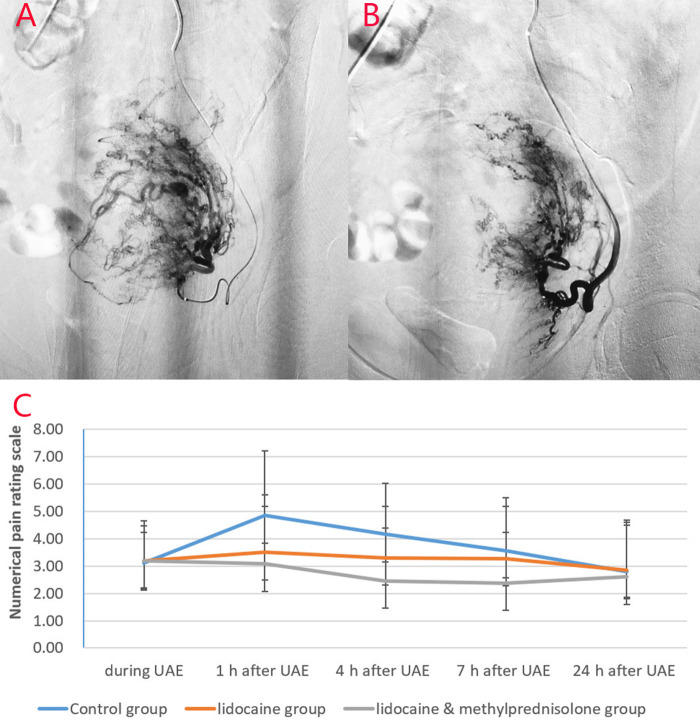
The postoperative pain scores at 1, 4, and 7 h after uterine artery embolization in the study group (3.08 ± 2.09, 2.46 ± 1.93, and 2.38 ± 1.85, respectively) were significantly lower than those in the control group (4.84 ± 2.36, 4.16 ± 1.87, and 3.56 ± 1.93, respectively) and the lidocaine group (3.50 ± 2.10, 3.30 ± 1.88, and 3.28 ± 1.89, respectively). At the first 24 h after embolization, the total usage of sufentanil in the study group (31.4 ± 4.16) was significantly lower than those in the control group (45.7 ± 6.51) and the lidocaine group (38.3 ± 6.25). At 1 and 4 h, the pain scores of the lidocaine group were significantly lower than those of the control group. In addition, at the first 24 h after embolization, the total usage of sufentanil in the lidocaine group was significantly lower than that in the control group.
Lidocaine in combination with methylprednisolone can significantly alleviate pain and reduce the usage of sufentanil after bilateral uterine artery embolization. Thus, methylprednisolone is a recommended addition to the therapeutic regimen after embolization.
子宫动脉栓塞术患者动脉内注射利多卡因产生的镇痛效果已被证明是安全有效的。然而,术后患者通常会经历相当程度的疼痛,疼痛管理至关重要。具有抗炎作用的甲泼尼龙广泛用于多种疾病的治疗。迄今为止,甲泼尼龙尚未用于子宫动脉栓塞术后。
回顾性纳入131例子宫肌瘤患者。45例患者(对照组)采用栓塞微球行双侧子宫动脉栓塞术治疗。50例患者(研究组)和36例患者(利多卡因组)在栓塞过程中给予利多卡因与栓塞微球混合使用,此外,研究组还给予甲泼尼龙。从接受子宫动脉栓塞术的患者中获取手术不同时间点完整的疼痛量表。通过比较疼痛评分、炎症指标以及24小时内舒芬太尼的使用情况评估镇痛效果,随后进行Kruskal-Wallis检验和最小显著差异事后分析。
研究组子宫动脉栓塞术后1、4和7小时的术后疼痛评分(分别为3.08±2.09、2.46±1.93和2.38±1.85)显著低于对照组(分别为4.84±2.36、4.16±1.87和3.56±1.93)和利多卡因组(分别为3.50±2.10、3.30±1.88和3.28±1.89)。栓塞后最初24小时内,研究组舒芬太尼的总用量(31.4±4.16)显著低于对照组(45.7±6.51)和利多卡因组(38.3±6.25)。在1小时和4小时时,利多卡因组的疼痛评分显著低于对照组。此外,栓塞后最初24小时内,利多卡因组舒芬太尼的总用量显著低于对照组。
利多卡因联合甲泼尼龙可显著减轻双侧子宫动脉栓塞术后的疼痛并减少舒芬太尼的用量。因此,甲泼尼龙是栓塞术后治疗方案中推荐添加的药物。