Xue Zhiyun, Angara Sandeep, Levitz David, Antani Sameer
Lister Hill National Center for Biomedical Communications, National Library of Medicine, National Institutes of Health, Bethesda, MD 20894.
DL Analytics, North Hollywood, CA 91602.
Proc SPIE Int Soc Opt Eng. 2022 Jan-Feb;11950. doi: 10.1117/12.2610235. Epub 2022 Mar 2.
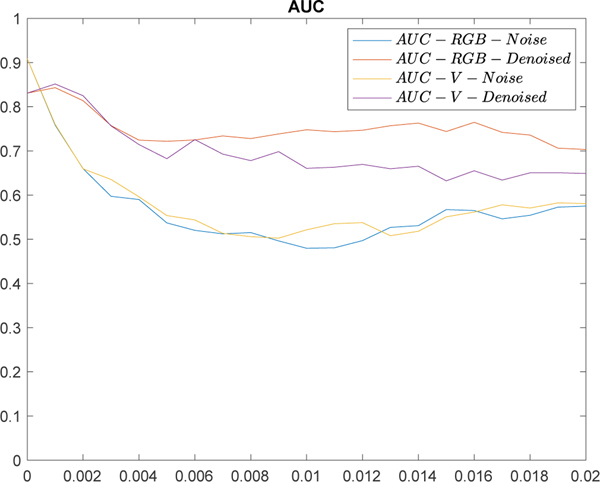
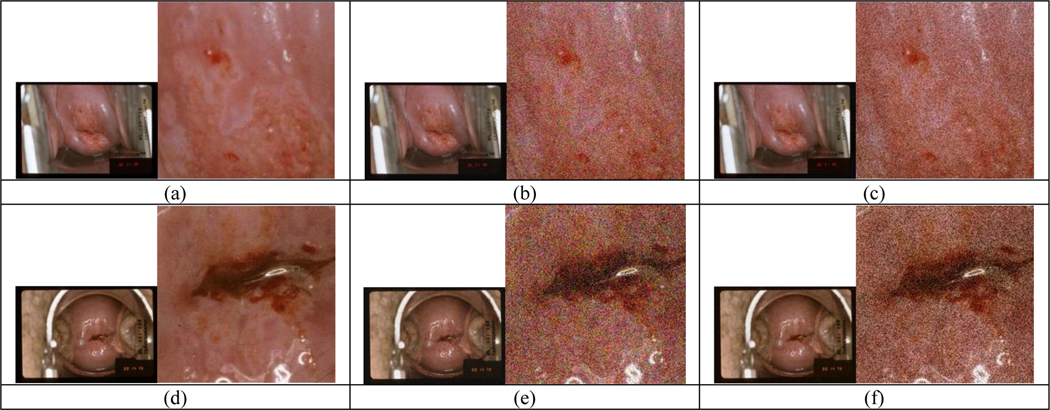
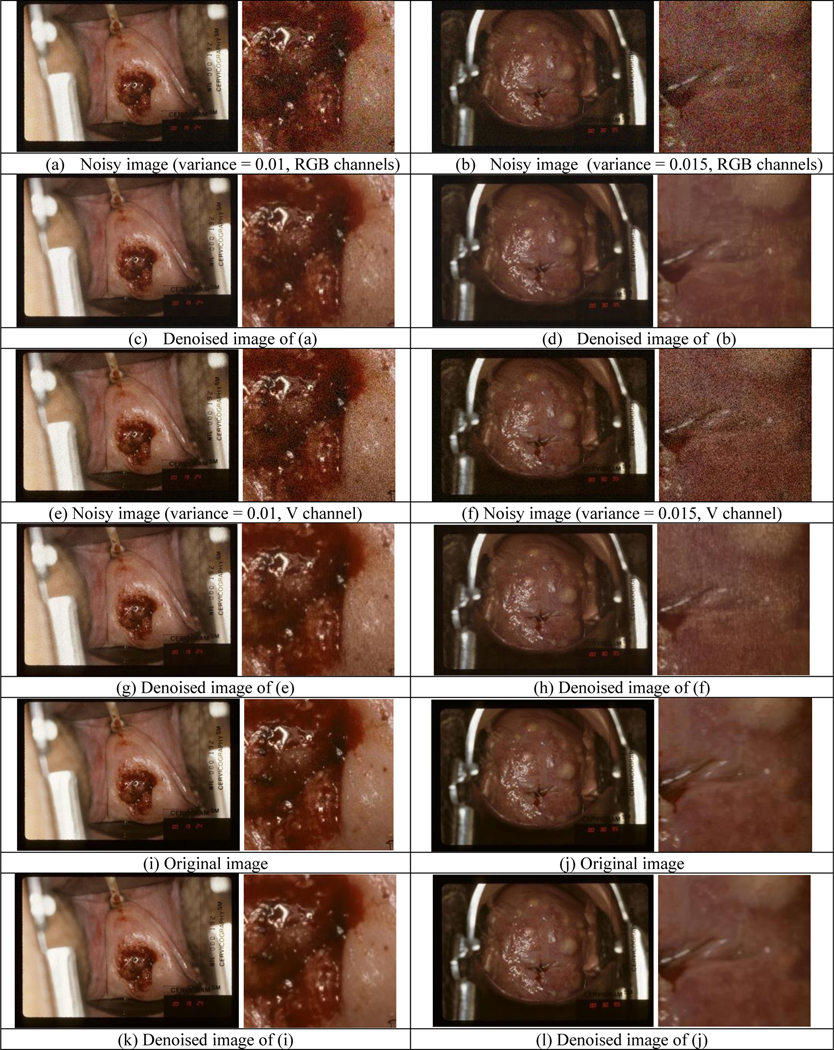
The burden of cervical cancer disproportionately falls on low- and middle-income countries (LMICs). Automated visual evaluation (AVE) is a technology being considered as an adjunct tool for the management of HPV-positive women. AVE involves analysis of a white light illuminated cervical image using machine learning classifiers. It is of importance to analyze various impacts of different kinds of image degradations on AVE. In this paper, we report our work regarding the impact of one type of image degradation, Gaussian noise, and one of its remedies we have been exploring. The images, originated from the Natural History Study (NHS) and ASCUS-LSIL Triage Study (ALTS), were modified by the addition of white Gaussian noise at different levels. The AVE pipeline used in the experiments consists of two deep learning components: a cervix locator which uses RetinaNet (an object detection network), and a binary pathology classifier that uses the ResNeSt network. Our findings indicate that Gaussian noise, which frequently appears in low light conditions, is a key factor in degrading the AVE's performance. A blind image denoising technique which uses Variational Denoising Network (VDNet) was tested on a set of 345 digitized cervigram images (115 positives) and evaluated both visually and quantitatively. AVE performances on both the synthetically generated noisy images and the corresponding denoised images were examined and compared. In addition, the denoising technique was evaluated on several real noisy cervix images captured by a camera-based imaging device used for AVE that have no histology confirmation. The comparison between the AVE performances on images with and without denoising shows that denoising can be effective at mitigating classification performance degradation.
宫颈癌负担在低收入和中等收入国家(LMICs)中分布不均。自动视觉评估(AVE)是一种被视为用于管理HPV阳性女性的辅助工具的技术。AVE涉及使用机器学习分类器分析白光照射的宫颈图像。分析不同类型的图像退化对AVE的各种影响非常重要。在本文中,我们报告了我们关于一种图像退化类型(高斯噪声)的影响以及我们一直在探索的一种补救方法的工作。这些图像源自自然史研究(NHS)和非典型鳞状细胞不能明确意义/低度鳞状上皮内病变分流研究(ALTS),通过添加不同水平的白色高斯噪声进行了修改。实验中使用的AVE管道由两个深度学习组件组成:一个使用RetinaNet(一种目标检测网络)的子宫颈定位器,以及一个使用ResNeSt网络的二元病理分类器。我们的研究结果表明,经常出现在低光照条件下的高斯噪声是降低AVE性能的关键因素。一种使用变分去噪网络(VDNet)的盲图像去噪技术在一组345张数字化宫颈图像(115张阳性)上进行了测试,并进行了视觉和定量评估。检查并比较了合成生成的噪声图像和相应去噪图像上的AVE性能。此外,该去噪技术还在一些由用于AVE的基于相机的成像设备捕获的真实噪声宫颈图像上进行了评估,这些图像没有组织学确认。有噪图像和去噪图像上AVE性能的比较表明,去噪可以有效减轻分类性能的下降。