
一种新型氮化硅纤维增强碳化硅基复合材料的微观力学性能——纳米压痕法
Micro-mechanical properties of a novel silicon nitride fiber reinforced silicon carbide matrix composite nano-indentation method.
作者信息
Sun Xun, Jiang Ru, Liu Haitao, Cheng Haifeng
机构信息
College of Aerospace Science and Engineering, National University of Defense Technology Changsha 410073 China
出版信息
RSC Adv. 2019 Aug 22;9(45):26373-26380. doi: 10.1039/c9ra03109j. eCollection 2019 Aug 19.
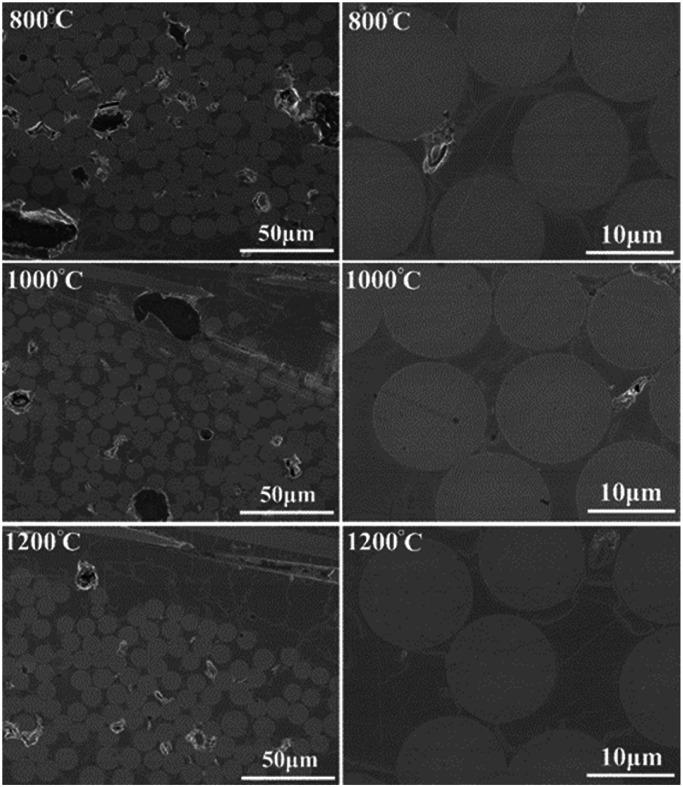
A novel SiN fiber reinforced SiC matrix composite has been prepared and the micro-mechanical properties of the composites have been explored. For the SiN fibers, the micro-mechanical properties remained almost unchanged with the increasing fabrication temperatures. In comparison, for the PCS derived SiC matrix, higher fabrication temperature could trigger more β-SiC formations, which led to enlarging the corresponding micro-mechanical properties. The microstructure analysis of the interfacial zones in the composites revealed strong interfacial reactions existing in the composites fabricated at ≥800 °C. Therefore, the interfacial shear strength of the composite was significantly increased from ∼420 MPa to ∼535 MPa with the fabrication temperature increasing from 800 °C to 1200 °C, thus impeding the toughening mechanisms of the composites. After introducing BN interphase, the interfacial shear strength was significantly reduced to ∼140 MPa and the flexural strength was increased from ∼140 MPa to ∼250 MPa. The work highlights the efficiency of introducing BN interphase to weaken the interfacial interaction, thus to enhance the macro-mechanical properties.
制备了一种新型的SiN纤维增强SiC基复合材料,并对其微观力学性能进行了研究。对于SiN纤维,随着制备温度的升高,微观力学性能几乎保持不变。相比之下,对于由聚碳硅烷(PCS)衍生的SiC基体,较高的制备温度会引发更多β-SiC的形成,从而导致相应微观力学性能的增大。复合材料界面区域的微观结构分析表明,在≥800℃制备的复合材料中存在强烈的界面反应。因此,随着制备温度从800℃升高到1200℃,复合材料的界面剪切强度从约420MPa显著提高到约535MPa,从而阻碍了复合材料的增韧机制。引入BN中间相后,界面剪切强度显著降低至约140MPa,弯曲强度从约140MPa提高到约250MPa。这项工作突出了引入BN中间相以减弱界面相互作用从而提高宏观力学性能的有效性。



 Zotero 插件