Institute of Cell Genetics, Medical University Innsbruck, 6020 Innsbruck, Austria.
Int J Mol Sci. 2022 May 10;23(10):5337. doi: 10.3390/ijms23105337.
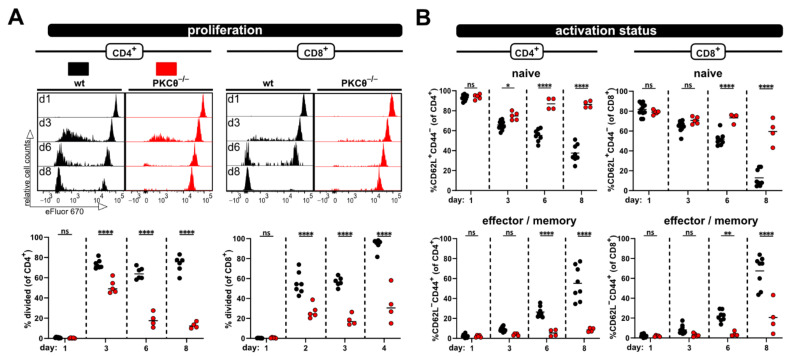
Depending on the context, robust and durable T lymphocyte activation is either desirable, as in the case of anti-tumor responses, or unwanted, in cases of autoimmunity when chronic stimulation leads to self-tissue damage. Therefore, reliable in vivo models are of great importance to identify and validate regulatory pathways of T lymphocyte activation. Here, we describe an in vivo mixed-lymphocyte-reaction (MLR) approach, which is based on the so-called parent-into-F1 (P → F1) mouse model in combination with the congenic marker CD45.1/2 and cell proliferation dye-labeling. This setup allows us to track adoptively transferred allogenic CD4 and CD8 T lymphocytes and analyze their phenotype as well as the proliferation by flow cytometry in the blood and spleen. We could show hypo-reactive responses of T lymphocytes isolated from knockout mice with a known defect in T lymphocyte activation. Thus, this MLR-based in vivo model provides the opportunity to analyze positive regulators of T cell responses under physiological conditions of polyclonal T lymphocyte activation in vivo.
根据具体情况,T 淋巴细胞的强烈和持久激活可能是有益的,例如在抗肿瘤反应中;也可能是有害的,例如在自身免疫中,慢性刺激会导致自身组织损伤。因此,可靠的体内模型对于鉴定和验证 T 淋巴细胞激活的调节途径非常重要。在这里,我们描述了一种体内混合淋巴细胞反应(MLR)方法,该方法基于所谓的亲代到 F1(P→F1)小鼠模型,结合了同基因标记 CD45.1/2 和细胞增殖染料标记。这种设置允许我们通过流式细胞术在血液和脾脏中追踪过继转移的同种异体 CD4 和 CD8 T 淋巴细胞,并分析其表型以及增殖情况。我们可以显示出在 T 淋巴细胞激活已知缺陷的基因敲除小鼠中分离出的 T 淋巴细胞的低反应性。因此,这种基于 MLR 的体内模型为在体内多克隆 T 淋巴细胞激活的生理条件下分析 T 细胞反应的阳性调节剂提供了机会。