
大鼠肠灌流模型中 FITC-葡聚糖和大分子模型药物的肠吸收。
Intestinal Absorption of FITC-Dextrans and Macromolecular Model Drugs in the Rat Intestinal Instillation Model.
机构信息
The Swedish Drug Delivery Center, Department of Pharmacy, Uppsala University, BMC P.O. Box 580, Uppsala SE-751 23, Sweden.
Advanced Drug Delivery, Pharmaceutical Sciences, R&D, AstraZeneca, Gothenburg 431 83, Sweden.
出版信息
Mol Pharm. 2022 Jul 4;19(7):2564-2572. doi: 10.1021/acs.molpharmaceut.2c00261. Epub 2022 Jun 1.
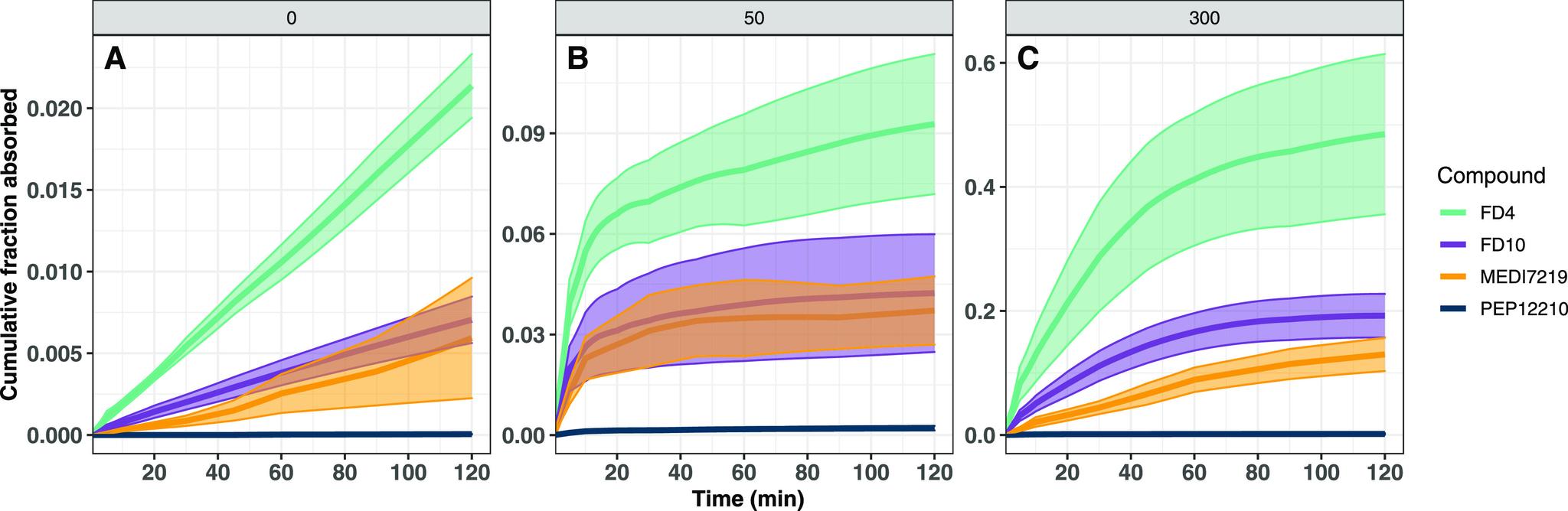
In this work, we studied the intestinal absorption of a peptide with a molecular weight of 4353 Da (MEDI7219) and a protein having a molecular weight of 11 740 Da (PEP12210) in the rat intestinal instillation model and compared their absorption to fluorescein isothiocyanate (FITC)-labeled dextrans of similar molecular weights (4 and 10 kDa). To increase the absorption of the compounds, the permeation enhancer sodium caprate (C10) was included in the liquid formulations at concentrations of 50 and 300 mM. All studied compounds displayed an increased absorption rate and extent when delivered together with 50 mM C10 as compared to control formulations not containing C10. The time period during which the macromolecules maintained an increased permeability through the intestinal epithelium was approximately 20 min for all studied compounds at 50 mM C10. For the formulations containing 300 mM C10, it was noted that the dextrans displayed an increased absorption rate (compared to 50 mM C10), and their absorption continued for at least 60 min. The absorption rate of MEDI7219, on the other hand, was similar at both studied C10 concentrations, but the duration of absorption was extended at the higher enhancer concentration, leading to an increase in the overall extent of absorption. The absorption of PEP12210 was similar in terms of the rate and duration at both studied C10 concentrations. This is likely caused by the instability of this molecule in the intestinal lumen. The degradation decreases the luminal concentrations over time, which in turn limits absorption at time points beyond 20 min. The results from this study show that permeation enhancement effects cannot be extrapolated between different types of macromolecules. Furthermore, to maximize the absorption of a macromolecule delivered together with C10, prolonging the duration of absorption appears to be important. In addition, the macromolecule needs to be stable enough in the intestinal lumen to take advantage of the prolonged absorption time window enabled by the permeation enhancer.
在这项工作中,我们研究了分子量为 4353 Da 的肽(MEDI7219)和分子量为 11740 Da 的蛋白质(PEP12210)在大鼠肠内滴注模型中的肠道吸收情况,并将其与具有相似分子量的荧光素异硫氰酸酯(FITC)标记的葡聚糖(4 和 10 kDa)的吸收进行了比较。为了增加化合物的吸收,在液体配方中加入了渗透增强剂癸酸钠(C10),浓度分别为 50 和 300 mM。与不含 C10 的对照制剂相比,所有研究的化合物在与 50 mM C10 一起给药时,吸收速率和程度均增加。在 50 mM C10 下,所有研究的化合物在大约 20 分钟内保持了增加的肠上皮通透性。对于含有 300 mM C10 的制剂,注意到葡聚糖的吸收速率增加(与 50 mM C10 相比),并且它们的吸收至少持续 60 分钟。另一方面,MEDI7219 的吸收速率在两种研究的 C10 浓度下相似,但在较高的增强剂浓度下,吸收持续时间延长,导致吸收总量增加。在两种研究的 C10 浓度下,PEP12210 的吸收在速率和持续时间方面相似。这可能是由于该分子在肠腔中不稳定。随着时间的推移,降解会降低腔内浓度,从而在 20 分钟后限制吸收。这项研究的结果表明,不能在不同类型的大分子之间推断渗透增强作用。此外,为了最大限度地提高与 C10 一起输送的大分子的吸收,延长吸收时间似乎很重要。此外,大分子需要在肠腔中足够稳定,以利用渗透增强剂所允许的延长吸收时间窗口。


 Zotero 插件