Li Dongxiu, Hong Xia, Chen Tingyu
Department of Nursing, Fujian Health College, Fuzhou, China.
Front Neurol. 2022 May 11;13:885179. doi: 10.3389/fneur.2022.885179. eCollection 2022.
Rheumatoid arthritis (RA) and Parkinson's disease (PD) are two common chronic diseases worldwide, and any potential link between the two would significantly impact public health practice. Considering the current inconsistent evidence, we conducted a meta-analysis and systematic review to examine the risk of PD in patients with RA.
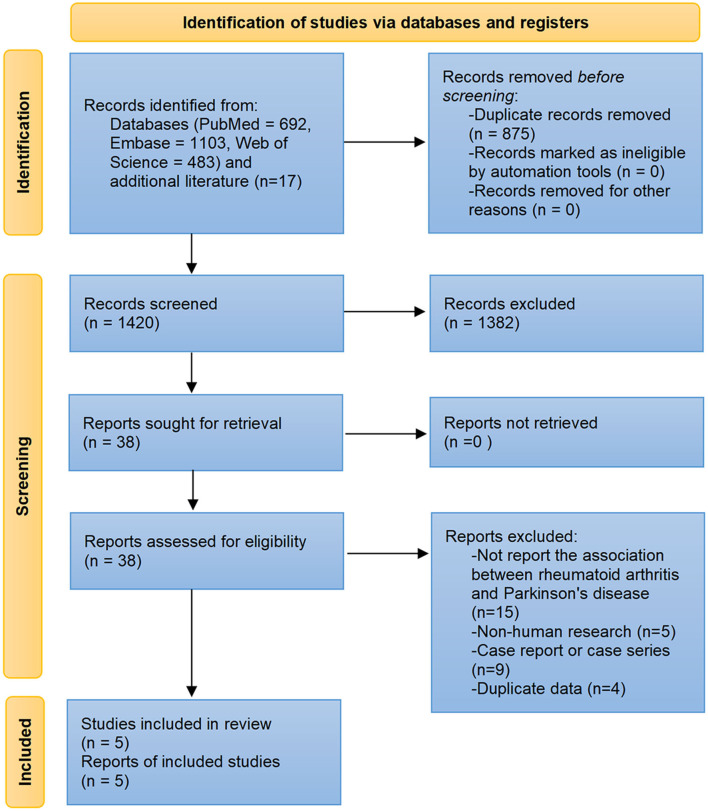
Two investigators (DL and XH) conducted a comprehensive search of PubMed, Embase, and Web of Science using medical subject headings terms combined with free words to identify relevant papers published from inception through December 31, 2021. All studies that explored the relationship between RA and PD were included for quantitative analysis and qualitative review. Random- and fixed-effects models were used to pool the risk ratios (RRs) of PD in patients with RA. The Newcastle-Ottawa scale was used to assess the quality of included studies. This study followed the Preferred Reporting Items for Systematic Reviews and Meta-Analyses (PRISMA 2020) guideline.
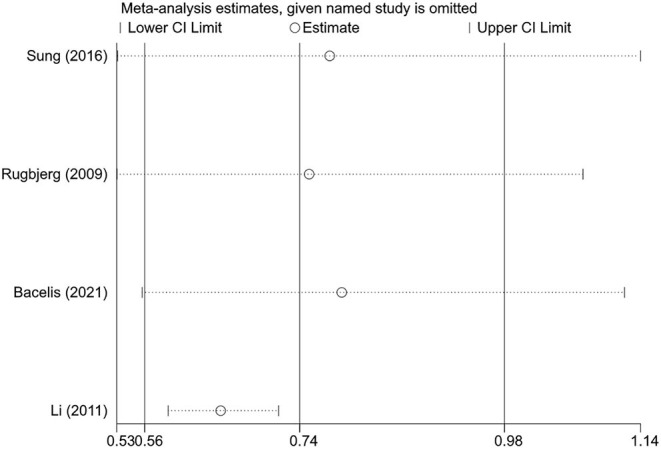
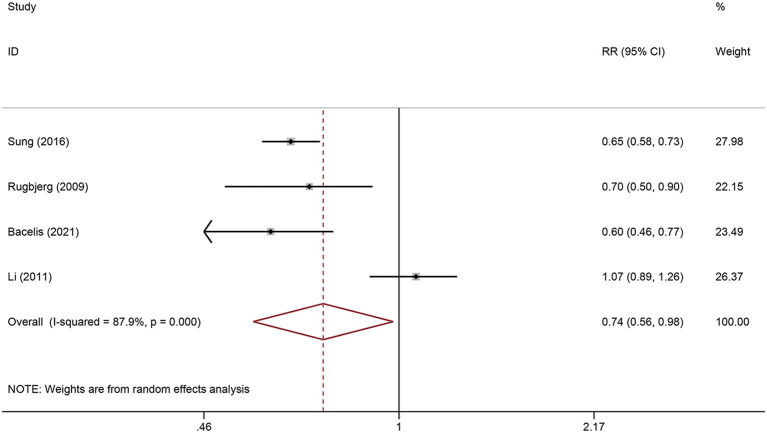
Four population-based studies involving 353,246 patients and one Mendelian randomized study were included in our study. The pooled result showed a significantly reduced risk of PD in patients with RA than in the general population (RR = 0.74, 95% CI: 0.56-0.98, = 0.034). No apparent effects of gender, age, region, follow-up time, or study design on PD risk were observed. Sensitivity analysis showed that pooled results were relatively stable, and no publication bias was detected. The Mendelian randomization study indicated a significant inverse association between RA and PD (genetic correlation: -0.10, = 0.0033) and that each one standard deviation increase in the risk of RA was significantly associated with a lower risk of PD. Of note, the current study is limited by the relatively small number of included studies and unmeasured confounding factors, especially for RA-related anti-inflammatory agents.
This study supports that people with RA had a lower PD risk than those without RA. Further studies are needed to explore the underlying molecular mechanisms of the interaction between the two diseases.
类风湿性关节炎(RA)和帕金森病(PD)是全球两种常见的慢性疾病,二者之间的任何潜在联系都会对公共卫生实践产生重大影响。鉴于目前证据不一致,我们进行了一项荟萃分析和系统评价,以研究RA患者患PD的风险。
两名研究者(DL和XH)使用医学主题词结合自由词对PubMed、Embase和Web of Science进行全面检索,以识别从创刊至2021年12月31日发表的相关论文。所有探讨RA与PD关系的研究均纳入定量分析和定性评价。采用随机效应模型和固定效应模型汇总RA患者患PD的风险比(RRs)。使用纽卡斯尔-渥太华量表评估纳入研究的质量。本研究遵循系统评价和荟萃分析的首选报告项目(PRISMA 2020)指南。
我们的研究纳入了四项涉及353,246名患者的基于人群的研究和一项孟德尔随机研究。汇总结果显示,RA患者患PD的风险显著低于一般人群(RR = 0.74,95%CI:0.56 - 0.98,P = 0.034)。未观察到性别、年龄、地区、随访时间或研究设计对PD风险有明显影响。敏感性分析表明汇总结果相对稳定,未检测到发表偏倚。孟德尔随机研究表明RA与PD之间存在显著的负相关(遗传相关性:-0.10,P = 0.0033),且RA风险每增加一个标准差与较低的PD风险显著相关。值得注意的是,本研究受到纳入研究数量相对较少以及未测量的混杂因素的限制,尤其是与RA相关的抗炎药物。
本研究支持RA患者患PD的风险低于非RA患者。需要进一步研究探索这两种疾病相互作用的潜在分子机制。