Department of Pulmonary Medicine, Respiratory Institute, Cleveland Clinic, 9500 Euclid Avenue / A90, Cleveland, OH, 44195, USA.
Department of Pathology, Cleveland Clinic, Cleveland, USA.
BMC Pulm Med. 2022 Jun 2;22(1):215. doi: 10.1186/s12890-022-01990-4.
Transbronchial cryobiopsy has been increasingly used to diagnose interstitial lung diseases. However, there is uncertainty regarding its accuracy and risks, mainly due to a paucity of prospective or randomized trials comparing cryobiopsy to surgical biopsy.
To evaluate the diagnostic yield and complications of cryobiopsy in patients selected by multidisciplinary discussion.
This was a prospective cohort from 2017 to 2019. We included consecutive patients with suspected interstitial lung diseases being considered for lung biopsy presented at our multidisciplinary meeting.
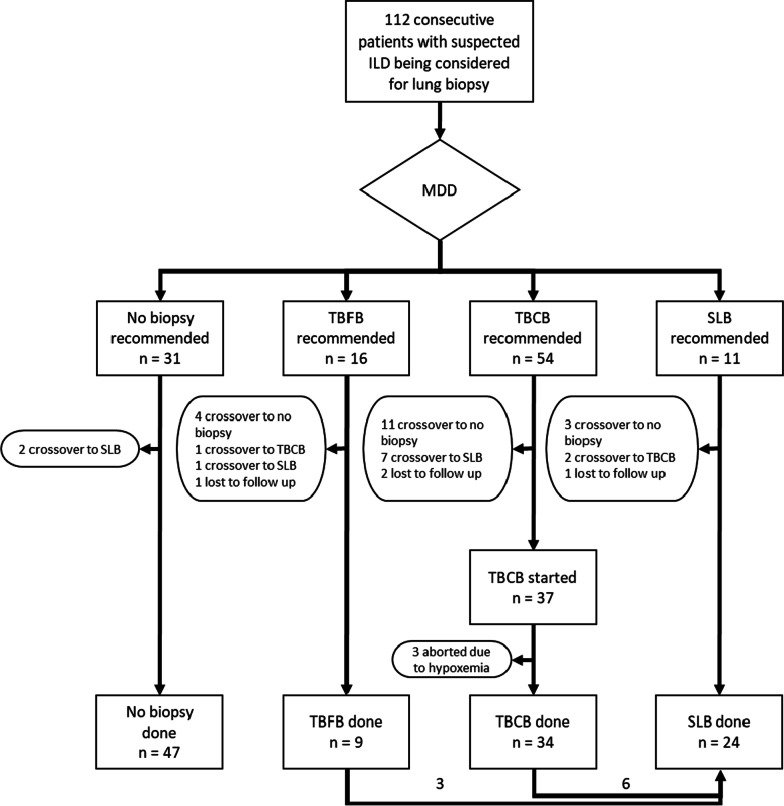
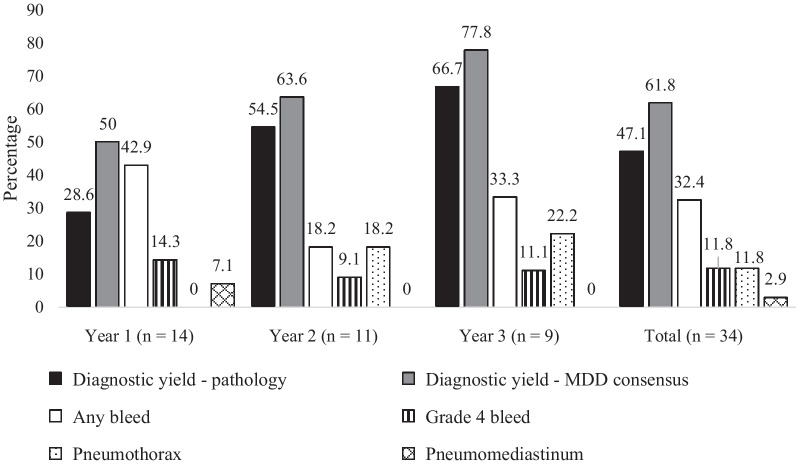
Of 112 patients, we recommended no biopsy in 31, transbronchial forceps biopsy in 16, cryobiopsy in 54 and surgical biopsy in 11. By the end of the study, 34 patients had had cryobiopsy and 24 patients, surgical biopsy. Overall pathologic and multidisciplinary diagnostic yield of cryobiopsy was 47.1% and 61.8%, respectively. The yield increased over time for both pathologic (year 1: 28.6%, year 2: 54.5%, year 3: 66.7%, p = 0.161) and multidisciplinary (year 1: 50%, year 2: 63.6%, year 3: 77.8%, p = 0.412) diagnosis. Overall rate of grade 4 bleeding after cryobiopsy was 11.8%. Cryobiopsy required less chest tube placement (11.8% vs 100%, p < 0.001) and less hospitalizations compared to surgical biopsy (26.5% vs 95.7%, p < 0.001), but hospitalized patients had a longer median hospital stay (2 days vs 1 day, p = 0.004).
Diagnostic yield of cryobiopsy increased over time but the overall grade 4 bleeding rate was 11.8%.
经支气管冷冻活检已越来越多地用于诊断间质性肺疾病。然而,由于缺乏比较冷冻活检与外科活检的前瞻性或随机试验,其准确性和风险仍存在不确定性。
评估多学科讨论选择的患者中经支气管冷冻活检的诊断效果和并发症。
这是一项 2017 年至 2019 年的前瞻性队列研究。我们纳入了在我院多学科会议上考虑进行肺活检的疑似间质性肺疾病连续患者。
在 112 例患者中,我们建议 31 例患者不进行活检,16 例患者进行经支气管活检钳活检,54 例患者进行冷冻活检,11 例患者进行外科活检。研究结束时,34 例患者进行了冷冻活检,24 例患者进行了外科活检。冷冻活检的整体病理和多学科诊断率分别为 47.1%和 61.8%。病理(第 1 年:28.6%,第 2 年:54.5%,第 3 年:66.7%,p=0.161)和多学科(第 1 年:50%,第 2 年:63.6%,第 3 年:77.8%,p=0.412)诊断的诊断率随时间推移而增加。冷冻活检后出现 4 级出血的总发生率为 11.8%。与外科活检相比,冷冻活检需要放置胸腔引流管的比例更低(11.8% vs 100%,p<0.001),住院率也更低(26.5% vs 95.7%,p<0.001),但住院患者的中位住院时间更长(2 天 vs 1 天,p=0.004)。
冷冻活检的诊断效果随时间推移而增加,但总体 4 级出血率为 11.8%。