
具有高孔隙率和均匀孔径分布的双轴拉伸PA6/PP膜的微孔形成机理
Microporous Formation Mechanism of Biaxial Stretching PA6/PP Membranes with High Porosity and Uniform Pore Size Distribution.
作者信息
Fang Wenxiang, Liang Guixue, Li Jiang, Guo Shaoyun
机构信息
The State Key Laboratory of Polymer Materials Engineering, Polymer Research Institute of Sichuan University, Chengdu 610065, Sichuan, China.
出版信息
Polymers (Basel). 2022 Jun 5;14(11):2291. doi: 10.3390/polym14112291.
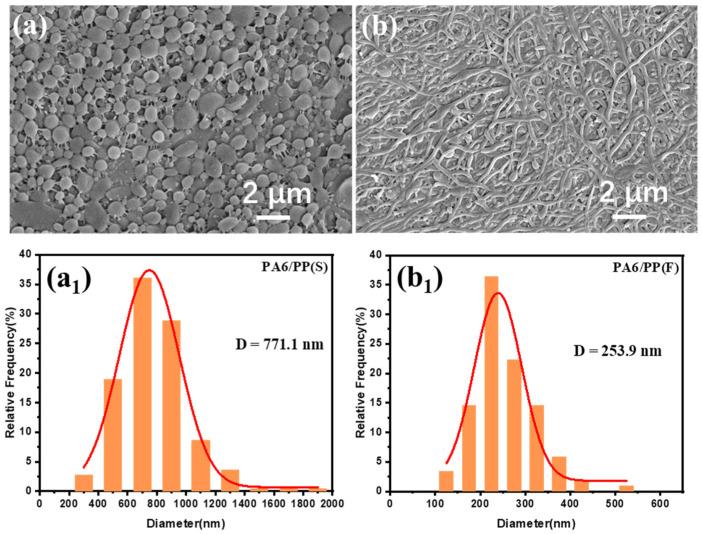
The low porosity and wide pore size distribution of biaxial stretching PP microporous membranes continue to be the primary impediments to their industrial application. To solve this problem, there is a critical and urgent need to study the micropore-forming mechanism of PP membranes. In this research, the interfacial micropore formation mechanism of PA6/PP membranes during biaxial stretching was investigated. PA6/PP membranes containing spherical PA6 and fibrillar PA6 were found to exhibit different interfacial micropore formation mechanisms. Numerous micropores were generated in the PA6/PP membranes, containing PA6 spherical particles via the interface separation between the PP matrix and PA6 spherical particles during longitudinal stretching. Subsequent transverse stretching further expanded the two-phase interface, promoting the breakdown and fibrosis of the PP matrix and forming a spider-web-like microporous structure centered on spherical PA6 particles. In PA6/PP membranes with PA6 fibers, fewer micropores were generated during longitudinal stretching, but the subsequent transverse stretching violently separated the PA6 fibers, resulting in a dense fiber network composed of PA6 fibers interwoven with PP fibers. Crucially, the PA6/PP biaxial stretching of microporous membranes presented an optimized pore structure, higher porosity, narrower pore size distribution, and better permeability than β-PP membranes. Furthermore, this study explored a new approach to the fabrication of high-performance PA6/PP microporous membranes, with good prospects for potential industrial application.
双轴拉伸聚丙烯微孔膜的低孔隙率和宽孔径分布仍然是其工业应用的主要障碍。为了解决这个问题,迫切需要研究聚丙烯膜的微孔形成机理。在本研究中,研究了双轴拉伸过程中PA6/PP膜的界面微孔形成机理。发现含有球形PA6和纤维状PA6的PA6/PP膜表现出不同的界面微孔形成机理。在纵向拉伸过程中,通过PP基体与PA6球形颗粒之间的界面分离,在含有PA6球形颗粒的PA6/PP膜中产生了大量微孔。随后的横向拉伸进一步扩大了两相界面,促进了PP基体的破裂和纤维化,并形成了以球形PA6颗粒为中心的蜘蛛网状微孔结构。在含有PA6纤维的PA6/PP膜中,纵向拉伸过程中产生的微孔较少,但随后的横向拉伸使PA6纤维剧烈分离,形成了由PA6纤维与PP纤维交织而成的致密纤维网络。至关重要的是,PA6/PP微孔膜的双轴拉伸呈现出优化的孔结构、更高的孔隙率、更窄的孔径分布以及比β-PP膜更好的渗透性。此外,本研究探索了一种制备高性能PA6/PP微孔膜的新方法,具有潜在的工业应用前景。




 Zotero 插件