Sibhatu Manuel Kassaye, Taye Desalegn Bekele, Gebreegziabher Senedu Bekele, Mesfin Edlawit, Bashir Hassen Mohammed, Varallo John
Jhpiego Ethiopia, Johns Hopkins University Affiliate, Mailbox 607. Bole subcity, Woreda 13, House No. B17/3, Addis Ababa, Ethiopia.
Ministry of Health of Ethiopia, Addis Ababa, Ethiopia.
Patient Saf Surg. 2022 Jun 10;16(1):20. doi: 10.1186/s13037-022-00329-6.
Ministry of Health (MOH) of Ethiopia adopted World Health Organization's evidence-proven surgical safety checklist (SSC) to reduce the occurrence of surgical complications, i.e., death, disability and prolong hospitalization. MOH commissioned this evaluation to learn about SSC completeness and compliance, and its effect on magnitude of surgical complications.
Health institution-based cross-sectional study with retrospective surgical chart audit was used to evaluate SSC utilization in 172 public and private health facilities in Ethiopia, December 2020-May 2021. A total of 1720 major emergency and elective surgeries in 172 (140 public and 32 private) facilities were recruited for chart review by an experienced team of surgical clinicians. A pre-tested tool was used to abstract data from patient charts and national database. Analyzed descriptive, univariable and bivariable data using Stata version-15 statistical software.
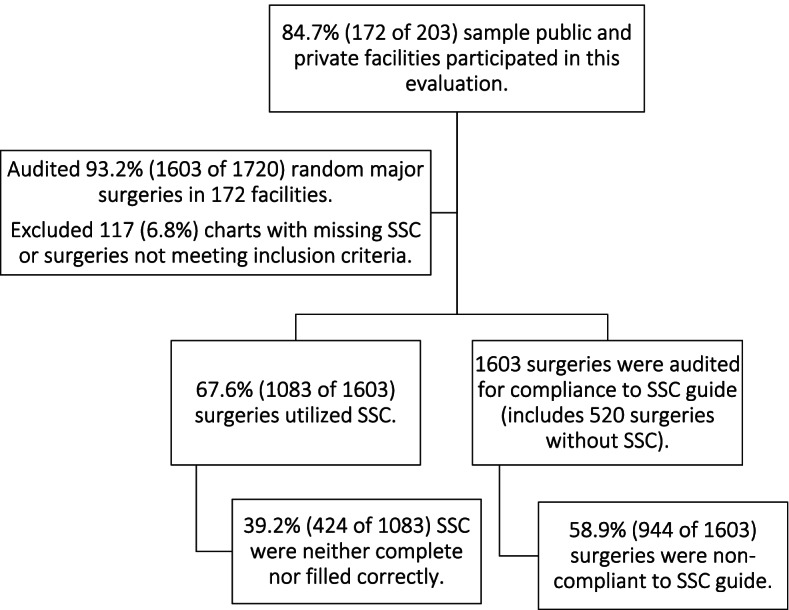
In 172 public and private health facilities across Ethiopia, 1603 of 1720 (93.2%) patient charts were audited; representations of public and private facilities were 81.4% (n = 140) and 18.6% (n = 32), respectively. Of surgeries that utilized SSC (67.6%, 1083 of 1603), the proportion of SSC that were filled completely and correctly were 60.8% (659 of 1083). Surgeries compliant to SSC guide achieved a statistically significant reduction in perioperative mortality (P = 0.002) and anesthesia adverse events (P = 0.005), but not in Surgical Site Infection (P = 0.086). Non-compliant surgeries neither utilized SSC nor completed the SSC correctly, 58.9% (944 of 1603).
Surgeries that adhered to the SSC achieved a statistically significant reduction in perioperative complications, including mortality. Disappointingly, a significant number of surgeries (58.9%) failed to adhere to SSC, a missed opportunity for reducing complications.
埃塞俄比亚卫生部采用了世界卫生组织经证据验证的手术安全核对表(SSC),以减少手术并发症的发生,即死亡、残疾和延长住院时间。卫生部委托进行此项评估,以了解SSC的完整性和合规性及其对手术并发症发生率的影响。
采用基于卫生机构的横断面研究及回顾性手术病历审核,于2020年12月至2021年5月评估埃塞俄比亚172家公立和私立卫生机构对SSC的使用情况。由经验丰富的外科临床医生团队选取172家(140家公立和32家私立)机构的1720例重大急诊和择期手术病历进行审核。使用经过预测试的工具从患者病历和国家数据库中提取数据。使用Stata 15版统计软件对描述性、单变量和双变量数据进行分析。
在埃塞俄比亚的172家公立和私立卫生机构中,对1720例患者病历中的1603例(93.2%)进行了审核;公立和私立机构的占比分别为81.4%(n = 140)和18.6%(n = 32)。在使用SSC的手术中(1603例中的67.6%,即1083例),完全正确填写SSC的比例为60.8%(1083例中的659例)。符合SSC指南的手术在围手术期死亡率(P = 0.002)和麻醉不良事件(P = 0.005)方面实现了统计学上的显著降低,但在手术部位感染方面未实现(P = 0.086)。不符合规定的手术既未使用SSC也未正确填写SSC,占58.9%(1603例中的944例)。
遵循SSC的手术在包括死亡率在内的围手术期并发症方面实现了统计学上的显著降低。令人失望的是,大量手术(58.9%)未遵循SSC,这是减少并发症的一个错失的机会。