Jing Shufang, Zhang Xiaoping, Niu Hangang, Lin Feng, Ayi Qiaoli, Wan Binna, Ren Xinyi, Su Xiaolei, Shi Shaohua, Liu Songping, Zeng Bo
Key Laboratory of Eco-environments in Three Gorges Reservoir Region (Ministry of Education), Chongqing Key Laboratory of Plant Ecology and Resources in Three Gorges Reservoir Region, School of Life Sciences, Southwest University, Chongqing, China.
School of Art and Design, Huanghuai University, Zhumadian, China.
Front Plant Sci. 2022 Jun 2;13:883800. doi: 10.3389/fpls.2022.883800. eCollection 2022.
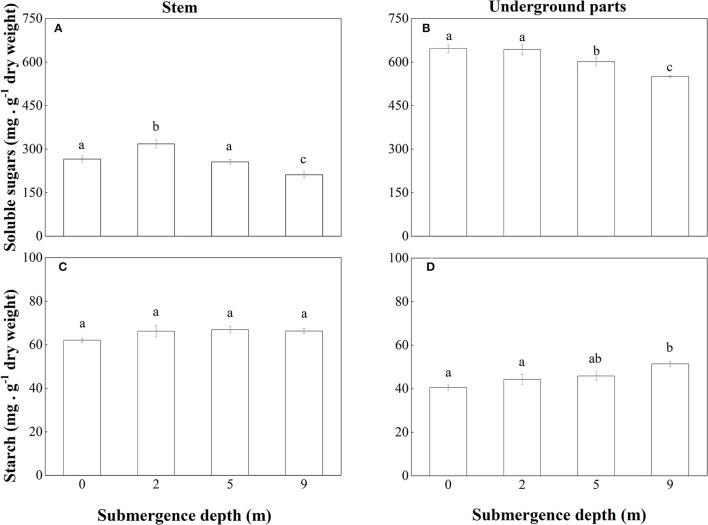
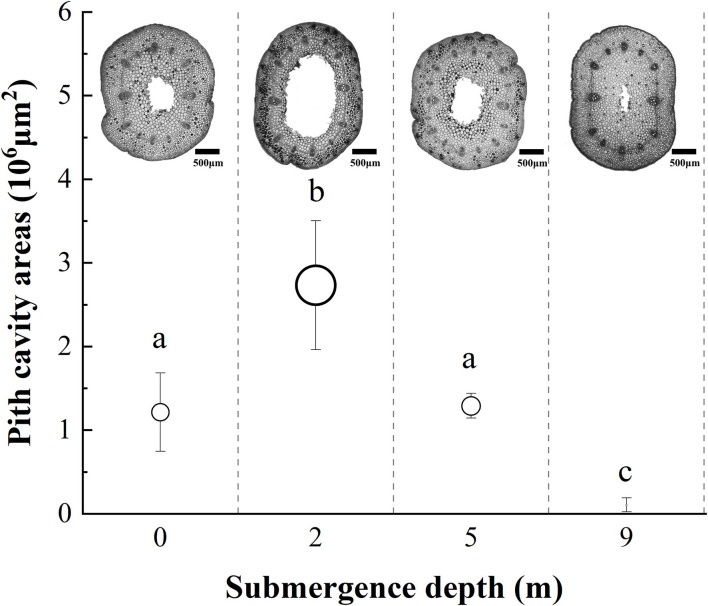
Global climate change has resulted in an increase in intensity and frequency of flooding, plants living in lowlands, and shore areas have to confront submergence caused by flooding, submergence-tolerant plants usually respond by adopting either escape or quiescence strategies. While certain plants exhibit a changeover from escape strategy upon partial submergence to quiescence strategy under complete shallow submergence, it remains unknown whether plants completely submerged at different water depths would adjust their strategies to cope with the change in submergence depth. is an ideal species to explore this adjustment as it is widely distributed in flood-disturbed habitats and exhibits an escape strategy when completely submerged in shallow waters. We investigated the responses of in terms of morphology, anatomy, and non-structural carbohydrate metabolism by conducting experiments using a series of submergence depths (0, 2, 5, and 9 m). During the submergence treatment, environmental factors such as light, dissolved oxygen, and temperature for submerged plants were kept constant. The results showed that plants submerged at depth of 2 m presented an escape strategy fast stem elongation, extensive pith cavity development, and small biomass loss. However, the retarded stem elongation, reduced pith cavity transverse area, and increased biomass loss along the water depth gradient indicated that altered its growth response as water depth increased from 2 to 9 m. It is found that the changeover of response strategies occurred at higher submergence depths (5-9 m). Based on the results of our experiments, we demonstrated that water depth played an important role in driving the change in strategy. The water-depth-dependent growth performance of would benefit the species in habit exploration and exploitation. Further studies should focus on the performances of plants when submerged at varied water depths with different light climates and dissolved oxygen content, and how water depths drive the response behaviors of the submerged plants.
全球气候变化导致洪水的强度和频率增加,生活在低地和海岸地区的植物不得不面对洪水造成的淹没,耐淹植物通常通过采取逃避或静止策略做出反应。虽然某些植物在部分淹没时表现出从逃避策略到完全浅淹没时的静止策略的转变,但尚不清楚在不同水深完全淹没的植物是否会调整其策略以应对淹没深度的变化。是探索这种调整的理想物种,因为它广泛分布于受洪水干扰的栖息地,并且在完全淹没于浅水中时表现出逃避策略。我们通过使用一系列淹没深度(0、2、5和9米)进行实验,研究了在形态、解剖结构和非结构性碳水化合物代谢方面的反应。在淹没处理期间,淹没植物的光照、溶解氧和温度等环境因素保持恒定。结果表明,淹没在2米深度的植物表现出逃避策略——茎快速伸长、髓腔广泛发育且生物量损失小。然而,随着水深从2米增加到9米,茎伸长受阻,髓腔横截面积减小以及生物量损失增加,这表明随着水深增加而改变了其生长反应。发现在较高的淹没深度(5 - 9米)出现反应策略的转变。基于我们的实验结果,我们证明水深在驱动策略变化方面起着重要作用。的水深依赖性生长表现将有利于该物种在栖息地的探索和利用。进一步的研究应关注植物在不同光照气候和溶解氧含量的不同水深下淹没时的表现,以及水深如何驱动淹没植物的反应行为。