
用于CO/CH分离的基于生物聚合物的混合基质膜(MMMs):实验与模型评估
Biopolymer-Based Mixed Matrix Membranes (MMMs) for CO/CH Separation: Experimental and Modeling Evaluation.
作者信息
Torre-Celeizabal Andrea, Casado-Coterillo Clara, Garea Aurora
机构信息
Department of Chemical and Biomolecular Engineering, Universidad de Cantabria, 39005 Santander, Spain.
出版信息
Membranes (Basel). 2022 May 28;12(6):561. doi: 10.3390/membranes12060561.
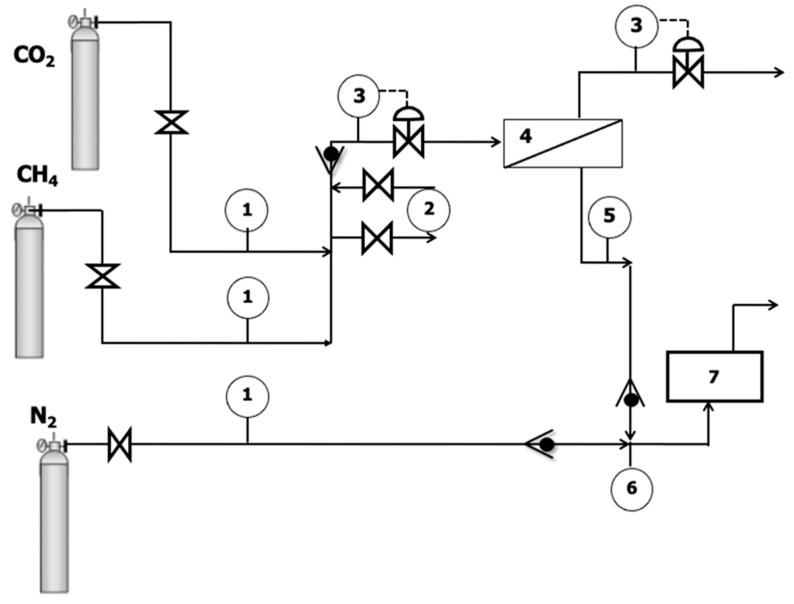
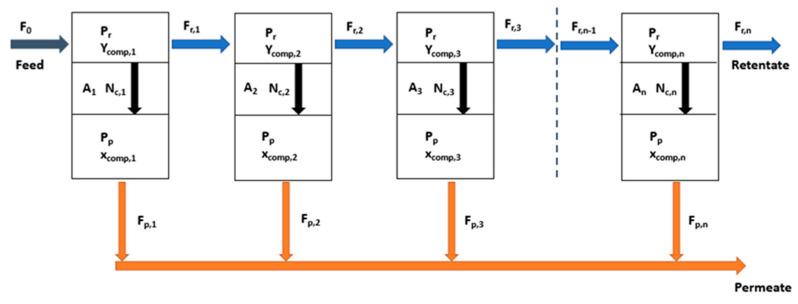
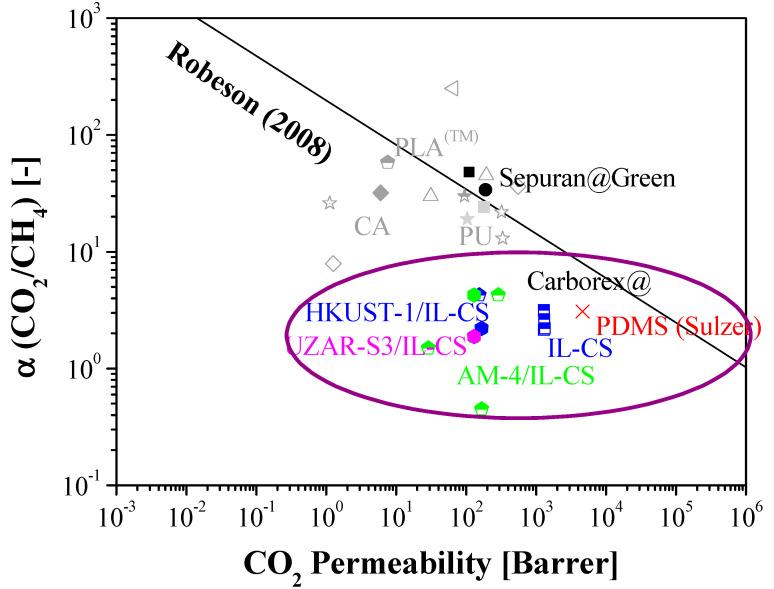
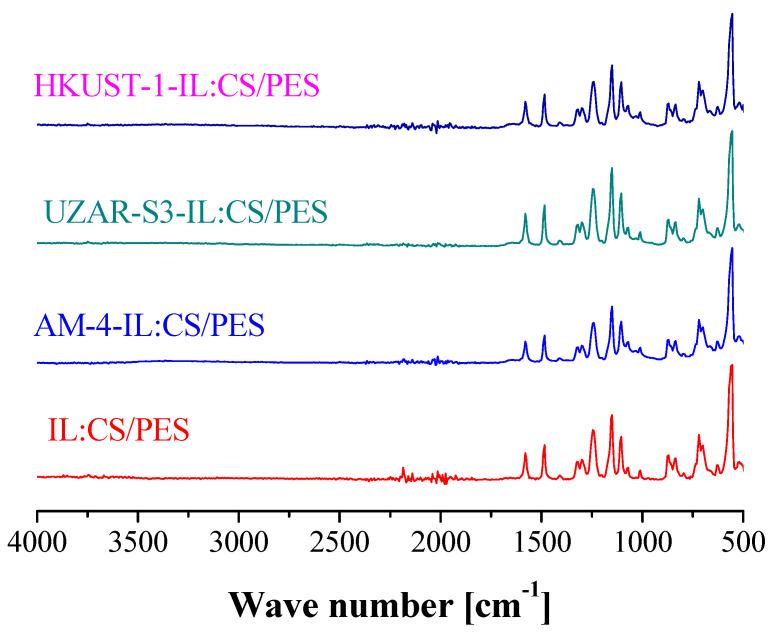
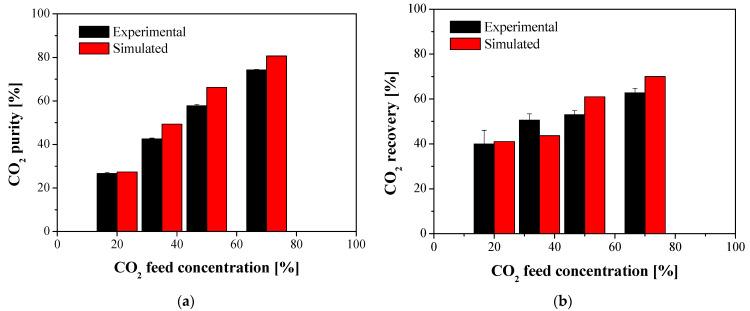
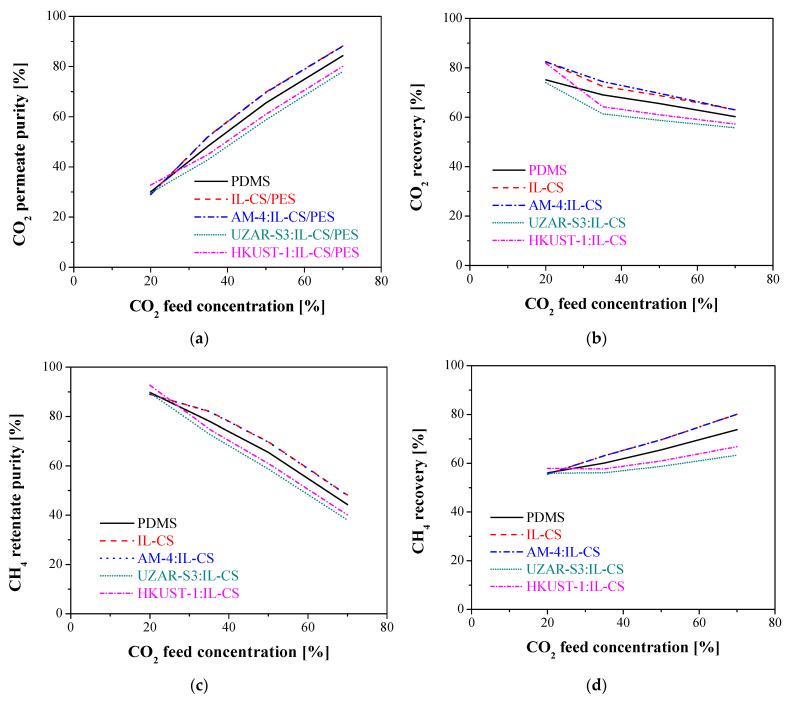
Alternative materials are needed to tackle the sustainability of membrane fabrication in light of the circular economy, so that membrane technology keeps playing a role as sustainable technology in CO separation processes. In this work, chitosan (CS)-based mixed matrix thin layers have been coated onto commercial polyethersulfone (PES) supports. The CS matrix was loaded by non-toxic 1-Ethyl-3-methylimidazolium acetate ionic liquid (IL) and/or laminar nanoporous AM-4 and UZAR-S3 silicates prepared without costly organic surfactants to improve CO permselectivity and mechanical robustness. The CO/CH separation behavior of these membranes was evaluated experimentally at different feed gas composition (CO/CH feed mixture from 20:80 to 70:30%), covering different separation applications associated with this separation. A cross-flow membrane cell model built using Aspen Custom Modeler was used to validate the process performance and relate the membrane properties with the target objectives of CO and CH recovery and purity in the permeate and retentate streams, respectively. The purely organic IL-CS and mixed matrix AM-4:IL-CS composite membranes showed the most promising results in terms of CO and CH purity and recovery. This is correlated with their higher hydrophilicity and CO adsorption and lower swelling degree, i.e., mechanical robustness, than UZAR-S3 loaded composite membranes. The purity and recovery of the 10 wt.% AM-4:IL-CS/PES composite membrane were close or even surpassed those of the hydrophobic commercial membrane used as reference. This work provides scope for membranes fabricated from renewable or biodegradable polymers and non-toxic fillers that show at least comparable CO/CH separation as existing membranes, as well as the simultaneous feedback on membrane development by the simultaneous correlation of the process requirements with the membrane properties to achieve those process targets.
鉴于循环经济,需要替代材料来解决膜制造的可持续性问题,以便膜技术在CO分离过程中继续作为可持续技术发挥作用。在这项工作中,基于壳聚糖(CS)的混合基质薄层已被涂覆在商用聚醚砜(PES)载体上。CS基质负载有无毒的1-乙基-3-甲基咪唑醋酸盐离子液体(IL)和/或层状纳米多孔AM-4和UZAR-S3硅酸盐,这些硅酸盐的制备无需昂贵的有机表面活性剂,以提高CO渗透选择性和机械强度。在不同的进料气体组成(CO/CH进料混合物从20:80到70:30%)下,对这些膜的CO/CH分离行为进行了实验评估,涵盖了与此分离相关的不同分离应用。使用Aspen Custom Modeler构建的错流膜池模型用于验证过程性能,并将膜性能分别与渗透物流和截留物流中CO和CH的回收和纯度的目标相关联。就CO和CH的纯度和回收率而言,纯有机IL-CS和混合基质AM-4:IL-CS复合膜显示出最有前景的结果。这与它们比负载UZAR-S3的复合膜具有更高的亲水性和CO吸附性以及更低的溶胀度(即机械强度)相关。10 wt.% AM-4:IL-CS/PES复合膜的纯度和回收率接近甚至超过了用作参考的疏水商业膜。这项工作为用可再生或可生物降解聚合物和无毒填料制造的膜提供了空间,这些膜显示出至少与现有膜相当的CO/CH分离性能,同时通过将过程要求与膜性能同时关联以实现这些过程目标,为膜的开发提供了反馈。




 Zotero 插件