Department of Experimental Immunohematology, Sanquin Research, Amsterdam, the Netherlands; Department of Biomolecular Mass Spectrometry and Proteomics, Utrecht Institute for Pharmaceutical Sciences and Bijvoet Center for Biomolecular Research, Utrecht University, Utrecht, The Netherlands.
Department of Immunopathology, Sanquin Research, Amsterdam, the Netherlands; Landsteiner Laboratory, Amsterdam UMC, University of Amsterdam, Amsterdam, the Netherlands.
EBioMedicine. 2022 Jul;81:104109. doi: 10.1016/j.ebiom.2022.104109. Epub 2022 Jun 22.
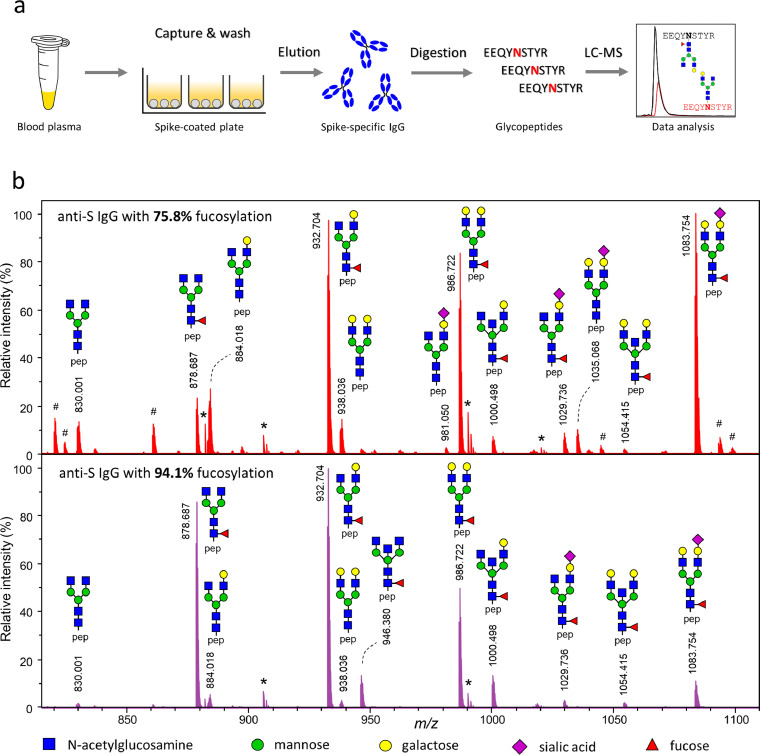
Immunoglobulin G (IgG) antibodies serve a crucial immuno-protective function mediated by IgG Fc receptors (FcγR). Absence of fucose on the highly conserved N-linked glycan in the IgG Fc domain strongly enhances IgG binding and activation of myeloid and natural killer (NK) cell FcγRs. Although afucosylated IgG can provide increased protection (malaria and HIV), it also boosts immunopathologies in alloimmune diseases, COVID-19 and dengue fever. Quantifying IgG fucosylation currently requires sophisticated methods such as liquid chromatography-mass spectrometry (LC-MS) and extensive analytical skills reserved to highly specialized laboratories.
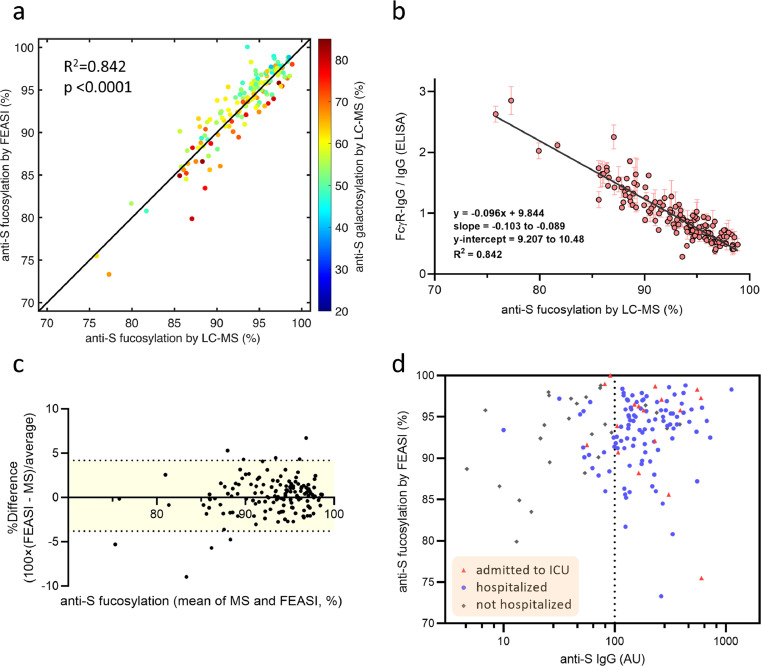
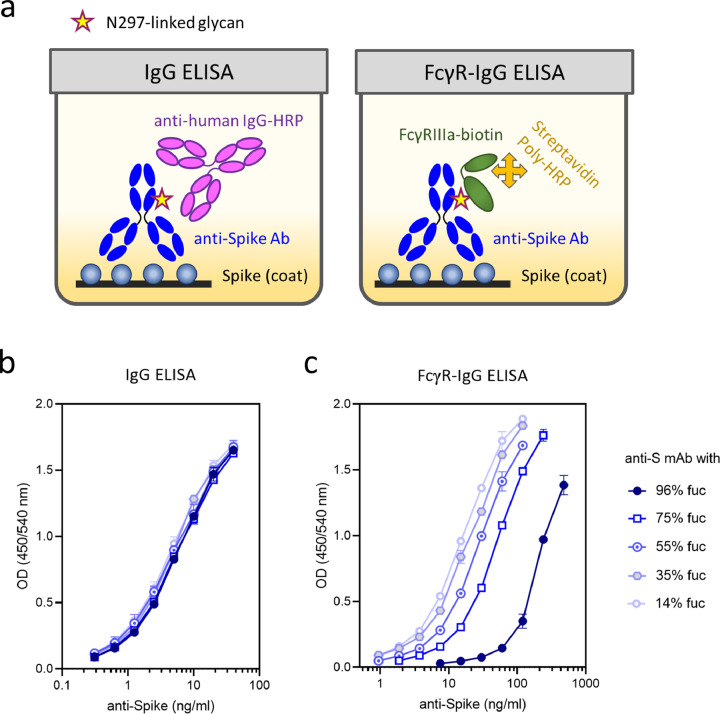
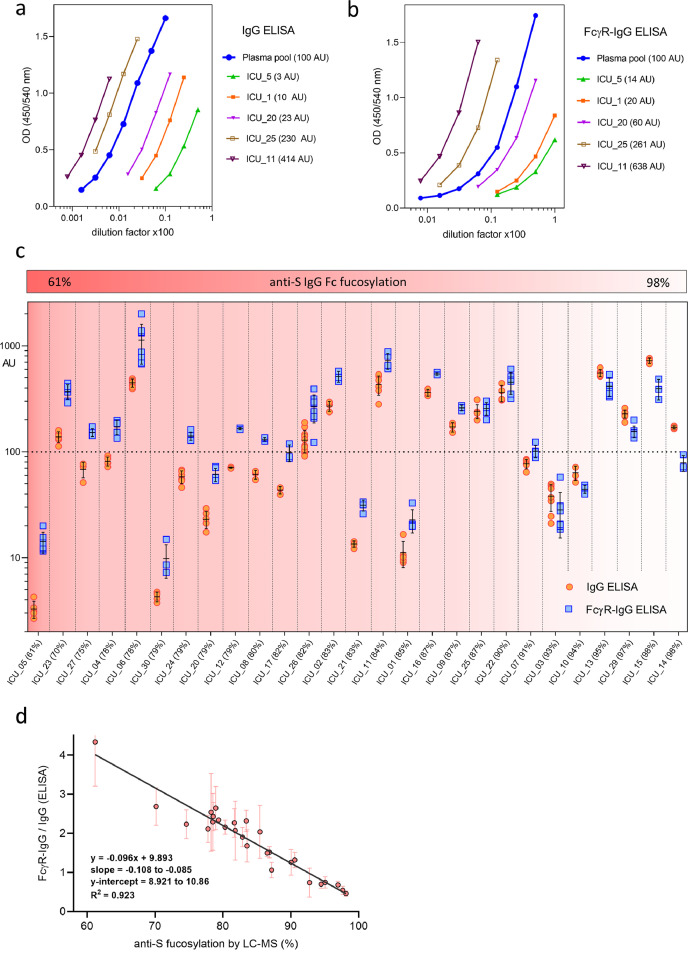
Here, we introduce the Fucose-sensitive Enzyme-linked immunosorbent assay (ELISA) for Antigen-Specific IgG (FEASI), an immunoassay capable of simultaneously quantitating and qualitatively determining IgG responses. FEASI is a two-tier immunoassay; the first assay is used to quantify antigen-specific IgG (IgG ELISA), while the second gives FcγRIIIa binding-dependent readout which is highly sensitive to both the IgG quantity and the IgG Fc fucosylation (FcγR-IgG ELISA).
IgG Fc fucosylation levels, independently determined by LC-MS and FEASI, in COVID-19 responses to the spike (S) antigen, correlated very strongly by simple linear regression (R=0.93, p < 0.0001). The FEASI method was then used to quantify IgG levels and fucosylation in COVID-19 convalescent plasma which was independently validated by LC-MS.
FEASI can be reliably implemented to measure relative and absolute IgG Fc fucosylation and quantify binding of antigen-specific IgG to FcγR in a high-throughput manner accessible to all diagnostic and research laboratories.
This work was funded by the Stichting Sanquin Bloedvoorziening (PPOC 19-08 and SQI00041) and ZonMW 10430 01 201 0021.
免疫球蛋白 G(IgG)抗体通过 IgG Fc 受体(FcγR)发挥关键的免疫保护功能。在 IgG Fc 结构域中高度保守的 N 连接聚糖上缺乏岩藻糖可显著增强 IgG 与髓系和自然杀伤(NK)细胞 FcγR 的结合和激活。虽然去岩藻糖 IgG 可以提供更强的保护(疟疾和 HIV),但它也会在同种免疫疾病、COVID-19 和登革热中引发免疫病理学。目前,定量 IgG 岩藻糖基化需要复杂的方法,如液相色谱-质谱联用(LC-MS)和广泛的分析技能,这些都保留给高度专业化的实验室。
在这里,我们介绍了用于抗原特异性 IgG 的岩藻糖敏感酶联免疫吸附测定(FEASI),这是一种能够同时定量和定性测定 IgG 反应的免疫测定法。FEASI 是一种两阶段免疫测定法;第一阶段用于定量抗原特异性 IgG(IgG ELISA),而第二阶段则提供 FcγRIIIa 结合依赖性读数,该读数对 IgG 数量和 IgG Fc 岩藻糖基化高度敏感(FcγR-IgG ELISA)。
通过 LC-MS 和 FEASI 独立确定的 COVID-19 对刺突(S)抗原的 IgG Fc 岩藻糖基化水平通过简单线性回归非常强地相关(R=0.93,p<0.0001)。然后,FEASI 方法用于定量 COVID-19 恢复期血浆中的 IgG 水平和岩藻糖基化,该方法通过 LC-MS 独立验证。
FEASI 可可靠地用于以高通量方式测量相对和绝对 IgG Fc 岩藻糖基化,并定量抗原特异性 IgG 与 FcγR 的结合,所有诊断和研究实验室都可以使用。
这项工作得到了 Stichting Sanquin Bloedvoorziening(PPOC 19-08 和 SQI00041)和 ZonMW 10430 01 201 0021 的资助。