
使用负载在TiO上的铑金属颗粒对水溶液中的硒酸盐(VI)进行还原去除。
Reductive removal of selenate (VI) in aqueous solution using rhodium metal particles supported on TiO.
作者信息
Oshima Kazumasa, Ito Kyogo, Konishi Eriko, Yamamoto Tsuyoshi, Fukai Jun, Kajiwara Toshihisa, Kishida Masahiro
机构信息
Department of Chemical Engineering, Graduate School of Engineering, Kyushu University Motooka 744, Nishi-ku Fukuoka 819-0395 Japan
出版信息
RSC Adv. 2022 Jun 15;12(28):17655-17660. doi: 10.1039/d2ra02889a. eCollection 2022 Jun 14.
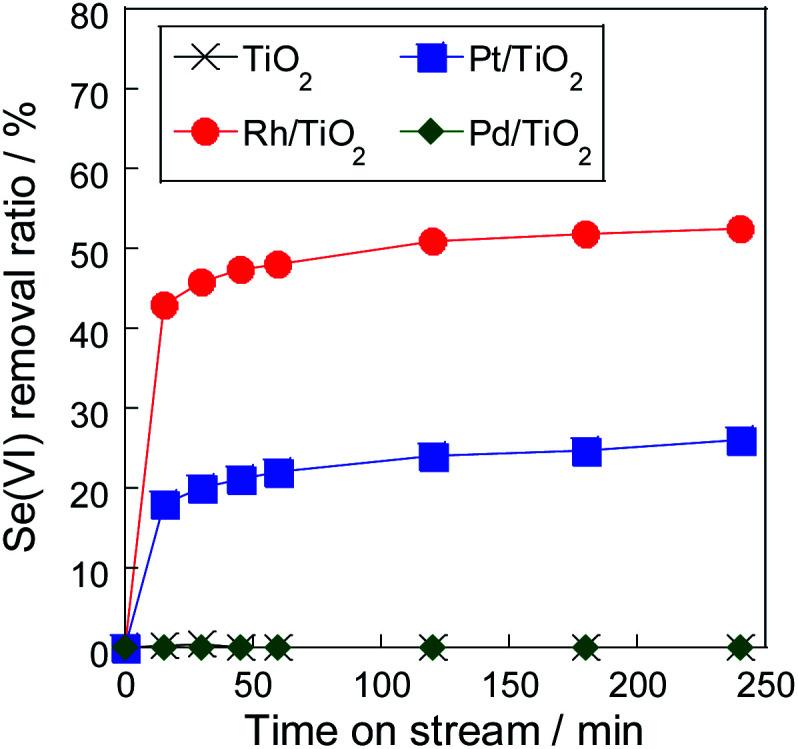
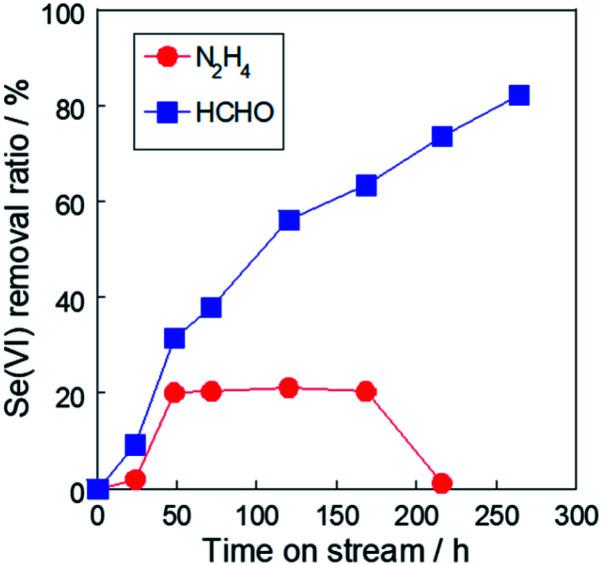
Selenium and its compounds in high concentration are toxic for humans, especially selenate (VI) is the most toxic due to its high solubility in water. To promote the reductive reaction of Se(vi) to Se(iv) or Se(0), which is relatively easy to remove in water, noble metal particles were added as reaction sites with a reductant. The highest removal performance of selenate in aqueous solution was achieved using rhodium particles supported on TiO (Rh/TiO). Selenate was rapidly reduced with hydrazine on the metal particle, leading to a selenium deposition on the particle inhibiting the stable reductive reaction. On the other hand, when a weaker reductant such as formaldehyde was used for the selenate reduction, the selenium deposition was suppressed due to its low reactivity, resulting in a stable reductive reaction of selenate in water.
高浓度的硒及其化合物对人体有毒,尤其是硒酸盐(VI),因其在水中的高溶解度而毒性最强。为了促进Se(VI)向Se(IV)或Se(0)的还原反应,这两种形态在水中相对容易去除,添加了贵金属颗粒作为与还原剂反应的位点。使用负载在TiO上的铑颗粒(Rh/TiO)实现了水溶液中硒酸盐的最高去除性能。硒酸盐在金属颗粒上被肼迅速还原,导致颗粒上有硒沉积,从而抑制了稳定的还原反应。另一方面,当使用较弱的还原剂如甲醛进行硒酸盐还原时,由于其低反应性,硒的沉积受到抑制,从而在水中实现了稳定的硒酸盐还原反应。




 Zotero 插件