
重型β-地中海贫血:高钙尿症的患病率、危险因素和临床后果。
Beta-thalassaemia major: Prevalence, risk factors and clinical consequences of hypercalciuria.
机构信息
Department of Medical Sciences, Section of Endocrinology and Internal Medicine, University of Ferrara, Ferrara, Italy.
Department of Medicine, Day Hospital of Thalassemia, AOU of Ferrara, Ferrara, Italy.
出版信息
Br J Haematol. 2022 Sep;198(5):903-911. doi: 10.1111/bjh.18345. Epub 2022 Jun 29.
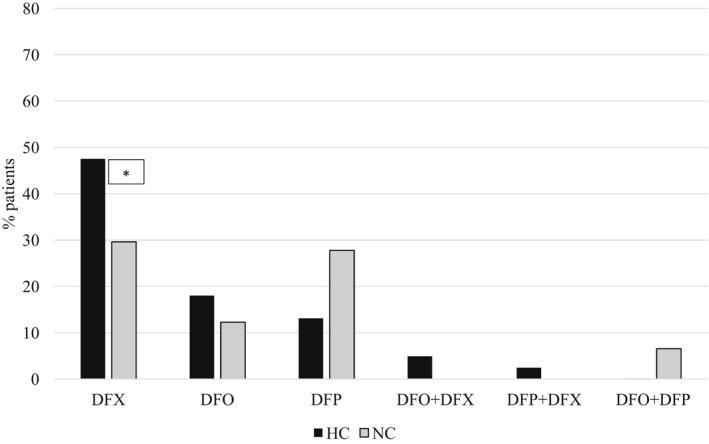
Regular transfusion and chelation therapy produces increased life expectancy in thalassaemic patients who may develop new complications. Since few data are available regarding hypercalciuria in β-thalassaemia major (TM), the aim of our study was to evaluate its prevalence, risk factors and clinical consequences. We enrolled 176 adult TM patients followed at the Center of Thalassemia of Ferrara. Hypercalciuria was defined by a calciuria of 4 mg/kg/day or more in a 24-h urine sample. Anamnestic, biochemical and radiological data were collected. Hypercalciuria prevalence was reported in 69.3% of patients (females 52.5%). Hypercalciuric (HC) patients used deferasirox (DFX) more often than normocalciuric (NC) patients (47.5% vs 29.6%; p < 0.05). In HC subjects plasma parathyroid hormone (PTH) (24.1 ± 10.4 vs 30.1 ± 13.2 pg/ml) and phosphate levels (3.6 ± 0.5 vs 3.8 ± 0.7 mg/dl) were lower, whereas serum calcium (9.6 ± 0.4 vs 9.4 ± 0.4 mg/dl) and urinary 24-h phosphaturia (0.9 ± 0.4 vs 0.6 ± 0.3 g/day) were higher as compared to NC patients (p < 0.05 for all comparisons). Supplementation with oral calcium and cholecalciferol was similar between the groups. A higher rate of kidney stones was present in HC (14.8%) versus NC patients (3.7%) (p < 0.05). Hypercalciuria is a frequent complication in adequately treated adult TM patients. Hypercalciuria prevalence is increased in DFX users whereas haemoglobin level or calcium supplements play no role. A significant proportion of HC patients developed kidney stones.
定期输血和螯合疗法可延长可能出现新并发症的地中海贫血患者的预期寿命。由于关于重型β地中海贫血(TM)患者高钙尿症的数据很少,我们的研究目的是评估其患病率、危险因素和临床后果。我们招募了在费拉拉地中海贫血中心接受治疗的 176 名成年 TM 患者。24 小时尿液样本中钙排泄量达到 4mg/kg/天或更高定义为高钙尿症。收集了病史、生化和放射学数据。报告称 69.3%的患者(女性为 52.5%)患有高钙尿症。高钙尿组(HC)患者比正常钙尿组(NC)患者更常使用地拉罗司(DFX)(47.5%比 29.6%;p<0.05)。在 HC 患者中,血浆甲状旁腺激素(PTH)(24.1±10.4 比 30.1±13.2pg/ml)和磷酸盐水平(3.6±0.5 比 3.8±0.7mg/dl)较低,而血清钙(9.6±0.4 比 9.4±0.4mg/dl)和 24 小时尿磷排泄量(0.9±0.4 比 0.6±0.3g/天)较高(所有比较均 p<0.05)。两组患者的口服钙和胆钙化醇补充剂相似。HC 组(14.8%)肾结石发生率高于 NC 组(3.7%)(p<0.05)。高钙尿症是充分治疗的成年 TM 患者的常见并发症。DFX 使用者中高钙尿症的患病率增加,而血红蛋白水平或钙补充剂则没有作用。相当一部分 HC 患者发生了肾结石。
 Zotero 插件