
人群水平影响与成本效益的连续血糖监测和间歇性扫描连续血糖监测技术为成年人与 1 型糖尿病在加拿大:一个建模研究。
Population-Level Impact and Cost-effectiveness of Continuous Glucose Monitoring and Intermittently Scanned Continuous Glucose Monitoring Technologies for Adults With Type 1 Diabetes in Canada: A Modeling Study.
机构信息
School of Kinesiology and Health Science, York University, Toronto, Canada.
Division of Endocrinology, Department of Medicine, University of Toronto, Toronto, Canada.
出版信息
Diabetes Care. 2022 Sep 1;45(9):2012-2019. doi: 10.2337/dc21-2341.
OBJECTIVE
Maintaining healthy glucose levels is critical for the management of type 1 diabetes (T1D), but the most efficacious and cost-effective approach (capillary self-monitoring of blood glucose [SMBG] or continuous [CGM] or intermittently scanned [isCGM] glucose monitoring) is not clear. We modeled the population-level impact of these three glucose monitoring systems on diabetes-related complications, mortality, and cost-effectiveness in adults with T1D in Canada.
RESEARCH DESIGN AND METHODS
We used a Markov cost-effectiveness model based on nine complication states for adults aged 18-64 years with T1D. We performed the cost-effectiveness analysis from a single-payer health care system perspective over a 20-year horizon, assuming a willingness-to-pay threshold of CAD 50,000 per quality-adjusted life-year (QALY). Primary outcomes were the number of complications and deaths and the incremental cost-effectiveness ratio (ICER) of CGM and isCGM relative to SMBG.
RESULTS
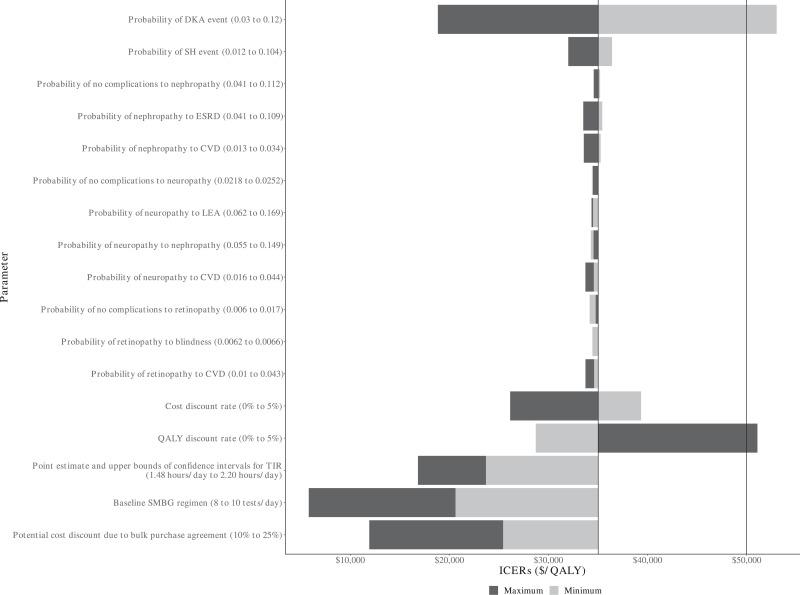
An initial cohort of 180,000 with baseline HbA1c of 8.1% was used to represent all Canadians aged 18-64 years with T1D. Universal SMBG use was associated with ∼11,200 people (6.2%) living without complications and ∼89,400 (49.7%) deaths after 20 years. Universal CGM use was associated with an additional ∼7,400 (4.1%) people living complications free and ∼11,500 (6.4%) fewer deaths compared with SMBG, while universal isCGM use was associated with ∼3,400 (1.9%) more people living complications free and ∼4,600 (2.6%) fewer deaths. Relative to SMBG, CGM and isCGM had ICERs of CAD 35,017/QALY and 17,488/QALY, respectively.
CONCLUSIONS
Universal use of CGM or isCGM in the Canadian T1D population is anticipated to reduce diabetes-related complications and mortality at an acceptable cost-effectiveness threshold.
目的
对于 1 型糖尿病(T1D)患者来说,维持健康的血糖水平至关重要,但最有效和最具成本效益的方法(毛细血管自我监测血糖[SMBG]或连续[CGM]或间歇性扫描[isCGM]血糖监测)尚不清楚。我们在加拿大建立了一个 T1D 成人患者群体模型,旨在评估这三种血糖监测系统对糖尿病相关并发症、死亡率和成本效益的影响。
研究设计和方法
我们使用了一种基于 9 种并发症状态的 Markov 成本效益模型,用于 18-64 岁的 T1D 成人患者。我们从单一支付者医疗保健系统的角度,在 20 年的时间内进行了成本效益分析,假设每增加一个质量调整生命年(QALY)的意愿支付阈值为 50000 加元。主要结果是 CGM 和 isCGM 相对于 SMBG 的并发症和死亡人数以及增量成本效益比(ICER)。
结果
我们使用一个初始的 18 万人队列,基线糖化血红蛋白(HbA1c)为 8.1%,代表所有 18-64 岁的加拿大 T1D 患者。普遍使用 SMBG 与大约 11200 人(6.2%)没有并发症和大约 89400 人(49.7%)在 20 年后死亡有关。与 SMBG 相比,普遍使用 CGM 与大约另外 7400 人(4.1%)没有并发症和大约 11500 人(6.4%)更少的死亡有关,而普遍使用 isCGM 与大约 3400 人(1.9%)更多没有并发症和大约 4600 人(2.6%)更少的死亡有关。与 SMBG 相比,CGM 和 isCGM 的增量成本效益比(ICER)分别为 35017 加元/QALY 和 17488 加元/QALY。
结论
在加拿大 T1D 人群中普遍使用 CGM 或 isCGM,预计将在可接受的成本效益阈值内降低糖尿病相关并发症和死亡率。


 Zotero 插件