
[Ga L ]金属笼对纳扎罗夫环化反应的催化作用:配合物醇的碱性是关键。
Catalysis by [Ga L ] Metallocage on the Nazarov Cyclization: The Basicity of Complexed Alcohol is Key.
机构信息
Departament de Química and Centro de Innovación en Química Avanzada (ORFEO-CINQA), Universitat Autònoma de Barcelona, 08193, Cerdanyola del Valles, Barcelona, Catalonia, Spain.
Department of Organic Chemistry, Arrhenius Laboratory, Stockholm University, 10691, Stockholm, Sweden.
出版信息
Chemistry. 2022 Oct 26;28(60):e202201792. doi: 10.1002/chem.202201792. Epub 2022 Sep 1.
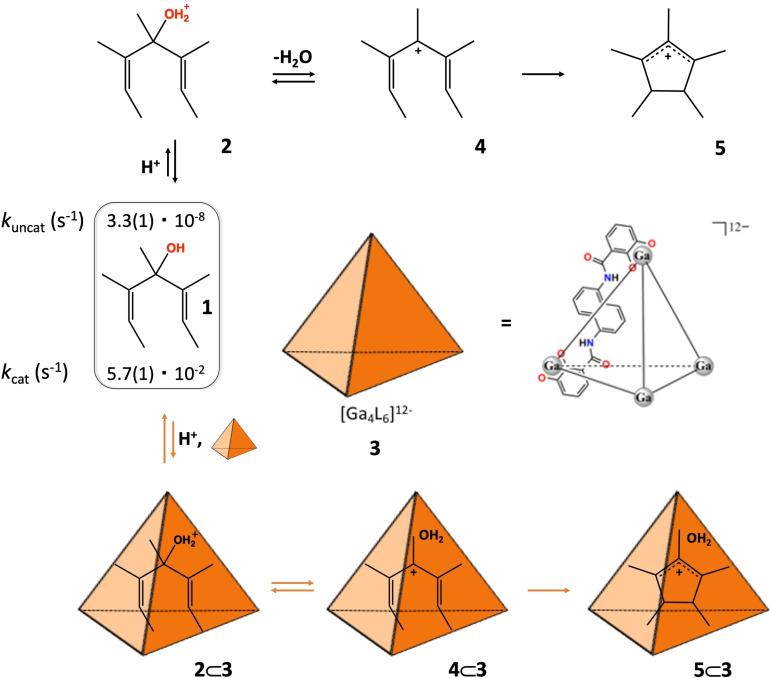
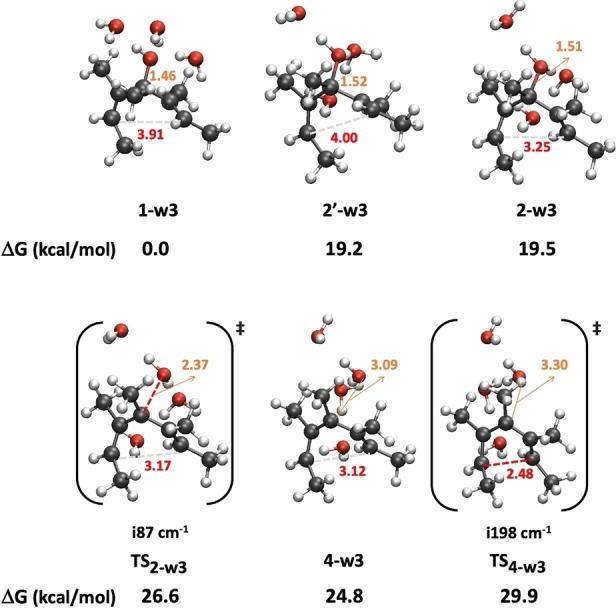
The Nazarov cyclization is investigated in solution and within K [Ga L ] supramolecular organometallic cage by means of computational methods. The reaction needs acidic condition in solution but works at neutral pH in the presence of the metallocage. The reaction steps for the process are analogous in both media: (a) protonation of the alcohol group, (b) water loss and (c) cyclization. The relative Gibbs energies of all the steps are affected by changing the environment from solvent to the metallocage. The first step in the mechanism, the alcohol protonation, turns out to be the most critical one for the acceleration of the reaction inside the metallocage. In order to calculate the relative stability of protonated alcohol inside the cavity, we propose a computational scheme for the calculation of basicity for species inside cavities and can be of general use. These results are in excellent agreement with the experiments, identifying key steps of catalysis and providing an in-depth understanding of the impact of the metallocage on all the reaction steps.
通过计算方法研究了 Nazarov 环化反应在溶液中和 K [GaL] 超分子金属有机笼内的情况。反应在溶液中需要酸性条件,但在金属笼存在下在中性 pH 值下进行。这两种介质中的反应步骤相似:(a)醇基的质子化,(b)失水和(c)环化。所有步骤的相对吉布斯能都受到从溶剂到金属笼环境变化的影响。反应机制的第一步,即醇的质子化,对于反应在金属笼内的加速是最关键的一步。为了计算腔内质子化醇的相对稳定性,我们提出了一种用于计算腔内物种碱性的计算方案,该方案具有通用性。这些结果与实验非常吻合,确定了催化的关键步骤,并深入了解了金属笼对所有反应步骤的影响。





 Zotero 插件