• 文献检索
  • 文档翻译
  • 深度研究
  • 学术资讯
  • Suppr Zotero 插件Zotero 插件
  • 邀请有礼
  • 套餐&价格
  • 历史记录
应用&插件
Suppr Zotero 插件Zotero 插件浏览器插件Mac 客户端Windows 客户端微信小程序
定价
高级版会员购买积分包购买API积分包
服务
文献检索文档翻译深度研究API 文档MCP 服务
关于我们
关于 Suppr公司介绍联系我们用户协议隐私条款
关注我们

Suppr 超能文献

核心技术专利:CN118964589B侵权必究
粤ICP备2023148730 号-1Suppr @ 2026

文献检索

告别复杂PubMed语法,用中文像聊天一样搜索,搜遍4000万医学文献。AI智能推荐,让科研检索更轻松。

立即免费搜索

文件翻译

保留排版,准确专业,支持PDF/Word/PPT等文件格式,支持 12+语言互译。

免费翻译文档

深度研究

AI帮你快速写综述,25分钟生成高质量综述,智能提取关键信息,辅助科研写作。

立即免费体验

非酒精性脂肪性肝炎患者肝移植后复发肝细胞癌发生率降低:倾向评分匹配分析。

Reduced Rates of Post-Transplant Recurrent Hepatocellular Carcinoma in Non-Alcoholic Steatohepatitis: A Propensity Score Matched Analysis.

机构信息

Department of Surgery, Thomas Jefferson University Hospital, Jefferson University Hospitals, Philadelphia, PA, United States.

Department of Gastroenterology, Thomas Jefferson University Hospital, Jefferson University Hospitals, Philadelphia, PA, United States.

出版信息

Transpl Int. 2022 Jul 5;35:10175. doi: 10.3389/ti.2022.10175. eCollection 2022.

DOI:10.3389/ti.2022.10175
PMID:35865863
原文链接:https://pmc.ncbi.nlm.nih.gov/articles/PMC9294152/
Abstract

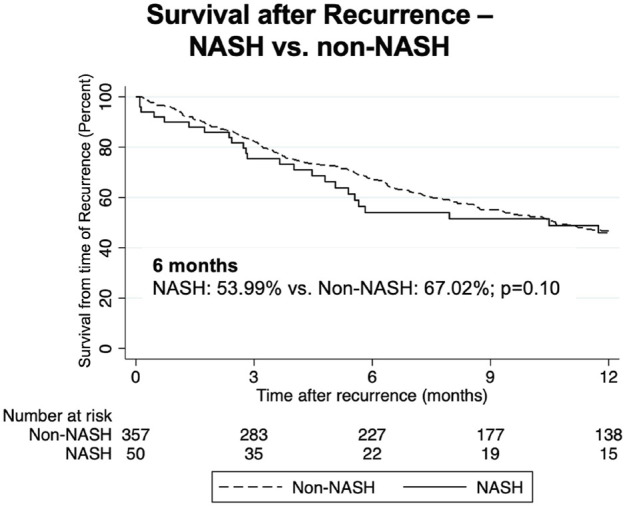
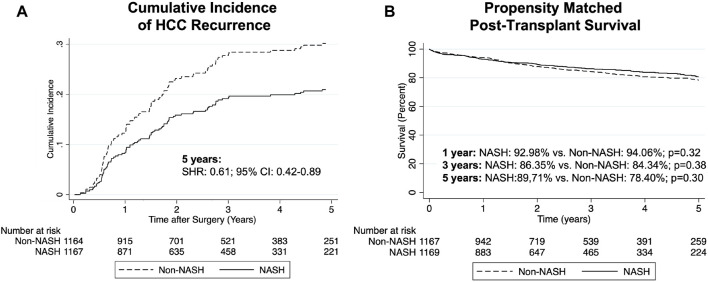
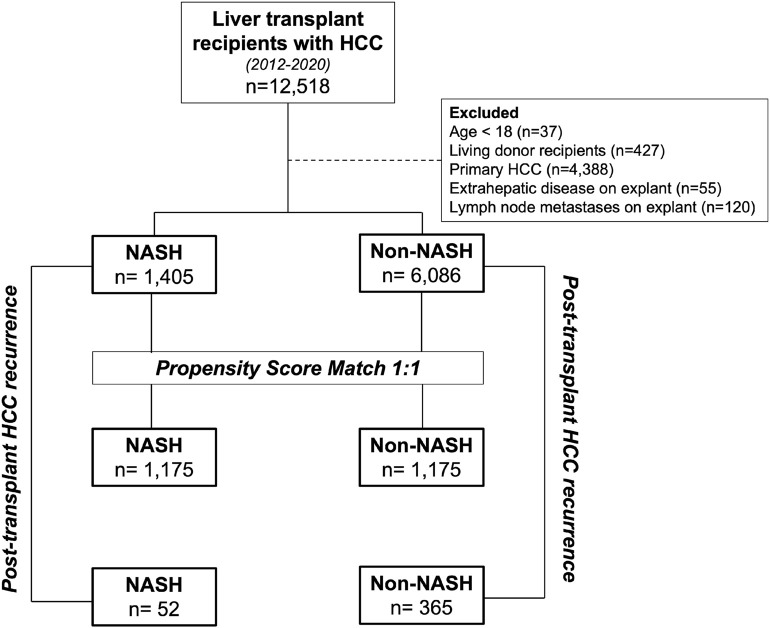
Non-alcoholic steatohepatitis (NASH)-related hepatocellular carcinoma (HCC) has become the second leading cause of HCC-related liver transplantation in the United States. This study investigated post-transplant recurrence and survival for patients transplanted for NASH-related HCC compared to non-NASH HCC etiologies. Retrospective review of the United Network for Organ Sharing (UNOS) Organ Procurement and Transplantation Network (OPTN) database identified 7,461 patients with HCC-1,405 with underlying NASH and 6,086 with non-NASH underlying diseases. After propensity score matching (PSM) to account for patient- and tumor-related confounders 1,175 remained in each group. Primary outcomes assessed were recurrence rate and recurrence-free survival. Recurrent malignancy at 5 years post-transplant was lower in NASH compared to non-NASH patients (5.80 vs. 9.41%, = 0.01). Recurrence-free survival, however, was similar at 5 years between groups. Patients with NASH-related HCC were less likely to have post-transplant recurrence than their non-NASH counterparts, although recurrence-free survival was similar at 5 years.

摘要

非酒精性脂肪性肝炎(NASH)相关肝细胞癌(HCC)已成为美国 HCC 相关肝移植的第二大主要原因。本研究调查了与非 NASH HCC 病因相比,移植治疗 NASH 相关 HCC 患者的移植后复发和生存情况。对美国器官共享联合网络(UNOS)器官获取和移植网络(OPTN)数据库的回顾性分析确定了 7461 例 HCC 患者,其中 1405 例为 NASH 基础疾病,6086 例为非 NASH 基础疾病。在对患者和肿瘤相关混杂因素进行倾向评分匹配(PSM)后,每组仍有 1175 例。主要结局评估为复发率和无复发生存率。移植后 5 年时,NASH 患者的复发性恶性肿瘤发生率低于非 NASH 患者(5.80% vs. 9.41%, = 0.01)。然而,两组之间 5 年的无复发生存率相似。与非 NASH 患者相比,NASH 相关 HCC 患者的移植后复发可能性较小,但 5 年无复发生存率相似。
https://cdn.ncbi.nlm.nih.gov/pmc/blobs/2154/9294152/2158635bef68/ti-35-10175-g003.jpg
https://cdn.ncbi.nlm.nih.gov/pmc/blobs/2154/9294152/41dfbe528387/ti-35-10175-g001.jpg
https://cdn.ncbi.nlm.nih.gov/pmc/blobs/2154/9294152/2236b12b8035/ti-35-10175-g002.jpg
https://cdn.ncbi.nlm.nih.gov/pmc/blobs/2154/9294152/2158635bef68/ti-35-10175-g003.jpg
https://cdn.ncbi.nlm.nih.gov/pmc/blobs/2154/9294152/41dfbe528387/ti-35-10175-g001.jpg
https://cdn.ncbi.nlm.nih.gov/pmc/blobs/2154/9294152/2236b12b8035/ti-35-10175-g002.jpg
https://cdn.ncbi.nlm.nih.gov/pmc/blobs/2154/9294152/2158635bef68/ti-35-10175-g003.jpg

相似文献

1
Reduced Rates of Post-Transplant Recurrent Hepatocellular Carcinoma in Non-Alcoholic Steatohepatitis: A Propensity Score Matched Analysis.非酒精性脂肪性肝炎患者肝移植后复发肝细胞癌发生率降低:倾向评分匹配分析。
Transpl Int. 2022 Jul 5;35:10175. doi: 10.3389/ti.2022.10175. eCollection 2022.
2
Post-transplantation outcome in non-alcoholic steatohepatitis cirrhosis: Comparison with alcoholic cirrhosis.肝移植术后非酒精性脂肪性肝炎肝硬化的转归:与酒精性肝硬化的比较。
Ann Hepatol. 2019 Nov-Dec;18(6):855-861. doi: 10.1016/j.aohep.2019.06.014. Epub 2019 Sep 6.
3
Outcomes of liver transplantation in non-alcoholic steatohepatitis (NASH) versus non-NASH associated hepatocellular carcinoma.非酒精性脂肪性肝炎(NASH)与非 NASH 相关的肝细胞癌患者行肝移植的结局。
HPB (Oxford). 2023 May;25(5):556-567. doi: 10.1016/j.hpb.2023.01.019. Epub 2023 Feb 3.
4
Outcomes of liver transplantation for non-alcoholic steatohepatitis: A European Liver Transplant Registry study.非酒精性脂肪性肝炎肝移植的结果:一项欧洲肝移植登记研究。
J Hepatol. 2019 Aug;71(2):313-322. doi: 10.1016/j.jhep.2019.04.011. Epub 2019 May 7.
5
Liver Transplantation for NASH-Related Hepatocellular Carcinoma Versus Non-NASH Etiologies of Hepatocellular Carcinoma.肝移植治疗非酒精性脂肪性肝炎相关肝细胞癌与非非酒精性脂肪性肝炎相关肝细胞癌的比较。
Transplantation. 2018 Apr;102(4):640-647. doi: 10.1097/TP.0000000000002043.
6
Higher Risk of Tumor Recurrence in NASH-Related Hepatocellular Carcinoma Following Curative Resection.NASH 相关肝细胞癌根治性切除术后肿瘤复发风险增加。
Viruses. 2022 Oct 31;14(11):2427. doi: 10.3390/v14112427.
7
Liver transplantation recipients with nonalcoholic steatohepatitis have lower risk hepatocellular carcinoma.患有非酒精性脂肪性肝炎的肝移植受者患肝细胞癌的风险较低。
Liver Transpl. 2017 Aug;23(8):1015-1022. doi: 10.1002/lt.24764. Epub 2017 Jun 26.
8
A comparison of survival and pathologic features of non-alcoholic steatohepatitis and hepatitis C virus patients with hepatocellular carcinoma.非酒精性脂肪性肝炎和丙型肝炎病毒患者肝细胞癌的生存和病理特征比较。
World J Gastroenterol. 2012 Aug 21;18(31):4145-9. doi: 10.3748/wjg.v18.i31.4145.
9
NASH Leading Cause of Liver Transplant in Women: Updated Analysis of Indications For Liver Transplant and Ethnic and Gender Variances.NASH 成为女性肝移植首要原因:肝移植适应证的最新分析及种族和性别差异
Am J Gastroenterol. 2018 Nov;113(11):1649-1659. doi: 10.1038/s41395-018-0088-6. Epub 2018 Jun 8.
10
Lower rates of receiving model for end-stage liver disease exception and longer time to transplant among nonalcoholic steatohepatitis hepatocellular carcinoma.非酒精性脂肪性肝炎肝细胞癌患者接受终末期肝病模型例外情况的比例较低,且移植等待时间较长。
Liver Transpl. 2016 Oct;22(10):1356-66. doi: 10.1002/lt.24507.

引用本文的文献

1
Liver transplantation for NASH-related hepatocellular carcinoma versus non-NASH etiologies of hepatocellular carcinoma: A systematic review and meta-analysis.非酒精性脂肪性肝炎相关肝细胞癌与非非酒精性脂肪性肝炎病因的肝细胞癌的肝移植:一项系统评价和荟萃分析。
PLoS One. 2025 Mar 19;20(3):e0317730. doi: 10.1371/journal.pone.0317730. eCollection 2025.

本文引用的文献

1
Direct-acting antiviral agents and risk of Hepatocellular carcinoma: Critical appraisal of the evidence.直接作用抗病毒药物与肝细胞癌风险:证据的批判性评估。
Ann Hepatol. 2022 Jan;27 Suppl 1:100568. doi: 10.1016/j.aohep.2021.100568. Epub 2021 Oct 23.
2
Hepatocellular carcinoma: old friends and new tricks.肝细胞癌:旧友与新招。
Exp Mol Med. 2020 Dec;52(12):1898-1907. doi: 10.1038/s12276-020-00527-1. Epub 2020 Dec 2.
3
Hepatocellular carcinoma: considerations for managed care professionals.肝细胞癌:管理式医疗专业人士的考虑因素。
Am J Manag Care. 2020 Oct;26(10 Suppl):S220-S226. doi: 10.37765/ajmc.2020.88513.
4
Hepatocellular Carcinoma-The Influence of Immunoanatomy and the Role of Immunotherapy.肝细胞癌——免疫解剖学的影响和免疫治疗的作用。
Int J Mol Sci. 2020 Sep 15;21(18):6757. doi: 10.3390/ijms21186757.
5
Impact of Type 2 Diabetes on Oncologic Outcomes of Hepatocellular Carcinomas in Non-Cirrhotic, Non-alcoholic Steatohepatitis: a Matched-Pair Analysis.2 型糖尿病对非肝硬化、非酒精性脂肪性肝炎肝细胞癌患者肿瘤学结局的影响:一项配对分析。
J Gastrointest Surg. 2021 May;25(5):1193-1202. doi: 10.1007/s11605-020-04628-0. Epub 2020 May 6.
6
Post-transplantation outcome in non-alcoholic steatohepatitis cirrhosis: Comparison with alcoholic cirrhosis.肝移植术后非酒精性脂肪性肝炎肝硬化的转归:与酒精性肝硬化的比较。
Ann Hepatol. 2019 Nov-Dec;18(6):855-861. doi: 10.1016/j.aohep.2019.06.014. Epub 2019 Sep 6.
7
Sorafenib and metformin: to be, or not to be, that is the question.索拉非尼和二甲双胍:是,还是不是,这是个问题。
Hepatobiliary Surg Nutr. 2019 Aug;8(4):411-413. doi: 10.21037/hbsn.2019.04.01.
8
Efficacy of Sorafenib for the Treatment of Post-Transplant Hepatocellular Carcinoma Recurrence.索拉非尼治疗肝移植后肝细胞癌复发的疗效。
J Korean Med Sci. 2018 Oct 12;33(45):e283. doi: 10.3346/jkms.2018.33.e283. eCollection 2018 Nov 5.
9
Liver Transplantation (LT) for Cryptogenic Cirrhosis (CC) and Nonalcoholic Steatohepatitis (NASH) Cirrhosis: Data from the Scientific Registry of Transplant Recipients (SRTR): 1994 to 2016.隐源性肝硬化(CC)和非酒精性脂肪性肝炎(NASH)肝硬化的肝移植(LT):来自移植受者科学登记处(SRTR)的数据:1994年至2016年。
Medicine (Baltimore). 2018 Aug;97(31):e11518. doi: 10.1097/MD.0000000000011518.
10
Nonalcoholic Steatohepatitis Is the Fastest Growing Cause of Hepatocellular Carcinoma in Liver Transplant Candidates.非酒精性脂肪性肝炎是肝移植候选者中肝细胞癌增长最快的病因。
Clin Gastroenterol Hepatol. 2019 Mar;17(4):748-755.e3. doi: 10.1016/j.cgh.2018.05.057. Epub 2018 Jun 14.