
NGC1818 unveils the origin of the extended main-sequence turn-off in young Magellanic Clouds clusters.
作者信息
Cordoni Giacomo, Milone Antonino P, Marino Anna F, Cignoni Michele, Lagioia Edoardo P, Tailo Marco, Carlos Marília, Dondoglio Emanuele, Jang Sohee, Mohandasan Anjana, Legnardi Maria V
机构信息
Dipartimento di Fisica e Astronomia "Galileo Galilei", Università degli Studi di Padova, Padova, IT-35122, Italy.
Istituto Nazionale di Astrofisica, Osservatorio Astronomico di Padova, Padova, IT-35122, Italy.
出版信息
Nat Commun. 2022 Jul 26;13(1):4325. doi: 10.1038/s41467-022-31977-y.
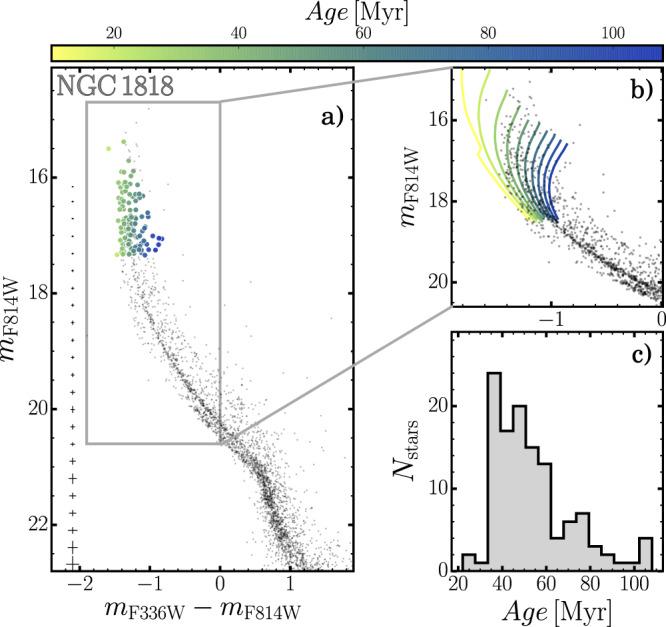
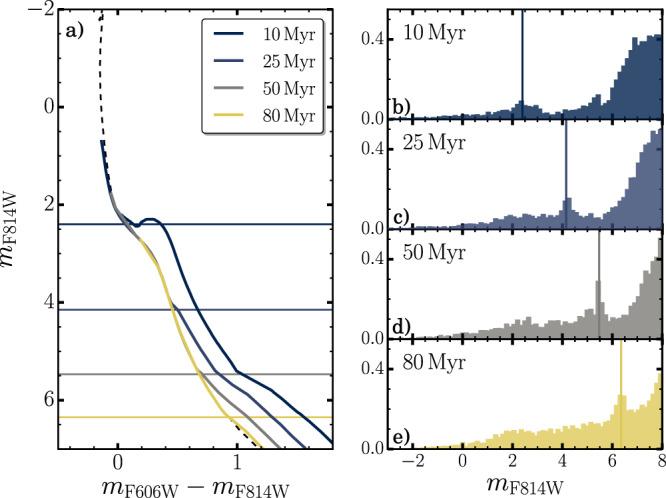
The origin of young star clusters represents a major challenge for modern stellar astrophysics. While stellar rotation partially explains the colour spread observed along main-sequence turn-offs, i.e. where stars leave the main-sequence after the exhaustion of hydrogen in their core, and the multiple main sequences in the colour-magnitude diagrams of stellar systems younger than approximately 2 Gyr, it appears that an age difference may still be required to fulfill the observational constraints. Here we introduce an alternative approach that exploits the main-sequence turn-on, i.e. the point alongside the colour-magnitude diagram where pre-main-sequence stars join the main-sequence, to disentangle between the effects of stellar rotation and age to assess the presence, or lack thereof, of prolonged star formation in the approximately 40-Myr-old cluster NGC1818. Our results provide evidence for a fast star formation, confined within 8 Myr, thus excluding age differences as responsible for the extended main-sequence turn-offs, and leading the way to alternative observational perspectives in the exploration of stellar populations in young clusters.



 Zotero 插件