
高温质子交换膜燃料电池内部温度、流量和压力的实时监测
Real-Time Monitoring of the Temperature, Flow, and Pressure Inside High-Temperature Proton Exchange Membrane Fuel Cells.
作者信息
Lee Chi-Yuan, Weng Fang-Bor, Chiu Chun-Wei, Nawale Shubham-Manoj, Lai Bo-Jui
机构信息
Department of Mechanical Engineering, Yuan Ze Fuel Cell Center, Yuan Ze University, Taoyuan 32003, Taiwan.
出版信息
Micromachines (Basel). 2022 Jun 30;13(7):1040. doi: 10.3390/mi13071040.
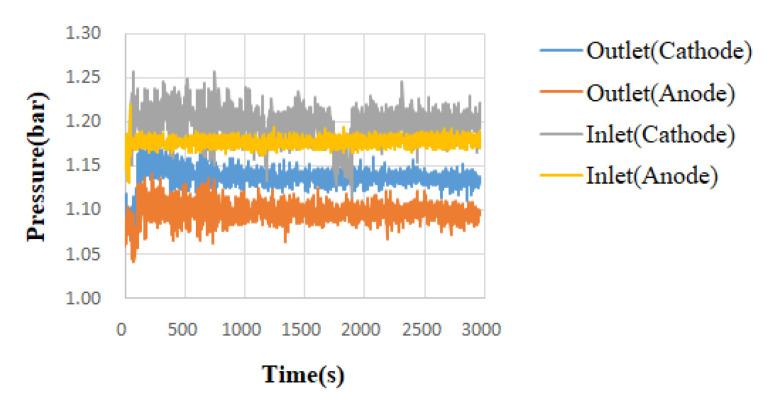
The proton exchange membrane fuel cell (PEMFC) system is a highly efficient and environmentally friendly energy conversion technology. However, the local temperature, flow, and pressure inhomogeneity within the fuel cell during the electrochemical reaction process may lead to depletion of PEMFC material and uneven fuel distribution, thus affecting the performance and service life of high-temperature PEMFCs. In this study, micromachining technology is used to develop a three-in-one flexible micro-sensor that is resistant to a high-temperature electrochemical environment (120~200 °C). Appropriate materials and process parameters are used to protect the micro-sensor from failure or damage under long-term testing, and to conduct a real-time micro-monitor of the local temperature, flow, and pressure distribution inside high-temperature PEMFCs.
质子交换膜燃料电池(PEMFC)系统是一种高效且环保的能量转换技术。然而,在电化学反应过程中,燃料电池内部的局部温度、流量和压力不均匀性可能会导致PEMFC材料耗尽以及燃料分布不均,从而影响高温PEMFC的性能和使用寿命。在本研究中,采用微加工技术开发了一种耐高温电化学环境(120~200°C)的三合一柔性微传感器。使用合适的材料和工艺参数来保护微传感器在长期测试下不会失效或损坏,并对高温PEMFC内部的局部温度、流量和压力分布进行实时微监测。




 Zotero 插件