Research and Innovation Unit of Radiology, University of Southern Denmark, Odense, Denmark.
OPEN - Open Patient data Explorative Network, Odense University Hospital, Odense, Denmark.
Medicine (Baltimore). 2022 Aug 5;101(31):e29553. doi: 10.1097/MD.0000000000029553.
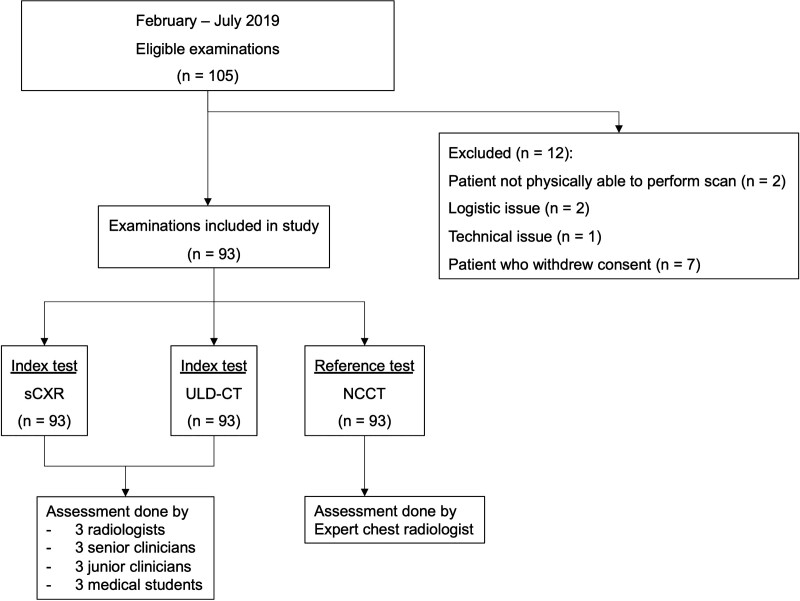
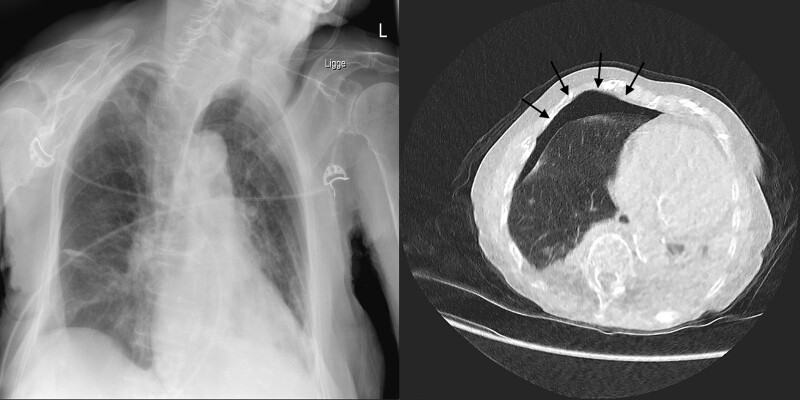
Ultra-low dose computed tomography (ULD-CT) assessed by non-radiologists in a medical Emergency Department (ED) has not been examined in previous studies. To (i) investigate intragroup agreement among attending physicians caring for ED patients (i.e., radiologists, senior- and junior clinicians) and medical students for the detection of acute lung conditions on ULD-CT and supine chest X-ray (sCXR), and (ii) evaluate the accuracy of interpretation compared to the reference standard. In this prospective study, non-traumatic patients presenting to the ED, who received an sCXR were included. Between February and July 2019, 91 patients who underwent 93 consecutive examinations were enrolled. Subsequently, a ULD-CT and non-contrast CT were performed. The ULD-CT and sCXR were assessed by 3 radiologists, 3 senior clinicians, 3 junior clinicians, and 3 medical students for pneumonia, pneumothorax, pleural effusion, and pulmonary edema. The non-contrast CT, assessed by a chest radiologist, was used as the reference standard. The results of the assessments were compared within each group (intragroup agreement) and with the reference standard (accuracy) using kappa statistics. Accuracy and intragroup agreement improved for pneumothorax on ULD-CT compared with the sCXR for all groups. Accuracy and intragroup agreement improved for pneumonia on ULD-CT when assessed by radiologists and for pleural effusion when assessed by medical students. In patients with acute lung conditions ULD-CT offers improvement in the detection of pneumonia by radiologists and the detection of pneumothorax by radiologists as well as non-radiologists compared to sCXR. Therefore, ULD-CT may be considered as an alternative first-line imaging modality to sCXR for non-traumatic patients who present to EDs.
非放射科医师在医疗急救部门(ED)进行的超低剂量计算机断层扫描(ULD-CT)在以前的研究中尚未得到检查。(i)研究照顾 ED 患者的主治医生(即放射科医生、高级和初级临床医生)和医学生在 ULD-CT 和仰卧位胸部 X 射线(sCXR)上检测急性肺部疾病的组内一致性,以及(ii)评估与参考标准相比的解释准确性。在这项前瞻性研究中,纳入了因非创伤性原因到 ED 就诊并接受 sCXR 检查的患者。2019 年 2 月至 7 月期间,共纳入了 91 名接受 93 次连续检查的患者。随后,进行了 ULD-CT 和非增强 CT 检查。3 名放射科医生、3 名高级临床医生、3 名初级临床医生和 3 名医学生对肺炎、气胸、胸腔积液和肺水肿进行了 ULD-CT 和 sCXR 评估。由胸部放射科医生评估的非增强 CT 被用作参考标准。使用 Kappa 统计数据比较每个组内的评估结果(组内一致性)和与参考标准的比较(准确性)。与 sCXR 相比,所有组的 ULD-CT 对气胸的准确性和组内一致性均有所提高。放射科医生评估的 ULD-CT 对肺炎的准确性和医学生评估的胸腔积液的组内一致性有所提高。在急性肺部疾病患者中,与 sCXR 相比,ULD-CT 可提高放射科医生对肺炎的检测以及放射科医生和非放射科医生对气胸的检测能力。因此,ULD-CT 可被视为非创伤性患者到 ED 就诊的替代一线成像方式。