
肾上腺限性 HSD3B1 遗传与激素非依赖性子宫内膜和乳腺癌亚型的关联。
Association Between Adrenal-Restrictive HSD3B1 Inheritance and Hormone-Independent Subtypes of Endometrial and Breast Cancer.
机构信息
Genitourinary Malignancies Research Center, Lerner Research Institute, Cleveland Clinic, Cleveland, OH, USA.
Department of Gynecologic Oncology, Women's Health Institute, Cleveland Clinic, Cleveland, OH, USA.
出版信息
JNCI Cancer Spectr. 2022 Sep 1;6(5). doi: 10.1093/jncics/pkac061.
BACKGROUND
The germline variant rs1047303 (HSD3B1[1245A/C]), restricting or enabling production of potent androgens and estrogens from adrenal precursors, affects outcomes of castration-resistant prostate cancer and is associated with estrogen receptor positivity in postmenopausal breast cancer. Like breast cancer, endometrial cancer is another malignancy with hormone-dependent and hormone-independent subtypes. We hypothesized that adrenal-restrictive HSD3B1 genotype would associate with hormone-independent cancer subtypes.
METHODS
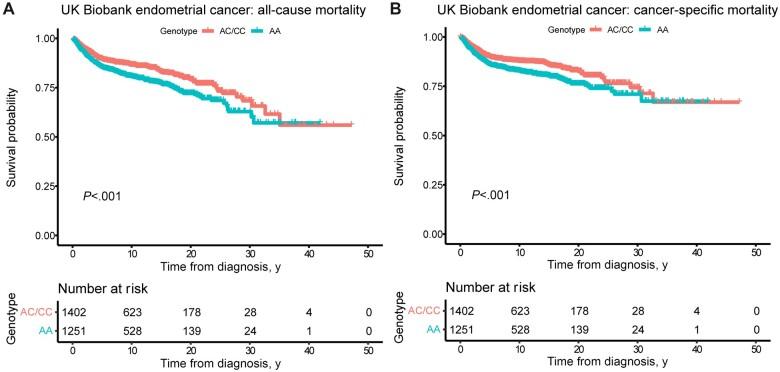
We employed a previously described classification of tumors in The Cancer Genome Atlas into genomic clusters. We determined HSD3B1 genotype frequencies by endometrial cancer genomic cluster and calculated the odds per adrenal-restrictive A allele for the largely hormone-independent copy-number (CN) high subtype vs other subtypes. An equivalent analysis was performed for the genomically similar, hormone-independent basal breast cancer subtype. Last, we performed survival analyses for UK Biobank participants with endometrial cancer by HSD3B1 genotype. All statistical tests were 2-sided.
RESULTS
The adrenal-restrictive HSD3B1(1245A) allele was associated with the CN-high endometrial cancer subtype (odds ratio [OR] = 1.63, 95% confidence interval [CI] = 1.14 to 2.32; P = .007). Similarly, HSD3B1(1245A) was associated with the basal breast cancer subtype (OR = 1.54, 95% CI = 1.13 to 2.08; P = .006). In the UK Biobank, endometrial cancer patients homozygous for HSD3B1(1245A) had worse overall (hazard ratio [HR] = 1.39, 95% CI = 1.16 to 1.68; P < .001) and cancer-specific (HR = 1.39, 95% CI = 1.14 to 1.70; P = .001) survival, consistent with the A allele being enriched in the more aggressive CN-high subtype.
CONCLUSIONS
These findings suggest roles for adrenal-restrictive vs adrenal-permissive steroidogenesis, by way of rs1047303 genotype, in the development of and/or outcomes from at least 3 commonly hormone-associated types of cancer: prostate, breast, and endometrial.
背景
种系变异 rs1047303(HSD3B1[1245A/C])限制或促进肾上腺前体产生强效雄激素和雌激素,影响去势抵抗性前列腺癌的结局,并与绝经后乳腺癌中的雌激素受体阳性相关。与乳腺癌一样,子宫内膜癌是另一种具有激素依赖性和激素非依赖性亚型的恶性肿瘤。我们假设肾上腺限制性 HSD3B1 基因型与激素非依赖性癌症亚型相关。
方法
我们采用了先前描述的癌症基因组图谱中的肿瘤分类方法,根据基因组簇确定 HSD3B1 基因型频率,并计算主要为激素非依赖性拷贝数(CN)高亚型的每一个肾上腺限制性 A 等位基因的优势比(OR)与其他亚型相比。对基因组相似的激素非依赖性基底乳腺癌亚型进行了等效分析。最后,我们对英国生物银行中患有子宫内膜癌的参与者进行了 HSD3B1 基因型的生存分析。所有统计检验均为双侧检验。
结果
肾上腺限制性 HSD3B1(1245A)等位基因与 CN 高子宫内膜癌亚型相关(OR=1.63,95%置信区间[CI]为 1.14 至 2.32;P=0.007)。同样,HSD3B1(1245A)与基底乳腺癌亚型相关(OR=1.54,95%CI 为 1.13 至 2.08;P=0.006)。在英国生物银行中,HSD3B1(1245A)纯合子的子宫内膜癌患者总生存期(HR=1.39,95%CI 为 1.16 至 1.68;P<0.001)和癌症特异性生存期(HR=1.39,95%CI 为 1.14 至 1.70;P=0.001)均较差,这与 A 等位基因在更具侵袭性的 CN 高亚型中富集一致。
结论
这些发现表明,通过 rs1047303 基因型,肾上腺限制性与肾上腺允许性甾体生成在至少 3 种常见的激素相关癌症(前列腺癌、乳腺癌和子宫内膜癌)的发生和/或结局中起作用。


 Zotero 插件