Chen Chen, Lou Min-Min, Sun Yi-Min, Luo Fang, Liu Feng-Tao, Luo Su-Shan, Wang Wen-Yuan, Wang Jian
State Key Laboratory of Medical Neurobiology, Department of Neurology and National Research Center for Aging and Medicine, Huashan Hospital, Fudan University, Shanghai, China.
State Key Laboratory of Medical Neurobiology, National Center for Neurological Disorders, Huashan Hospital, Fudan University, Shanghai, China.
Front Neurosci. 2022 Aug 11;16:879548. doi: 10.3389/fnins.2022.879548. eCollection 2022.
Phospholipase A2 Group VI (PLA2G6), encoding calcium-independent phospholipase A, has been isolated as the gene responsible for an autosomal recessive form of early-onset Parkinson's disease (namely, PARK14). Compared to idiopathic Parkinson's disease (iPD), PARK14 has several atypical clinical features. PARK14 has an earlier age at onset and is more likely to develop levodopa-induced dyskinesia. In iPD, serum metabolomics has observed alterations in several metabolic pathways that are related to disease status and clinical manifestations. This study aims to describe the serum metabolomics features of patients with PARK14.
This case-control biomarker study tested nine patients diagnosed with PARK14. Eight age and sex-matched healthy subjects were recruited as controls. To evaluate the influence of single heterozygous mutation, we enrolled eight healthy one-degree family members of patients with PARK14, two patients diagnosed with early-onset Parkinson's disease (EOPD) who had only a single heterozygous PLA2G6 mutation, and one patient with EOPD without any known pathogenic mutation.
The diagnosis of PARK14 was made according to the diagnostic criteria for Parkinson's disease (PD) and confirmed by genetic testing. To study the serum metabolic features, we analyzed participants' serum using UHPLC-QTOF/MS analysis, a well-established technology.
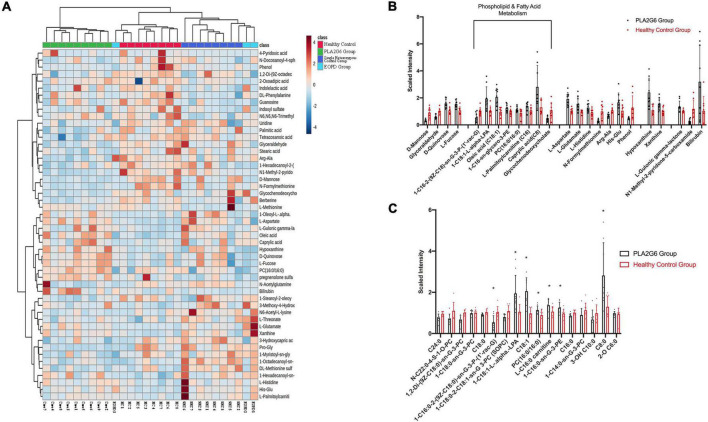
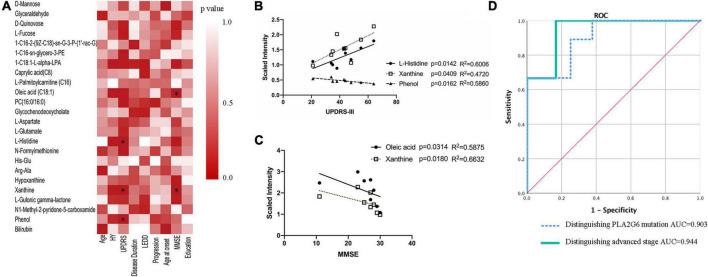
We quantified 50 compounds of metabolites from the serum of all the study subjects. Metabolites alterations in serum had good predictive accuracy for PARK14 diagnosis (AUC 0.903) and advanced stage in PARK14 (AUC 0.944). Of the 24 metabolites that changed significantly in patients' serum, eight related to lipid metabolism. Oleic acid and xanthine were associated with MMSE scores. Xanthine, L-histidine, and phenol correlated with UPDRS-III scores. Oleic acid and 1-oleoyl-L-alpha-lysophosphatidic acid could also predict the subclass of the more advanced stage in the PLA2G6 Group in ROC models.
The significantly altered metabolites can be used to differentiate PLA2G6 pathogenic mutations and predict disease severity. Patients with PLA2G6 mutations had elevated lipid compounds in C18:1 and C16:0 groups. The alteration of lipid metabolism might be the key intermediate process in PLA2G6-related disease that needs further investigation.
磷脂酶A2第VI组(PLA2G6)编码不依赖钙的磷脂酶A,已被确定为早发性帕金森病常染色体隐性遗传形式(即PARK14)的致病基因。与特发性帕金森病(iPD)相比,PARK14具有一些非典型临床特征。PARK14起病年龄更早,更易出现左旋多巴诱导的运动障碍。在iPD中,血清代谢组学已观察到与疾病状态和临床表现相关的几种代谢途径的改变。本研究旨在描述PARK14患者的血清代谢组学特征。
本病例对照生物标志物研究检测了9例诊断为PARK14的患者。招募8名年龄和性别匹配的健康受试者作为对照。为评估单杂合突变的影响,我们纳入了8名PARK14患者的健康一级亲属、2例仅携带单杂合PLA2G6突变的早发性帕金森病(EOPD)患者以及1例无任何已知致病突变的EOPD患者。
根据帕金森病(PD)诊断标准对PARK14进行诊断,并通过基因检测进行确认。为研究血清代谢特征,我们采用超高效液相色谱-四极杆飞行时间质谱联用分析(UHPLC-QTOF/MS分析)这一成熟技术对参与者的血清进行分析。
我们对所有研究对象血清中的50种代谢物进行了定量。血清中的代谢物改变对PARK14诊断(曲线下面积0.903)和PARK14晚期(曲线下面积0.944)具有良好的预测准确性。在患者血清中显著变化的24种代谢物中,有8种与脂质代谢有关。油酸和黄嘌呤与简易精神状态检查表(MMSE)评分相关。黄嘌呤、L-组氨酸和苯酚与帕金森病统一评分量表第三部分(UPDRS-III)评分相关。在ROC模型中,油酸和1-油酰-L-α-溶血磷脂酸也可预测PLA2G6组中更晚期的亚类。
显著改变的代谢物可用于区分PLA2G6致病突变并预测疾病严重程度。携带PLA2G6突变的患者C18:1和C16:0组中的脂质化合物升高。脂质代谢的改变可能是PLA2G6相关疾病的关键中间过程,有待进一步研究。