Center for Information and Neural Networks (CiNet), National Institute of Information and Communications Technology (NICT), Suita, Japan.
Graduate School of Information Science and Technology, Osaka University, Suita, Japan.
Cyberpsychol Behav Soc Netw. 2022 Oct;25(10):678-685. doi: 10.1089/cyber.2021.0340. Epub 2022 Sep 13.
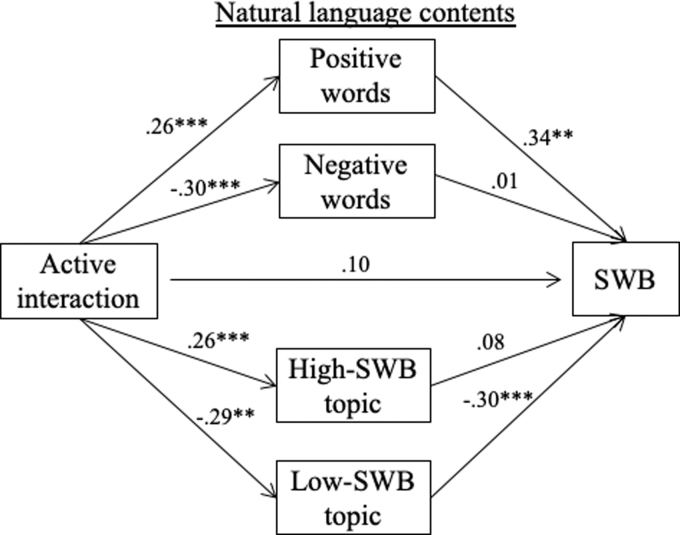
Previous studies indicated that active interactions on social networking services (SNS) are positively linked to subjective well-being (SWB). However, how semantic SNS content affects the association between the degree of SNS interaction and SWB has not been investigated. We addressed this issue by conducting a mediation analysis using natural language processing. We first analyzed Twitter data and SWB scores from 217 participants and found that the degree of active interactions on Twitter (i.e., frequency of reply) was positively correlated with SWB. Next, our multivariate mediation analysis demonstrated that positive words served as SWB-promoting mechanisms for highly interactive people, whereas worrying words led to lower SWB for less interactive people, but negative words did not. This study revealed that natural language content explains why individuals who are highly interactive on SNS have higher SWB, whereas less interactive individuals show lower SWB.
先前的研究表明,在社交网络服务(SNS)上的积极互动与主观幸福感(SWB)呈正相关。然而,语义 SNS 内容如何影响 SNS 互动程度与 SWB 之间的关联尚未得到研究。我们通过自然语言处理进行中介分析来解决这个问题。我们首先分析了 217 名参与者的 Twitter 数据和 SWB 评分,发现 Twitter 上的积极互动程度(即回复频率)与 SWB 呈正相关。接下来,我们的多元中介分析表明,积极词汇是促进高度互动者 SWB 的机制,而消极词汇则导致互动程度较低者的 SWB 降低,但消极词汇没有这种影响。这项研究揭示了自然语言内容解释了为什么在 SNS 上高度互动的个体具有更高的 SWB,而互动程度较低的个体则表现出较低的 SWB。