
新辅助化疗可提高具有高临床风险评分的可切除结直肠癌肝转移患者的总生存率——一项回顾性倾向评分匹配分析。
Neoadjuvant chemotherapy improves overall survival in resectable colorectal liver metastases patients with high clinical risk scores-- A retrospective, propensity score matching analysis.
作者信息
Chen Feng-Lin, Wang Yan-Yan, Liu Wei, Xing Bao-Cai
机构信息
Key Laboratory of Carcinogenesis and Translational Research, Ministry of Education, Peking University School of Oncology, Hepatopancreatobiliary Surgery Department I, Beijing Cancer Hospital and Institute, Beijing, China.
出版信息
Front Oncol. 2022 Sep 5;12:973418. doi: 10.3389/fonc.2022.973418. eCollection 2022.
BACKGROUND
The use of neoadjuvant chemotherapy (NAC) in resectable colorectal liver metastases (CRLM) patients is controversial. High-risk patients are more likely to benefit from NAC despite its hepatotoxic effects. Since patients with a high tumor burden receive NAC more frequently, previous retrospective studies have imbalanced baseline characteristics. The results of randomized controlled trials are still pending. This study aimed to assess the efficacy of NAC in resectable CRLM patients with high clinical risk scores (CRS) proposed by Fong et al. after balancing baseline characteristics by propensity score matching (PSM).
METHODS
Resectable CRLM patients with high CRS (3-5) undergoing hepatectomy between January 2003 and May 2021 were retrospectively studied. Patients were divided into the NAC and the upfront surgery group. Survival outcomes and surgical outcomes were compared after PSM.
RESULTS
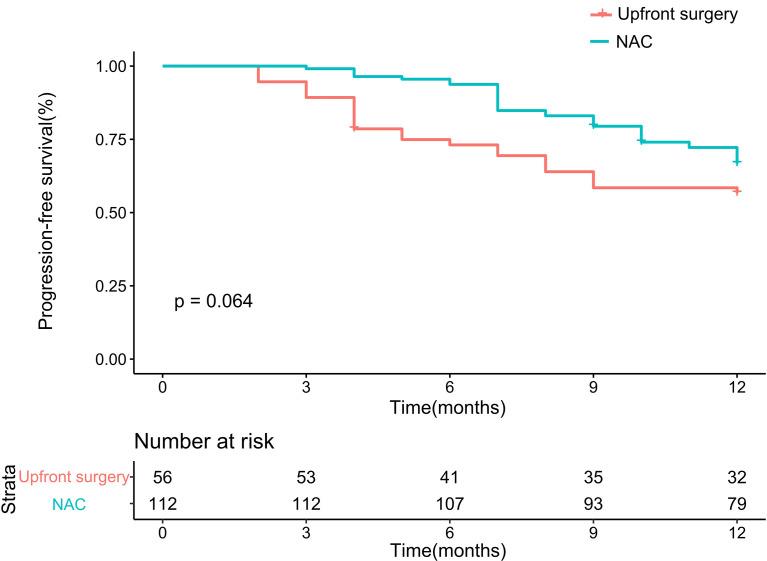
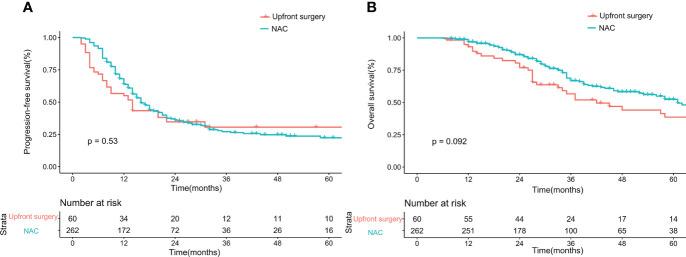
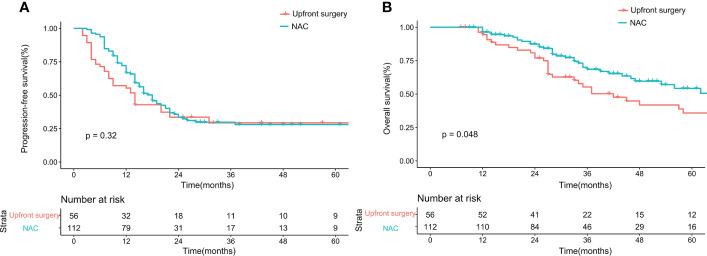
The current study included 322 patients with a median follow-up of 40 months. After one-to-two PSM, patients were matched into the upfront surgery group (n = 56) and the NAC group (n = 112). Baseline characteristics were balanced after matching. There was no difference in long-term progression-free survival (PFS), while overall survival (OS) from the initial diagnosis was improved in the NAC group ( = 0.048). Postoperative hospital stays were shorter in the NAC group ( = 0.020). Surgical outcomes were similar, including major hepatectomy rate, intraoperative ablation rate, blood loss, operative time, perioperative blood transfusion, positive surgical margin, and postoperative intensive care unit stay. In multivariable analysis, mutation, maximum tumor diameter≥3cm, and no NAC were independent risk factors for OS. The 1-year PFS in the NAC group was improved, although it failed to reach a statistical difference ( = 0.064).
CONCLUSIONS
NAC could improve OS in resectable CRLM patients with high CRS (3-5) and have a shorter postoperative hospital stay.
背景
新辅助化疗(NAC)在可切除的结直肠癌肝转移(CRLM)患者中的应用存在争议。尽管有肝毒性作用,但高危患者更可能从NAC中获益。由于肿瘤负荷高的患者更频繁地接受NAC,以往的回顾性研究存在基线特征不平衡的问题。随机对照试验的结果仍未确定。本研究旨在通过倾向评分匹配(PSM)平衡基线特征后,评估NAC对Fong等人提出的具有高临床风险评分(CRS)的可切除CRLM患者的疗效。
方法
回顾性研究2003年1月至2021年5月间接受肝切除术的高CRS(3 - 5)的可切除CRLM患者。患者分为NAC组和直接手术组。PSM后比较生存结局和手术结局。
结果
本研究纳入322例患者,中位随访40个月。经过1:2的PSM后,患者被匹配到直接手术组(n = 56)和NAC组(n = 112)。匹配后基线特征得到平衡。长期无进展生存期(PFS)无差异,而NAC组从初始诊断开始的总生存期(OS)得到改善(P = 0.048)。NAC组术后住院时间更短(P = 0.020)。手术结局相似,包括大肝切除率、术中消融率、失血量、手术时间、围手术期输血、手术切缘阳性率和术后重症监护病房停留时间。在多变量分析中,KRAS突变、最大肿瘤直径≥3cm和未接受NAC是OS独立危险因素。NAC组1年PFS有所改善,尽管未达到统计学差异(P = 0.064)。
结论
NAC可改善高CRS(3 - 5)的可切除CRLM患者的OS,并缩短术后住院时间。
 Zotero 插件