
典型聚氨酯混合料路面的层间剪切特性
Interlaminar Shear Characteristics of Typical Polyurethane Mixture Pavement.
作者信息
Gao Guohua, Sun Min, Xu Chuanchang, Qu Guangzhen, Yang Yaohui
机构信息
Shandong Key Laboratory of Highway Technology and Safety Assessment, Jinan 250000, China.
Shandong Hi-Speed Engineering Test Co., Ltd., Jinan 250098, China.
出版信息
Polymers (Basel). 2022 Sep 13;14(18):3827. doi: 10.3390/polym14183827.
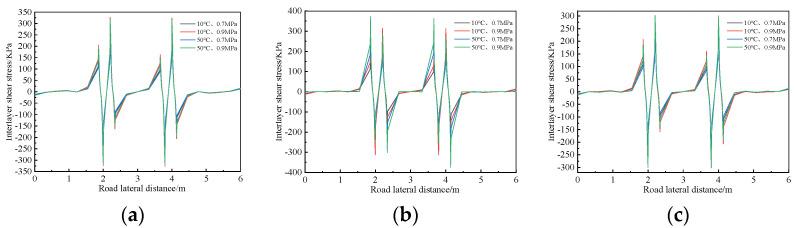
Polyurethane (PU) can be used as a road material binder, and its mechanical properties, durability, temperature stability, and other road performance metrics are good. However, the interlayer bonding between PU mixtures and asphalt mixtures is poor. The influence of the pavement structure, interlayer treatment scheme, load, and environmental factors on the interlayer shear characteristics of PU mixture composite pavement is analysed. Further, dynamic modulus, Hamburg rutting, accelerated loading, and inclined shear tests were conducted, and the typical PU mixture pavement shear stress was calculated. The interlaminar shear stress of double layer PU mixture pavement, polyurethane-asphalt composite pavement, and typical asphalt pavement were calculated. The results showed that the PU mixture has a low rutting deformation rate, stable mechanical properties, and strong resistance to the coupled action of temperature, water, and loading. The double-layer PU mixture structure has good water-temperature stability and fatigue resistance; however, freeze-thaw and accelerated loading cause great damage to the double-layer PU mixture structure. The residual shear strength ratio after freeze-thaw cycles and accelerated loading is only 50.3% and 35.6%, respectively, while the influence on the double-layer asphalt mixture structure is less. The theoretical calculation results of different pavement structures show that when the temperature increases from 10 °C to 50 °C, the interlaminar shear stress of polyurethane-asphalt composite pavement increases by about 20%. Additionally, the shear stress of pavement PU mixture pavement and typical asphalt pavement is mainly affected by load, and the temperature changes have an obvious effect on the interlayer shear stress of polyurethane-asphalt composite pavement. The calculated maximum shear stress of the three pavement structures with different working conditions is less than the interlaminar shear strength measured by the inclined shear test, indicating that the interlaminar treatment scheme of composite specimens can meet the shear resistance requirements of the three typical pavement structure types.
聚氨酯(PU)可作为道路材料粘结剂,其力学性能、耐久性、温度稳定性及其他路用性能指标良好。然而,PU混合料与沥青混合料之间的层间粘结性较差。分析了路面结构、层间处理方案、荷载及环境因素对PU混合料复合路面层间剪切特性的影响。此外,进行了动态模量、汉堡车辙、加速加载和斜剪试验,并计算了典型PU混合料路面的剪应力。计算了双层PU混合料路面、聚氨酯-沥青复合路面和典型沥青路面的层间剪应力。结果表明,PU混合料车辙变形率低,力学性能稳定,对温度、水和荷载耦合作用的抵抗能力强。双层PU混合料结构具有良好的水温稳定性和抗疲劳性能;然而,冻融和加速加载对双层PU混合料结构造成了很大破坏。冻融循环和加速加载后的残余抗剪强度比分别仅为50.3%和35.6%,而对双层沥青混合料结构的影响较小。不同路面结构的理论计算结果表明,当温度从10℃升高到50℃时,聚氨酯-沥青复合路面的层间剪应力增加约20%。此外,路面PU混合料路面和典型沥青路面的剪应力主要受荷载影响,温度变化对聚氨酯-沥青复合路面的层间剪应力有明显影响。三种不同工况路面结构计算得到的最大剪应力均小于斜剪试验测得的层间抗剪强度,表明复合试件的层间处理方案能够满足三种典型路面结构类型的抗剪要求。


 Zotero 插件