
心肌梗死后迷走神经介导的心脏传导阻滞与控制房室结的心外膜神经元可塑性有关。
Vagally-mediated heart block after myocardial infarction associated with plasticity of epicardial neurons controlling the atrioventricular node.
作者信息
Tompkins John D, Buckley Una, Salavatian Siamak, Shivkumar Kalyanam, Ardell Jeffrey L
机构信息
Neurocardiology Research Program of Excellence, Cardiac Arrhythmia Center, David Geffen School of Medicine, University of California, Los Angeles, Los Angeles, CA, United States.
出版信息
Front Synaptic Neurosci. 2022 Aug 15;14:960458. doi: 10.3389/fnsyn.2022.960458. eCollection 2022.
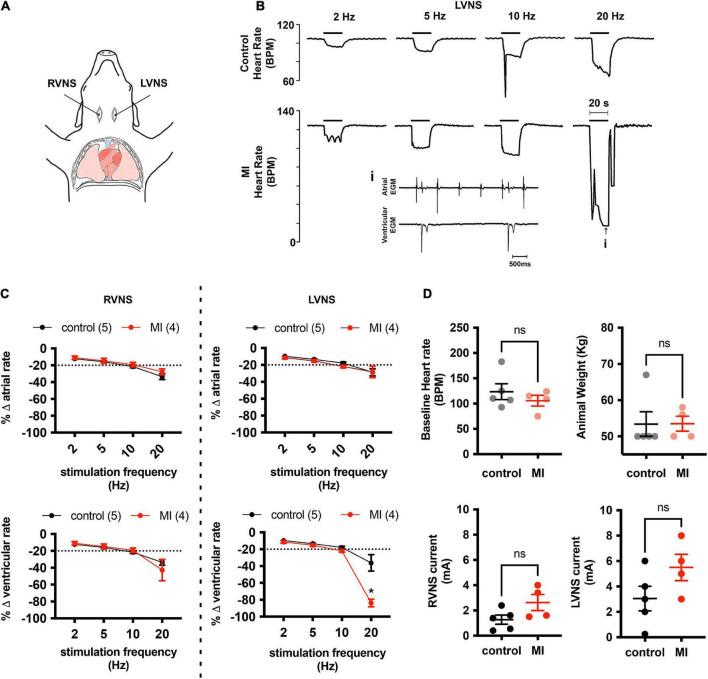
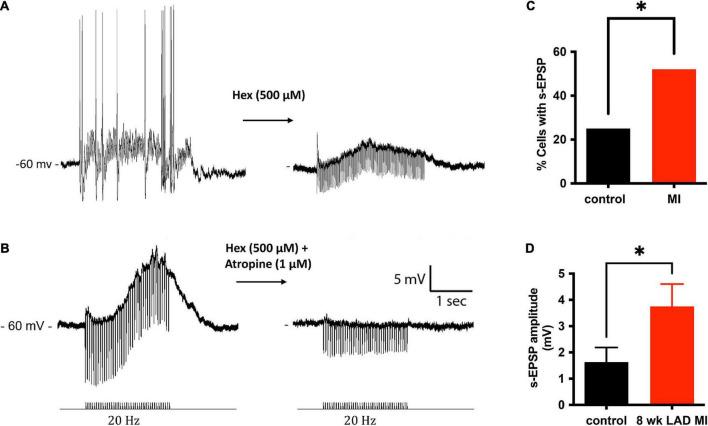
Imbalances in the opposing actions of sympathetic and parasympathetic nerves controlling the heart enhance risk for arrhythmia and sudden cardiac death after myocardial infarction (MI). Plasticity in peripheral neuron function may underlie the observed changes in cardiomotor nerve activity. We studied vagal control of the heart in pigs after chronic infarction of the left ventricle. Stimulation of the cervical vagus nerve produced greater bradycardic responses 8-weeks after MI. Recordings of epicardial electrocardiograms demonstrate increased severity and duration of atrioventricular (AV) block in MI-pigs during 20 Hz vagal stimulation. Intracellular voltage recordings from isolated neurons of the inferior vena cava-inferior left atrium (IVC-ILA) ganglionated plexus, a cluster of epicardial neurons receiving innervation from the vagus known to regulate the AV node, were used to assess plasticity of membrane and synaptic physiology of intrinsic cardiac neurons (ICNs) after MI. Changes to both passive and active membrane properties were observed, including more negative resting membrane potentials and greater input resistances in MI-pig ICNs, concomitant with a depression of neuronal excitability. Immunoreactivity to pituitary adenylate cyclase-activating polypeptide (PACAP), a cardiotropic peptide known to modulate cardiac neuron excitability, was localized to perineuronal varicosities surrounding pig IVC-ILA neurons. Exogenous application of PACAP increased excitability of control but not MI-ICNs. Stimulation (20 Hz) of interganglionic nerves in the whole-mount preparations elicited slow excitatory postsynaptic potentials (sEPSPs) which persisted in hexamethonium (500 μM), but were blocked by atropine (1 μM), indicating muscarinic receptor-mediated inhibition of M-current. Extracellular application of 1 mM BaCl to inhibit M-current increased neuronal excitability. The muscarine-sensitive sEPSPs were observed more frequently and were of larger amplitude in IVC-ILA neurons from MI animals. In conclusion, we suggest the increased probability of muscarinic sEPSPs play a role in the potentiation of the vagus nerve mediated-slowing of AV nodal conduction following chronic MI. We identify both a novel role of a muscarinic sensitive current in the regulation of synaptic strength at ICNs projecting to the AV node, and demonstrate changes to both intrinsic plasticity and synaptic plasticity of IVC-ILA neurons which may contribute to greater risk for heart block and sudden cardiac death after MI.
控制心脏的交感神经和副交感神经的拮抗作用失衡会增加心肌梗死(MI)后心律失常和心源性猝死的风险。外周神经元功能的可塑性可能是观察到的心脏运动神经活动变化的基础。我们研究了左心室慢性梗死后猪的心脏迷走神经控制。在心肌梗死后8周,刺激颈迷走神经产生了更大的心动过缓反应。心外膜心电图记录显示,在20Hz迷走神经刺激期间,心肌梗死猪的房室(AV)阻滞的严重程度和持续时间增加。从下腔静脉-左下心房(IVC-ILA)神经节丛的分离神经元进行细胞内电压记录,该神经节丛是一群接受迷走神经支配并已知调节房室结的心外膜神经元,用于评估心肌梗死后心脏固有神经元(ICN)的膜和突触生理学可塑性。观察到被动和主动膜特性均发生变化,包括心肌梗死猪ICN的静息膜电位更负、输入电阻更大,同时神经元兴奋性降低。对垂体腺苷酸环化酶激活多肽(PACAP)的免疫反应性定位于猪IVC-ILA神经元周围的神经周曲张体,PACAP是一种已知可调节心脏神经元兴奋性的心脏营养肽。外源性应用PACAP可增加对照ICN而非心肌梗死ICN的兴奋性。在整装制剂中刺激(20Hz)神经节间神经会引发缓慢兴奋性突触后电位(sEPSP),该电位在六甲铵(500μM)中持续存在,但被阿托品(1μM)阻断,表明毒蕈碱受体介导对M电流的抑制。细胞外应用1mM BaCl2抑制M电流可增加神经元兴奋性。在心肌梗死动物的IVC-ILA神经元中,毒蕈碱敏感的sEPSP更频繁地被观察到且幅度更大。总之,我们认为毒蕈碱sEPSP概率增加在慢性心肌梗死后迷走神经介导的房室结传导减慢的增强中起作用。我们确定了毒蕈碱敏感电流在调节投射到房室结的ICN突触强度中的新作用,并证明了IVC-ILA神经元的固有可塑性和突触可塑性的变化,这可能导致心肌梗死后心脏传导阻滞和心源性猝死的风险增加。



 Zotero 插件