
一项社会接触调查参与情况的混合方法分析。
A mixed methods analysis of participation in a social contact survey.
机构信息
School of Biological Sciences, University of Bristol, Bristol, UK; School of Population Health Sciences, University of Bristol, Bristol, UK; Department of Mathematical Sciences, University of Liverpool, Liverpool, UK.
School of Population Health Sciences, University of Bristol, Bristol, UK; NIHR Health Protection Research Unit in Behavioural Science and Evaluation, University of Bristol, Bristol, UK.
出版信息
Epidemics. 2022 Dec;41:100635. doi: 10.1016/j.epidem.2022.100635. Epub 2022 Sep 22.
BACKGROUND
Social contact survey data forms a core component of modern epidemic models: however, there has been little assessment of the potential biases in such data.
METHODS
We conducted focus groups with university students who had (n = 13) and had never (n = 14) completed a social contact survey during the COVID-19 pandemic. Qualitative findings were explored quantitatively by analysing participation data.
RESULTS
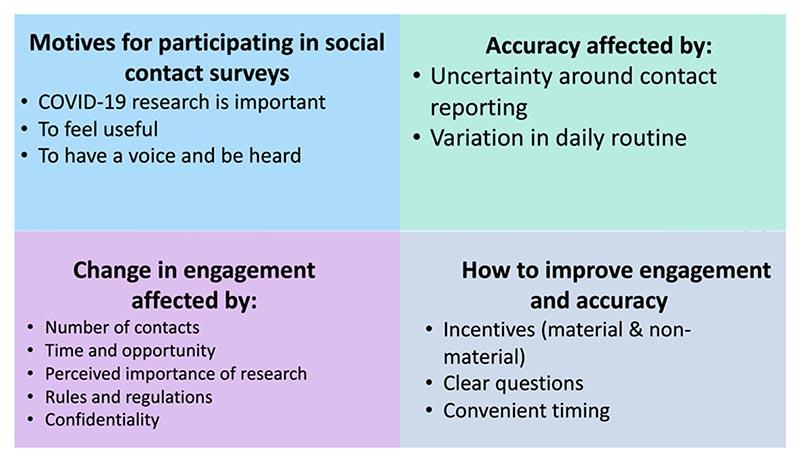
The opportunity to contribute to COVID-19 research, to be heard and feel useful were frequently reported motivators for participating in the contact survey. Reductions in survey engagement following lifting of COVID-19 restrictions may have occurred because the research was perceived to be less critical and/or because the participants were busier and had more contacts. Having a high number of contacts to report, uncertainty around how to report each contact, and concerns around confidentiality were identified as factors leading to inaccurate reporting. Focus groups participants thought that financial incentives or provision of study results would encourage participation.
CONCLUSIONS
Incentives could improve engagement with social contact surveys. Qualitative research can inform the format, timing, and wording of surveys to optimise completion and accuracy.
背景
社会接触调查数据是现代传染病模型的核心组成部分:然而,人们很少评估此类数据中存在的潜在偏差。
方法
我们对在 COVID-19 大流行期间完成过(n=13)和从未完成过(n=14)社会接触调查的大学生进行了焦点小组讨论。通过分析参与数据,对定性发现进行了定量探索。
结果
有机会为 COVID-19 研究做出贡献、被倾听和感到有用,这些都是参与者参与接触调查的常见动机。随着 COVID-19 限制的解除,调查参与度的下降可能是因为研究被认为不那么重要,或者因为参与者更忙,接触的人更多。报告大量联系人、不确定如何报告每个联系人以及对保密性的担忧被确定为导致不准确报告的因素。焦点小组参与者认为经济激励或提供研究结果将鼓励参与。
结论
激励措施可以提高社会接触调查的参与度。定性研究可以为调查的格式、时间安排和措辞提供信息,以优化完成度和准确性。

 Zotero 插件