Department of Epidemiology and Biostatistics, Institute of Basic Medical Sciences Chinese Academy of Medical Sciences; School of Basic Medicine Peking Union Medical College, Beijing, China.
Cardiology Department, Kailuan General Hospital, Tangshan, China.
Hepatol Commun. 2022 Dec;6(12):3393-3405. doi: 10.1002/hep4.2081. Epub 2022 Oct 25.
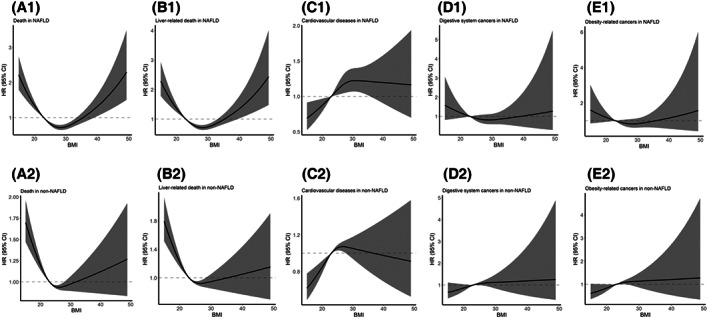
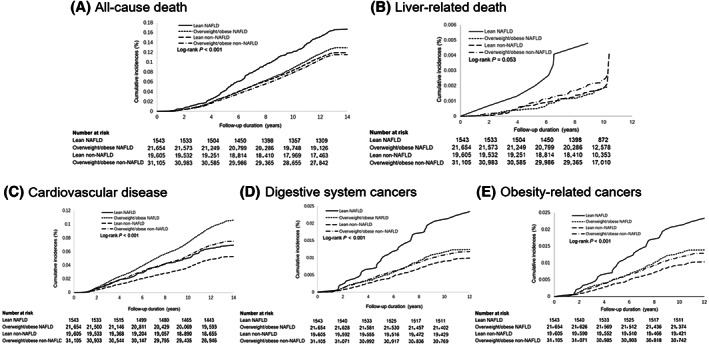
The ability to determine the prognosis of lean nonalcoholic fatty liver disease (NAFLD) is essential for decision making in clinical settings. Using a large community-based Chinese cohort, we aimed to investigate NAFLD outcomes by body mass index (BMI). We used the restricted cubic splines method to investigate the dose-response relationship between BMI and outcomes in subjects with NAFLD and those without NAFLD. We included 73,907 subjects from the Kailuan cohort and grouped all subjects into four phenotypes by using NAFLD and BMI (<23 kg/m ). The probability of developing outcomes for individuals with lean NAFLD (LN), overweight/obese NAFLD (ON), overweight/obese non-NAFLD (ONN), and lean non-NAFLD (LNN) was estimated. We found a U-shaped association between BMI and death but a linear positive association concerning cardiovascular disease (CVD) after adjusting for age and other covariates. Compared with the LNN group, the adjusted hazard ratios (HRs) and 95% confidence intervals (CIs) of the LN, ON, and ONN groups were 1.30 (1.14-1.49), 0.86 (0.80-0.91), 0.84 (0.80-0.89) for all-cause death, 2.61 (1.13-6.03), 0.74 (0.44-1.26), 1.10 (0.70-1.74) for liver-related death, 2.12 (1.46-3.08), 1.23 (0.99-1.54), 1.19 (0.98-1.43) for digestive system cancers, and 2.04 (1.40-2.96), 1.30 (1.05-1.61), 1.21 (1.01-1.46) for obesity-related cancers. Subjects with LN had a significantly higher risk of colorectal cancer and esophagus cancer. However, the ON group had the highest CVD risk (HR, 1.39; 95% CI, 1.27-1.52). The LN group with hypertension had a higher risk of adverse outcomes, and those without hypertension had a similar risk compared to LNN. Conclusion: Subjects with LN may experience a higher risk of all-cause death, digestive system cancers, and obesity-related cancers than the other three groups but a lower risk of CVD than ON subjects. LN with hypertension may be a high-risk phenotype.
使用大型社区为基础的中国队列,我们旨在通过体重指数(BMI)研究非酒精性脂肪肝(NAFLD)的结局。我们使用限制立方样条方法来研究 NAFLD 患者和非 NAFLD 患者中 BMI 与结局之间的剂量反应关系。我们纳入了来自开滦队列的 73907 名受试者,并使用 NAFLD 和 BMI(<23kg/m )将所有受试者分为 4 种表型。估计个体发生结局的概率,这些个体患有瘦型 NAFLD(LN)、超重/肥胖型 NAFLD(ON)、超重/肥胖型非 NAFLD(ONN)和瘦型非 NAFLD(LNN)。我们发现 BMI 与死亡之间呈 U 型关联,但在调整年龄和其他协变量后,与心血管疾病(CVD)呈线性正相关。与 LNN 组相比,LN、ON 和 ONN 组的全因死亡校正后的危险比(HR)和 95%置信区间(CI)分别为 1.30(1.14-1.49)、0.86(0.80-0.91)、0.84(0.80-0.89),全因死亡校正后的 HR 和 95%CI 分别为 2.61(1.13-6.03)、0.74(0.44-1.26)、1.10(0.70-1.74),肝脏相关死亡校正后的 HR 和 95%CI 分别为 2.12(1.46-3.08)、1.23(0.99-1.54)、1.19(0.98-1.43),消化系统癌症校正后的 HR 和 95%CI 分别为 2.04(1.40-2.96)、1.30(1.05-1.61)、1.21(1.01-1.46),肥胖相关癌症校正后的 HR 和 95%CI 分别为 1.39(1.27-1.52)。LN 组患结直肠癌和食管癌的风险显著升高。然而,ON 组患 CVD 的风险最高(HR,1.39;95%CI,1.27-1.52)。LN 组高血压患者发生不良结局的风险较高,而无高血压患者的风险与 LNN 组相似。结论:与其他三组相比,LN 患者可能有更高的全因死亡、消化系统癌症和肥胖相关癌症风险,但 CVD 风险低于 ON 患者。LN 伴高血压可能是一种高危表型。