
母亲教育程度和就业对巴基斯坦儿童健康的调节作用。
The Moderating Role of Maternal Education and Employment on Child Health in Pakistan.
作者信息
Asif Muhammad Farhan, Ali Shafaqat, Ali Majid, Abid Ghulam, Lassi Zohra S
机构信息
National College of Business Administration and Economics, Lahore 54000, Pakistan.
Department of Statistics, Kohsar University, Murree 43600, Pakistan.
出版信息
Children (Basel). 2022 Oct 14;9(10):1559. doi: 10.3390/children9101559.
BACKGROUND
Pakistan has challenges in fulfilling its universal responsibilities of providing better health facilities to everyone. The Sustainable Development Goals (SDGs) aim to reduce maternal and infant mortality rates. Despite declines in mother and child death, the total mortality ratio has marginally increased. However, neonatal death has not decreased significantly. Family planning is important for controlling population growth and improving child as well as maternal health. Pakistan's government has unceasingly tried to enhance the provision of contraceptive facilities, but still, an unmet need for family planning (UMNFP) exists in our country. Women are said to have UMNFP if they want to limit or space childbearing, but they are not using contraception methods for any reason. The study aimed to explore the effect of the UMNFP and to investigate the moderating role of a mother's education and employment status on a child's health.
METHODS
We analyzed the data of 2,244 women in this study. To investigate the study objectives, we utilized the secondary dataset of the Pakistan Demographic and Health Survey (PDHS) 2017-18 (publicly available on the website of the National Institute of Population Studies) and applied binary logistic regression using SPSS 24.
RESULTS
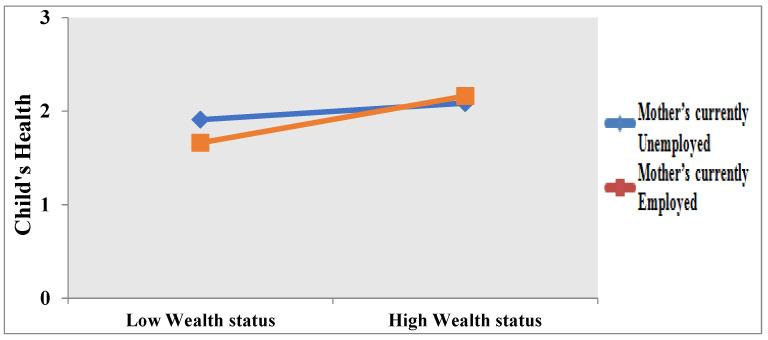
Results suggest a positive effect of a woman's age (25 to 39 years), maternal education (higher), father's education (higher), family's wealth status (richest), mass media exposure, and adequate birth spacing (at least for 33 months) on a child's health. On the other hand, there is an indirect association between maternal employment, unmet need for family planning, and a child's health. The moderating role of maternal education and employment on the relationship between household wealth status and a child's health is positive.
CONCLUSIONS
We conclude that the strong predictors of child health are UMNFP, maternal education, and employment. The link between the met need for family planning and the child's health is positive. The moderating effect of maternal education and household wealth status on a child's health is progressive. Similarly, the interaction effect of a mother's employment and household wealth status on a child's health is positive. Finally, we concluded that the link between the health of the child and household wealth status is much more diverse and positive when the mother is highly educated and currently employed.
背景
巴基斯坦在履行向所有人提供更好医疗设施的普遍责任方面面临挑战。可持续发展目标旨在降低孕产妇和婴儿死亡率。尽管母婴死亡率有所下降,但总死亡率略有上升。然而,新生儿死亡率并未显著下降。计划生育对于控制人口增长以及改善儿童和孕产妇健康至关重要。巴基斯坦政府一直在努力增加避孕设施的供应,但我国仍存在未满足的计划生育需求(UMNFP)。如果妇女想要限制生育间隔但因任何原因未使用避孕方法,则被认为存在未满足的计划生育需求。该研究旨在探讨未满足的计划生育需求的影响,并调查母亲的教育和就业状况对儿童健康的调节作用。
方法
我们在本研究中分析了2244名妇女的数据。为了调查研究目标,我们利用了2017 - 18年巴基斯坦人口与健康调查(PDHS)的二次数据集(可在国家人口研究所网站上公开获取),并使用SPSS 24应用二元逻辑回归。
结果
结果表明,妇女年龄(25至39岁)、母亲教育程度(较高)、父亲教育程度(较高)、家庭财富状况(最富有)、大众媒体曝光以及足够的生育间隔(至少33个月)对儿童健康有积极影响。另一方面,母亲就业、未满足的计划生育需求与儿童健康之间存在间接关联。母亲教育和就业对家庭财富状况与儿童健康之间关系的调节作用是积极的。
结论
我们得出结论,儿童健康的有力预测因素是未满足的计划生育需求、母亲教育和就业。满足计划生育需求与儿童健康之间的联系是积极的。母亲教育和家庭财富状况对儿童健康的调节作用是渐进的。同样,母亲就业与家庭财富状况对儿童健康的交互作用是积极的。最后,我们得出结论,当母亲受过高等教育且目前就业时,儿童健康与家庭财富状况之间的联系更加多样化且呈正相关。

 Zotero 插件