
轻度间伐可以提高高山人工林的土壤水分有效性和持水能力。
Light thinning can improve soil water availability and water holding capacity of plantations in alpine mountains.
作者信息
Gao Yuan, He Zhibin, Zhu Xi, Chen Longfei, Du Jun
机构信息
Linze Inland River Basin Research Station, Chinese Ecosystem Research Network, Key Laboratory of Eco-Hydrology of Inland River Basin, Northwest Institute of Eco-Environment and Resources, Chinese Academy of Sciences, Lanzhou, China.
University of Chinese Academy of Sciences, Beijing, China.
出版信息
Front Plant Sci. 2022 Oct 12;13:1032057. doi: 10.3389/fpls.2022.1032057. eCollection 2022.
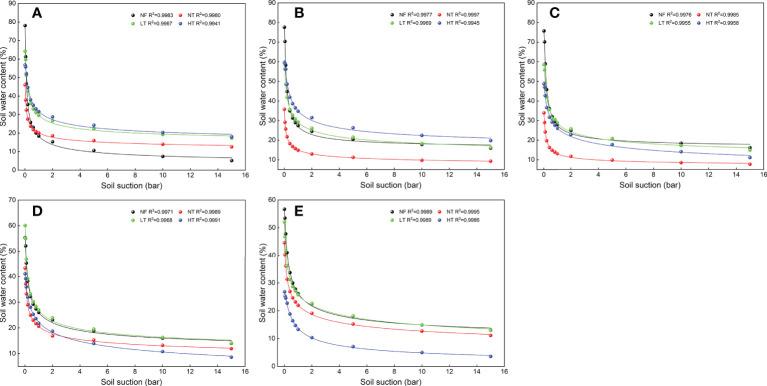
The establishment of large-scale forest plantations in the arid and semi-arid area of the Qilian Mountains in China has effectively protected water and soil resources and enhanced carbon sequestration capacity of forest ecosystems. However, the effects of different management practices in these plantations on soil water holding capacity (SWHC) and soil water availability (SWA) are uncertain in this fragile ecosystem. Here, we investigated the effects of no thinning (NT), light thinning (LT, 20% thinning intensity), and heavy thinning (HT, 40% thinning intensity) on SWHC and SWA in different soil depths of a forest plantation, and compared them to those in a natural forest (NF). Our results revealed that at low soil water suction stage, SWHC in the plantations (LT, HT, and NT) was greater in the topsoil layer (0-40 cm) than that in the NF site, while SWHC in the subsoil layer (40-80 cm) in NF was significantly greater than that in the thinning stands. At medium and high-water suction stage, SWHC in LT and NF stands was greater than that in HT and NT. Soil water characteristic curves fitted by VG model showed that the relative change in soil water content in LT topsoil layer was the smallest and SWHC was greatest. Changes in soil physicochemical properties included higher bulk density and lower total porosity, which reduced the number of macropores in the soil and affected SWHC. The bulk density, total porosity, silt content, and field capacity were the main factors jointly affecting SWA. High planting density was the main reason for the low SWA and SWHC in NT, but this can be alleviated by stand thinning. Overall, 20% thinning intensity (light intensity thinning) may be an effective forest management practice to optimize SWHC and SWA in plantations to alleviate soil water deficits.
在中国祁连山干旱和半干旱地区建立大规模人工林,有效保护了水土资源,增强了森林生态系统的碳固存能力。然而,在这个脆弱的生态系统中,这些人工林不同经营措施对土壤持水能力(SWHC)和土壤水分有效性(SWA)的影响尚不确定。在此,我们研究了不间伐(NT)、轻度间伐(LT,间伐强度20%)和重度间伐(HT,间伐强度40%)对人工林不同土壤深度的SWHC和SWA的影响,并将其与天然林(NF)进行比较。我们的结果表明,在低土壤吸力阶段,人工林(LT、HT和NT)表层土壤(0 - 40厘米)的SWHC高于NF样地,而NF样地底土层(40 - 80厘米)的SWHC显著高于间伐林分。在中高土壤吸力阶段,LT和NF林分的SWHC高于HT和NT。用VG模型拟合的土壤水分特征曲线表明,LT表层土壤水分含量的相对变化最小,SWHC最大。土壤理化性质的变化包括较高的容重和较低的总孔隙度,这减少了土壤中大孔隙的数量,影响了SWHC。容重、总孔隙度、粉粒含量和田间持水量是共同影响SWA的主要因素。高种植密度是NT林分SWA和SWHC较低的主要原因,但通过林分间伐可以缓解这一问题。总体而言,20%的间伐强度(轻度间伐)可能是优化人工林SWHC和SWA以缓解土壤水分亏缺的有效森林经营措施。




 Zotero 插件