
负载纳米零价铁的玉米秸秆生物炭用于高效去除六价铬:修复性能及界面化学行为
Nano zero-valent iron loaded corn-straw biochar for efficient removal of hexavalent chromium: remediation performance and interfacial chemical behaviour.
作者信息
Wei Yuzhen, Chu Run, Zhang Qinhu, Usman Muhammad, Haider Fasih Ullah, Cai Liqun
机构信息
College of Forestry, Gansu Agricultural University Lanzhou 730070 P. R. China
College of Resources and Environmental Sciences, Gansu Agricultural University Lanzhou 730070 P. R. China.
出版信息
RSC Adv. 2022 Oct 5;12(41):26953-26965. doi: 10.1039/d2ra04650d. eCollection 2022 Sep 16.
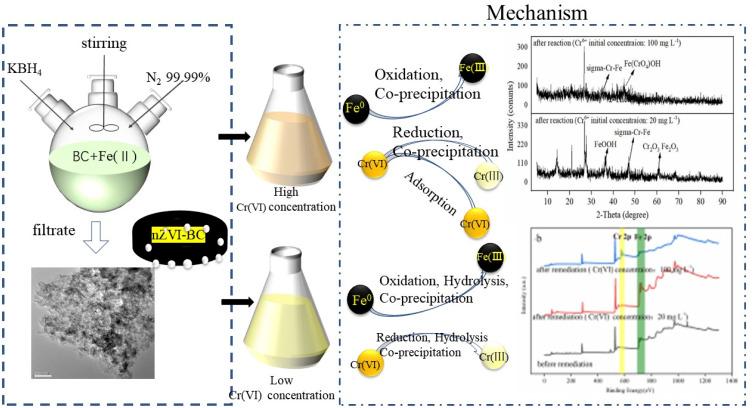
To improve the poor stability of nano zero-valent iron (nZVI), corn-straw biochar (BC) was used as a support for the synthesis of composites of nZVI-biochar (nZVI/BC) in different mass ratios. After a thorough characterization, the obtained nZVI/BC composite was used to remove hexavalent chromium [Cr(vi)] in an aquatic system under varying conditions including composite amount, Cr(vi) concentration, and pH. The obtained results show that the treatment efficiency varied in the following order: nZVI-BC (1 : 3) > nZVI-BC (1 : 5) > nZVI alone > BC alone. This order indicates the higher efficiency of composite material and the positive effect of nZVI content in the composite. Similarly, the composite dosage and Cr(vi) concentration had significant effects on the removal performance and 2 g L and 6 g L were considered to be the optimum dose at a Cr(vi) concentration of 20 mg L and 100 mg L, respectively. The removal efficiency was maximum (100%) at pH 2 whereas solution pH increased significantly after the reaction (from 2 to 4.13). The removal kinetics of Cr(vi) was described by a pseudo-second-order model which indicated that the removal process was mainly controlled by the rate of chemical adsorption. The thermodynamics was more in line with the Freundlich model which indicated that the removal was multi-molecular layer adsorption. TEM-EDS, XRD, and XPS were applied to characterize the crystal lattice and structural changes of the material to specify the interfacial chemical behaviour on the agent surface. These techniques demonstrate that the underlying mechanisms of Cr(vi) removal include adsorption, chemical reduction-oxidation reaction, and co-precipitation on the surface of the nZVI-BC composite. The results indicated that the corn-straw BC as a carrier material highly improved Cr(vi) removal performance of nZVI and offered better utilization of the corn straw.
为改善纳米零价铁(nZVI)稳定性较差的问题,采用玉米秸秆生物炭(BC)作为载体,合成了不同质量比的nZVI-生物炭复合材料(nZVI/BC)。经过全面表征后,将所得的nZVI/BC复合材料用于在不同条件下(包括复合材料用量、Cr(Ⅵ)浓度和pH值)去除水体系中的六价铬[Cr(Ⅵ)]。所得结果表明,处理效率按以下顺序变化:nZVI-BC(1∶3)>nZVI-BC(1∶5)>单独的nZVI>单独的BC。该顺序表明复合材料具有更高的效率以及复合材料中nZVI含量的积极作用。同样,复合材料用量和Cr(Ⅵ)浓度对去除性能有显著影响,在Cr(Ⅵ)浓度分别为20 mg/L和100 mg/L时,2 g/L和6 g/L被认为是最佳剂量。在pH值为2时去除效率最高(100%),而反应后溶液pH值显著升高(从2升至4.13)。Cr(Ⅵ)的去除动力学由准二级模型描述,这表明去除过程主要受化学吸附速率控制。热力学更符合Freundlich模型,这表明去除是多分子层吸附。采用透射电子显微镜-能谱仪(TEM-EDS)、X射线衍射仪(XRD)和X射线光电子能谱仪(XPS)对材料的晶格和结构变化进行表征,以确定试剂表面的界面化学行为。这些技术表明,Cr(Ⅵ)去除的潜在机制包括在nZVI-BC复合材料表面的吸附、化学还原-氧化反应和共沉淀。结果表明,玉米秸秆生物炭作为载体材料极大地提高了nZVI对Cr(Ⅵ)的去除性能,并使玉米秸秆得到了更好的利用。


 Zotero 插件