Medical Clinic and Policlinic 1, Hematology, Cellular Therapy and Hemostaseology, Leipzig University Hospital, Liebigstr. 20, 04103, Leipzig, Germany.
Department of Internal Medicine/Cardiology, Heart Center Leipzig at the University of Leipzig and Leipzig Heart Institute, Strümpellstr. 39, 04289, Leipzig, Germany.
Basic Res Cardiol. 2022 Nov 10;117(1):55. doi: 10.1007/s00395-022-00969-w.
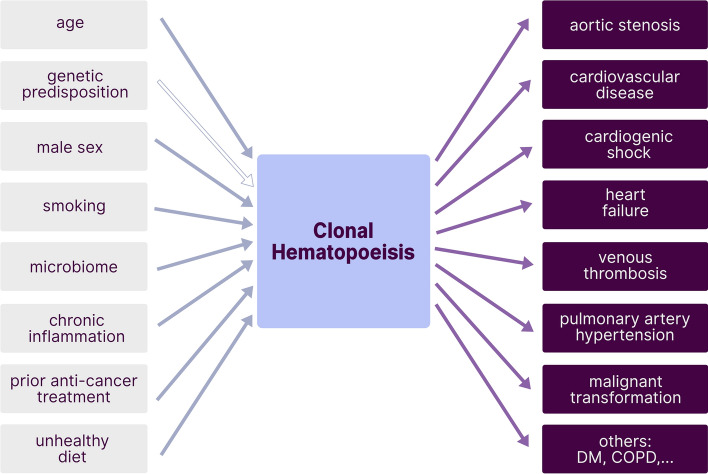
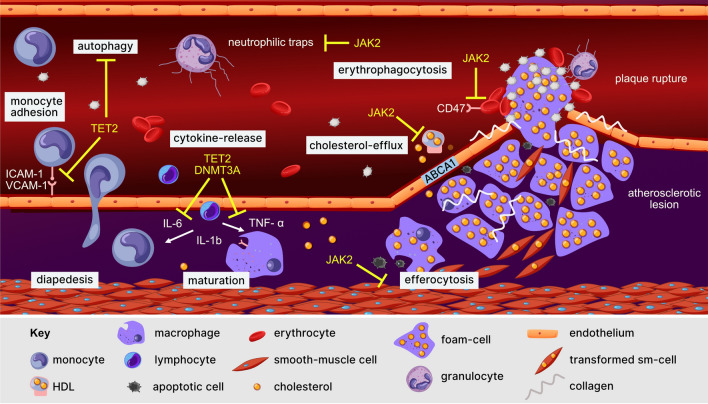
Cardiovascular and oncological diseases represent the global major causes of death. For both, a novel and far-reaching risk factor has been identified: clonal hematopoiesis (CH). CH is defined as clonal expansion of peripheral blood cells on the basis of somatic mutations, without overt hematological malignancy. The most commonly affected genes are TET2, DNMT3A, ASXL1 and JAK2. By the age of 70, at least 20-50% of all individuals carry a CH clone, conveying a striking clinical impact by increasing all-cause mortality by 40%. This is due predominantly to a nearly two-fold increase of cardiovascular risk, but also to an elevated risk of malignant transformation. Individuals with CH show not only increased risk for, but also worse outcomes after arteriosclerotic events, such as stroke or myocardial infarction, decompensated heart failure and cardiogenic shock. Elevated cytokine levels, dysfunctional macrophage activity and activation of the inflammasome suggest that a vicious cycle of chronic inflammation and clonal expansion represents the major functional link. Despite the apparently high impact of this entity, awareness, functional understanding and especially clinical implications still require further research. This review provides an overview of the current knowledge of CH and its relation to cardiovascular and hematological diseases. It focuses on the basic functional mechanisms in the interplay between atherosclerosis, inflammation and CH, identifies issues for further research and considers potential clinical implications.
心血管疾病和肿瘤是全球主要致死病因。目前发现了一种全新且影响深远的致病因素与这两类疾病相关:克隆性造血(clonal hematopoiesis,CH)。CH 是指外周血造血细胞基于体细胞突变而发生克隆性扩增,但无显性血液恶性肿瘤。最常受影响的基因是 TET2、DNMT3A、ASXL1 和 JAK2。到 70 岁时,至少 20%-50%的个体携带有 CH 克隆,通过使全因死亡率增加 40%而产生显著的临床影响。这主要归因于心血管风险增加近两倍,但也归因于恶性转化风险增加。CH 个体不仅动脉粥样硬化事件(如中风或心肌梗死、心力衰竭失代偿和心源性休克)的风险增加,而且预后也更差。细胞因子水平升高、巨噬细胞功能障碍和炎性小体激活表明,慢性炎症和克隆性扩增的恶性循环代表了主要的功能联系。尽管该实体的影响显然很高,但对其的认识、功能理解,尤其是临床意义仍需要进一步研究。本文综述了 CH 及其与心血管和血液系统疾病的关系的现有知识。本文重点关注动脉粥样硬化、炎症和 CH 之间相互作用的基本功能机制,确定了进一步研究的问题,并考虑了潜在的临床意义。