
非典型淀粉样β 异构体在阿尔茨海默病中的隐匿作用。
The Hidden Role of Non-Canonical Amyloid β Isoforms in Alzheimer's Disease.
机构信息
Department of Informatics and Microsystems Technology, University of Applied Sciences Kaiserslautern, D-66482 Zweibruecken, Germany.
Department of Neurogenetics, Max Planck Institute for Multidisciplinary Sciences, D-37075 Goettingen, Germany.
出版信息
Cells. 2022 Oct 29;11(21):3421. doi: 10.3390/cells11213421.
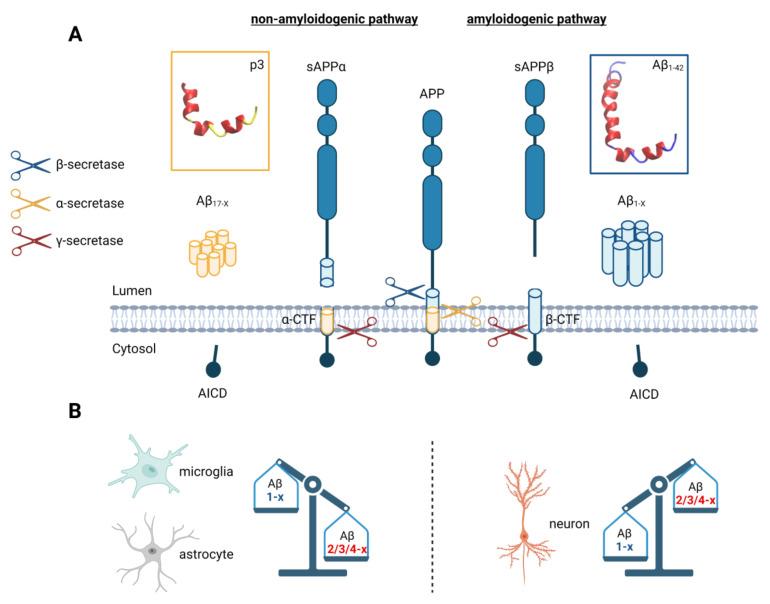
Recent advances have placed the pro-inflammatory activity of amyloid β (Aβ) on microglia cells as the focus of research on Alzheimer's Disease (AD). Researchers are confronted with an astonishing spectrum of over 100 different Aβ variants with variable length and chemical modifications. With the exception of Aβ and Aβ, the biological significance of most peptides for AD is as yet insufficiently understood. We therefore aim to provide a comprehensive overview of the contributions of these neglected Aβ variants to microglia activation. First, the impact of Aβ receptors, signaling cascades, scavenger mechanisms, and genetic variations on the physiological responses towards various Aβ species is described. Furthermore, we discuss the importance of different types of amyloid precursor protein processing for the generation of these Aβ variants in microglia, astrocytes, oligodendrocytes, and neurons, and highlight how alterations in secondary structures and oligomerization affect Aβ neurotoxicity. In sum, the data indicate that gene polymorphisms in Aβ-driven signaling pathways in combination with the production and activity of different Aβ variants might be crucial factors for the initiation and progression of different forms of AD. A deeper assessment of their interplay with glial cells may pave the way towards novel therapeutic strategies for individualized medicine.
近年来,淀粉样蛋白β(Aβ)在小胶质细胞中的促炎活性已成为阿尔茨海默病(AD)研究的焦点。研究人员面临着令人惊讶的 100 多种不同 Aβ 变体,其长度和化学修饰各不相同。除了 Aβ和 Aβ外,大多数肽类物质对 AD 的生物学意义尚未得到充分理解。因此,我们旨在全面概述这些被忽视的 Aβ 变体对小胶质细胞激活的贡献。首先,描述了 Aβ 受体、信号级联、清除机制和遗传变异对各种 Aβ 物种的生理反应的影响。此外,我们讨论了不同类型的淀粉样前体蛋白加工对这些 Aβ 变体在小胶质细胞、星形胶质细胞、少突胶质细胞和神经元中生成的重要性,并强调了二级结构和寡聚化的改变如何影响 Aβ 的神经毒性。总之,这些数据表明,Aβ 驱动的信号通路中的基因多态性与不同 Aβ 变体的产生和活性相结合,可能是引发和进展不同形式 AD 的关键因素。更深入地评估它们与神经胶质细胞的相互作用可能为个体化医学的新型治疗策略铺平道路。



 Zotero 插件