Washington University School of Medicine, St. Louis, Missouri, USA.
University of Miami, Coral Gables, Florida, USA.
Cancer Med. 2023 Mar;12(6):7381-7388. doi: 10.1002/cam4.5439. Epub 2022 Nov 20.
To determine if the COVID-19 pandemic has further exacerbated racial disparities in late-stage presentation of breast, colorectal, lung, and prostate cancers.
We conducted a registry-based retrospective study of patients with newly reported diagnoses of breast, colorectal, lung, and prostate cancers between March 2019-June 2019 (pre-COVID-19) and March 2020-June 2020 (early-COVID-19). We compared the volume of new diagnoses and stage at presentation according to race between both periods.
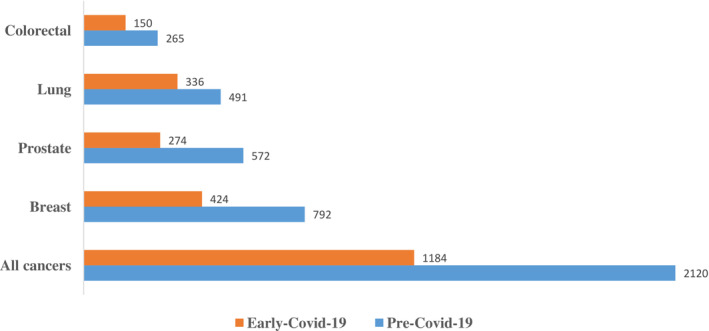
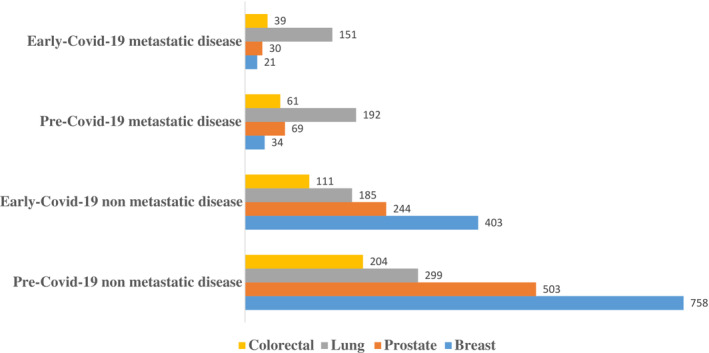
During the study period, a total of 3528 patients had newly diagnosed cancer; 3304 of which had known disease stages and were included in the formal analyses. 467 (14.1%) were Blacks, and 2743 were (83%) Whites. 1216 (36.8%) had breast, 415 (12.6%) had colorectal, 827 (25%) had lung, and 846 (25.6%) had prostate cancers, respectively. The pre-COVID-19 period included 2120 (64.2%), and the early-COVID-19 period included 1184 (35.8%), representing a proportional 44.2% decline in the volume of new cases of breast, colorectal, lung, and prostate cancers, p < 0.0001. Pre-COVID-19, 16.8% were diagnosed with metastatic disease, versus 20.4% early-COVID-19, representing a proportional increase of 21.4% in the numbers of new cases with metastatic disease, p = 0.01. There was a non-significant proportional decline of 1.9% in Black patients diagnosed with non-metastatic breast, colorectal, lung, and prostate cancers early-COVID-19 (p = 0.71) and a non-significant proportional increase of 7% in Black patients diagnosed with metastatic disease (p = 0.71). Difference-in-difference analyses showed no statistically significant differences in metastatic presentation comparing Black to White patients.
While we identified substantial reductions in the volume of new cancer diagnoses and increases in metastatic presentations due to the COVID-19 pandemic, the impact was similar for White and Black patients.
确定 COVID-19 大流行是否进一步加剧了乳腺癌、结直肠癌、肺癌和前列腺癌晚期表现中的种族差异。
我们对 2019 年 3 月至 6 月(COVID-19 前)和 2020 年 3 月至 6 月(COVID-19 早期)期间新诊断为乳腺癌、结直肠癌、肺癌和前列腺癌的患者进行了一项基于登记的回顾性研究。我们根据这两个时期的种族比较了新诊断数量和就诊时的阶段。
在研究期间,共有 3528 名患者新诊断出癌症;其中 3304 名患者已知疾病阶段,并纳入了正式分析。467 名(14.1%)为黑人,2743 名(83%)为白人。分别有 1216 名(36.8%)患有乳腺癌,415 名(12.6%)患有结直肠癌,827 名(25%)患有肺癌,846 名(25.6%)患有前列腺癌。COVID-19 前时期包括 2120 例(64.2%),COVID-19 早期时期包括 1184 例(35.8%),这代表乳腺癌、结直肠癌、肺癌和前列腺癌新病例数量分别下降了 44.2%,p<0.0001。COVID-19 前时期,16.8%的患者被诊断为转移性疾病,而 COVID-19 早期时期为 20.4%,这代表转移性疾病新病例数增加了 21.4%,p=0.01。COVID-19 早期时期,黑人患者被诊断为非转移性乳腺癌、结直肠癌、肺癌和前列腺癌的比例下降了 1.9%(p=0.71),黑人患者被诊断为转移性疾病的比例增加了 7%(p=0.71),但这些差异无统计学意义。差异分析显示,COVID-19 大流行期间,黑人患者与白人患者的转移性表现无统计学差异。
尽管我们发现由于 COVID-19 大流行,新癌症诊断数量大幅减少,转移性疾病比例增加,但这种影响在白人和黑人患者中相似。