
分蘖芋植株离散元柔性模型的建立及夹拉试验
Establishment of discrete element flexible model of the tiller taro plant and clamping and pulling experiment.
作者信息
Wanru Liu, Guozhong Zhang, Yong Zhou, Haopeng Liu, Nanrui Tang, Qixin Kang, Zhuangzhuang Zhao
机构信息
College of Engineering, Huazhong Agricultural University, Wuhan, China.
Key Laboratory of Agricultural Equipment in Mid-Lower Yangtze River, Ministry of Agriculture and Rural Affairs, Wuhan, China.
出版信息
Front Plant Sci. 2022 Nov 3;13:1019017. doi: 10.3389/fpls.2022.1019017. eCollection 2022.
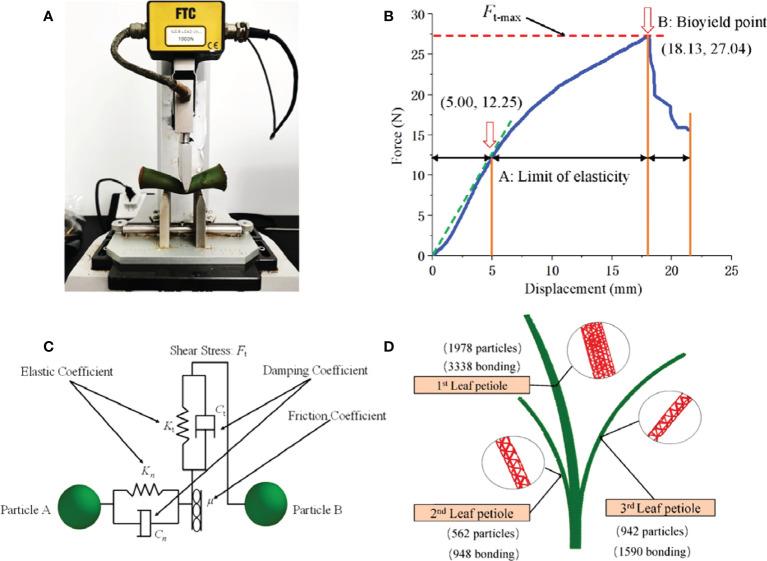
The taro harvesting process is affected by a complex system composed of particle mechanics system and multi-body dynamics system. The discrete element method(DEM) can effectively solve the nonlinear problem of the interaction between harvesting components and working materials. Therefore, the discrete element model of taro tiller plants is of great importance for taro harvesting. This paper proposes a simulation method to establish a discrete element flexible plant model and dynamic clamping and pulling process of taro tiller plant. Discrete Element models of taro corm and flexible tiller petiole and leaf were established using DEM method, and the discrete element flexible model of the taro plant was established. Taro clamping and pulling force testing platform was designed and built. The single factor and Plackett-Burman experiments were used to determine the simulation parameters and optimize the taro plant model by taking the correlation coefficient of clamping force and correlation coefficient of pulling force collected from the simulation and the bench experiment as the experiment index. The parameter calibration results of discrete element model of taro plant are as follows: petiole-petiole method/tangential contact stiffness was 8.15×10 N·m, and normal/tangential critical stress was 6.65×10 Pa. The contact stiffness of pseudostem- corm method was 1.22×10 N·m, the critical stress of normal/tangential was 1.18×10 Pa, and the energy of soil surface was 4.15×10J·m. When the pulling speed is 0.1, 0.2, 0.3, 0.4 and 0.5 m·s, the correlation coefficients between the simulation experiment and the bench experiment are 0.812, 0.850, 0.770, 0.697 and 0.652, respectively. The average value of correlation coefficient is 0.756, indicating that the simulated discrete element plant model is close to the real plant model. The discrete element model of taro plant established in this paper has high reliability. The final purpose of this paper is to provide a model reference for the design and optimization of taro harvester by discrete element method.
芋头收获过程受颗粒力学系统和多体动力学系统组成的复杂系统影响。离散元法(DEM)能有效解决收获部件与工作物料间相互作用的非线性问题。因此,芋头分蘖植株的离散元模型对芋头收获至关重要。本文提出一种模拟方法,用于建立离散元柔性植株模型及芋头分蘖植株的动态夹持与拔取过程。采用DEM方法建立了芋头球茎、柔性分蘖叶柄和叶片的离散元模型,并建立了芋头植株的离散元柔性模型。设计搭建了芋头夹持与拔取力测试平台。以模拟和台架试验采集的夹持力相关系数和拔取力相关系数为试验指标,采用单因素试验和Plackett-Burman试验确定模拟参数并优化芋头植株模型。芋头植株离散元模型的参数标定结果如下:叶柄-叶柄法/切向接触刚度为8.15×10 N·m,法向/切向临界应力为6.65×10 Pa。假茎-球茎法的接触刚度为1.22×10 N·m,法向/切向临界应力为1.18×10 Pa,土壤表面能量为4.15×10J·m。当拔取速度为0.1、0.2、0.3、0.4和0.5 m·s时,模拟试验与台架试验的相关系数分别为0.812、0.850、0.770、0.697和0.652。相关系数平均值为0.756,表明模拟的离散元植株模型与真实植株模型接近。本文建立的芋头植株离散元模型具有较高可靠性。本文的最终目的是为采用离散元法设计和优化芋头收获机提供模型参考。




 Zotero 插件