
电阻率层析成像(ERT)和地球化学分析数据集,用于划定受生猪粪便池塘影响的地下区域。
Electrical resistivity tomography (ERT) and geochemical analysis dataset to delimit subsurface affected areas by livestock pig slurry ponds.
作者信息
Capa-Camacho Ximena, Martínez-Pagán Pedro, Martínez-Segura Marcos, Gabarrón María, Faz Ángel
机构信息
Department of Mining and Civil Engineering, Universidad Politécnica de Cartagena, 30203 Cartagena, Spain.
Sustainable Use, Management, and Reclamation of Soil and Water Research Group, Escuela Técnica Superior de Ingeniería Agronómica, Universidad Politécnica de Cartagena, Paseo Alfonso XIII, 52, 30203 Cartagena, Spain.
出版信息
Data Brief. 2022 Oct 21;45:108684. doi: 10.1016/j.dib.2022.108684. eCollection 2022 Dec.
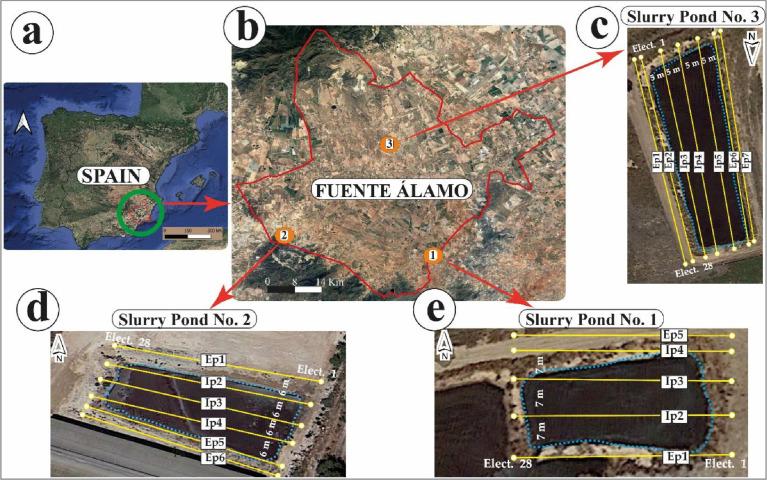
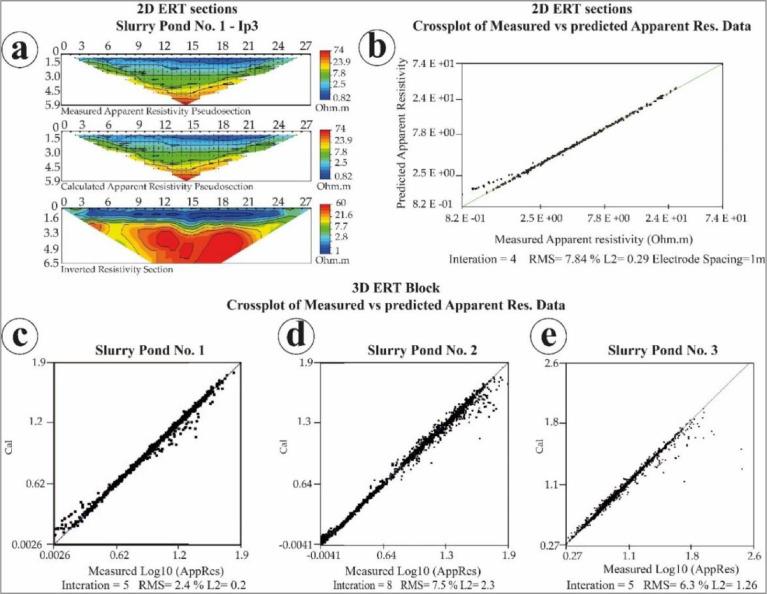
The electrical resistivity tomography (ERT) technique was employed with the support of geochemical analyses to delimit the affected surface area by slurry pig ponds. Data were taken in three selected slurry ponds located in Fuente Álamo municipality, Murcia region (SE Spain), to obtain electrical resistivity value-based 2D sections and 3D blocks. All ERT-based survey data were obtained in September 2020 using a SuperSting R8 resistivity meter from Advanced Geosciences Inc. and using the dipole-dipole array consisting of a total of twenty-eight electrodes. The soil samples were taken from drilling core sampling by boreholes at each slurry pond, and physical-chemical analyses of soil samples were obtained using standard laboratory testing methods. Electrical resistivity values and physical-chemical analysis data obtained from soil samples were contrasted, whose comparison showed a correlation between profiles-based electrical resistivity, laboratory-based electrical conductivity (EC) data, and nitrate (N-NO) content from soil samples. The statistical analysis was run by SPSS Statistics v.23 software (IBM, Neconductivity York, NY, USA) to establish the non-parametric Spearman correlation. The dataset establishes a reliable methodology and provides insight and information to delimit the affected subsurface area by pig slurry. Data contained within this publication are presented concurrently with Capa-Camacho et al. 2022 [1].
在地球化学分析的支持下,采用电阻层析成像(ERT)技术来划定泥浆猪粪池影响的地表区域。在位于穆尔西亚地区(西班牙东南部)丰特阿拉莫市的三个选定泥浆池中采集数据,以获取基于电阻率值的二维剖面和三维体块。所有基于ERT的测量数据均于2020年9月使用Advanced Geosciences Inc.公司的SuperSting R8电阻率仪并采用由总共28个电极组成的偶极 - 偶极阵列获得。土壤样本从每个泥浆池的钻孔岩芯采样中获取,并使用标准实验室测试方法对土壤样本进行物理化学分析。对比了从土壤样本中获得的电阻率值和物理化学分析数据,其比较显示了基于剖面的电阻率、基于实验室的电导率(EC)数据以及土壤样本中硝酸盐(N - NO)含量之间的相关性。使用SPSS Statistics v.23软件(IBM,美国纽约州纽约市)进行统计分析以建立非参数斯皮尔曼相关性。该数据集建立了一种可靠的方法,并为划定猪粪浆影响的地下区域提供了见解和信息。本出版物中包含的数据与卡帕 - 卡马乔等人2022年的研究[1]同时呈现。




 Zotero 插件