Graham Hugh A, Puttock Alan K, Elliott Mark, Anderson Karen, Brazier Richard E
Centre for Resilience in Environment, Water and Waste (CREWW), Geography College of Life and Environmental Sciences, University of Exeter Exeter UK.
Devon Wildlife Trust Exeter Devon UK.
Hydrol Process. 2022 Nov;36(11):e14735. doi: 10.1002/hyp.14735. Epub 2022 Nov 1.
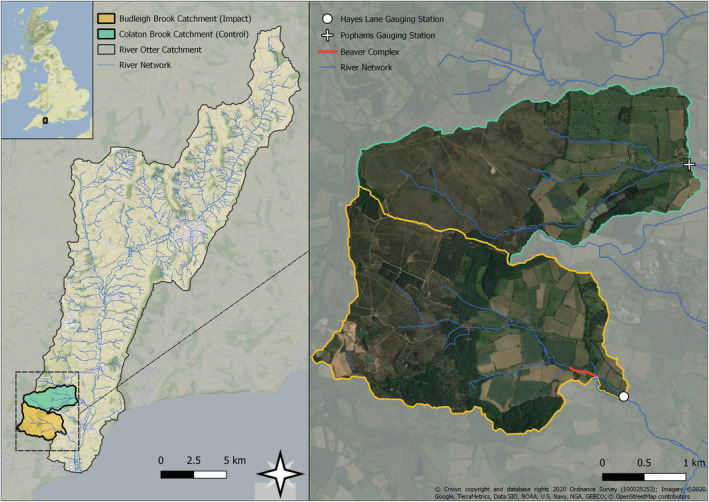
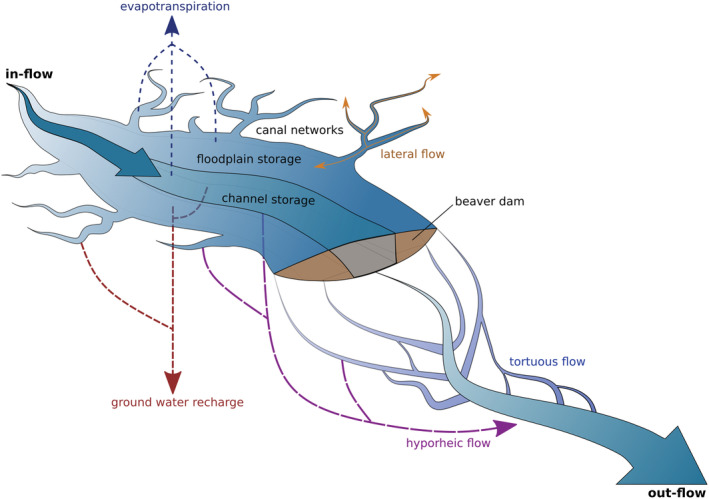
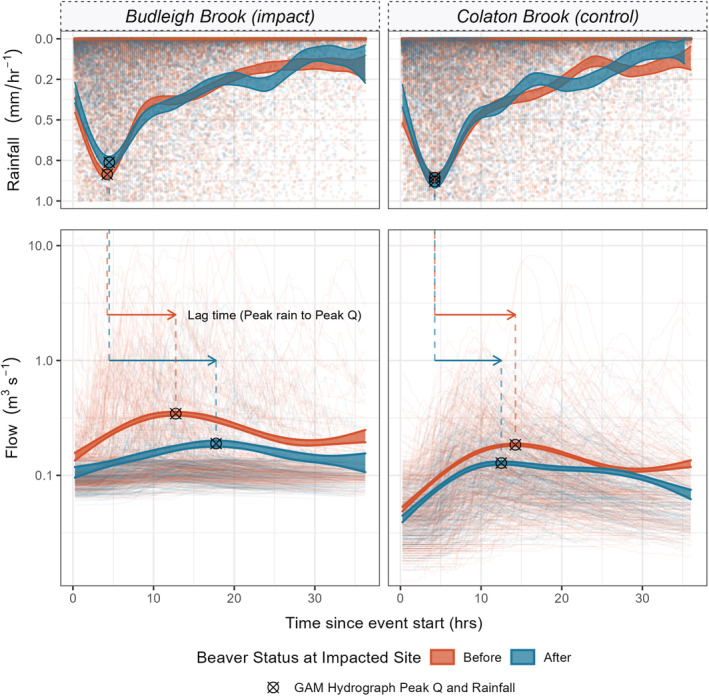
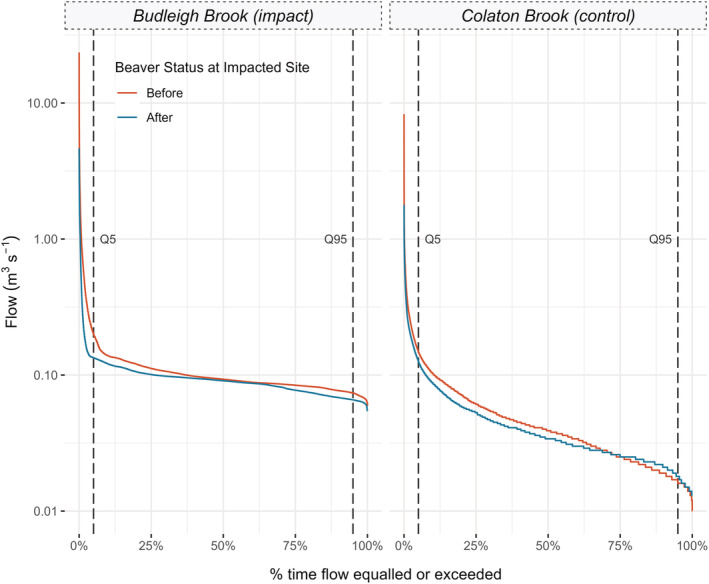
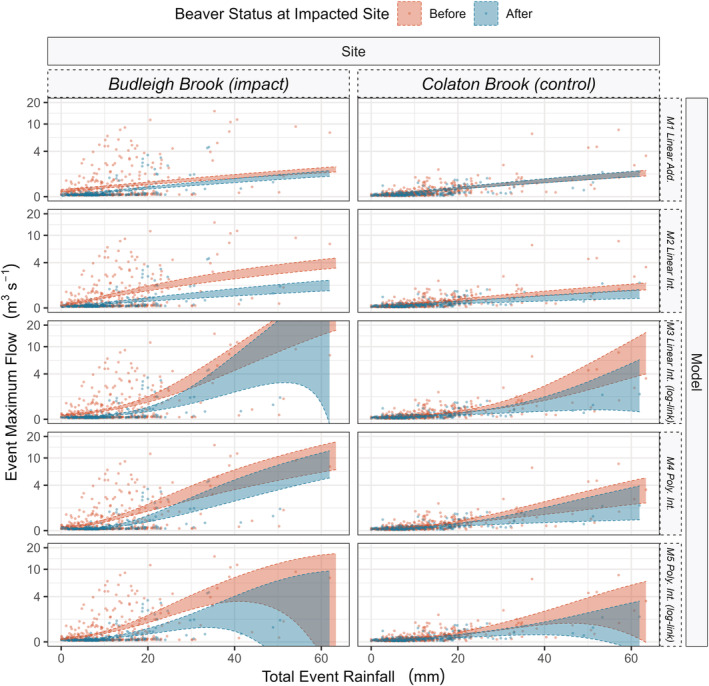
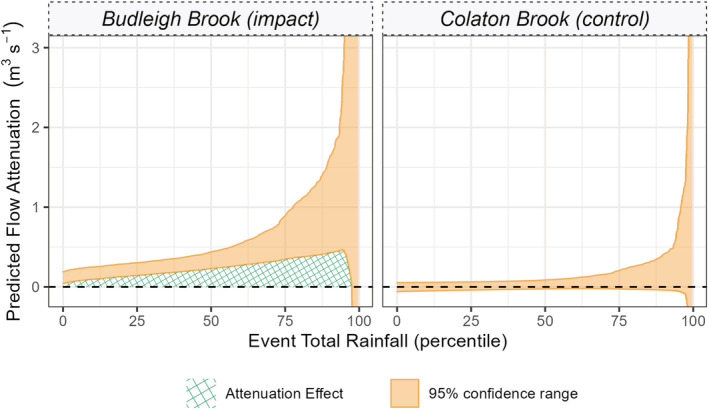
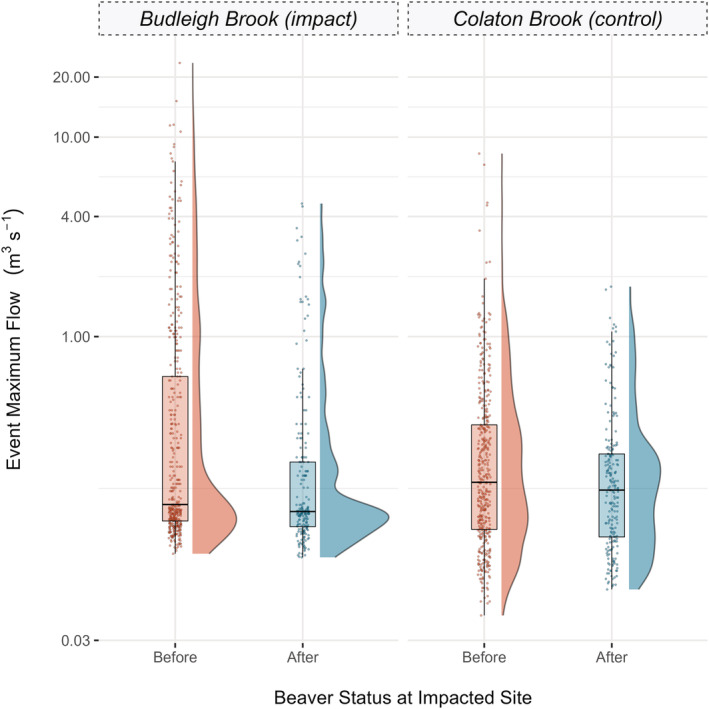
Beavers influence hydrology by constructing woody dams. Using a Before After Control Impact experimental design, we quantified the effects of a beaver dam sequence on the flow regime of a stream in SW England and consider the mechanisms that underpin flow attenuation in beaver wetlands. Rainfall-driven hydrological events were extracted between 2009 and 2020, for the impacted ( = 612) and control ( = 634) catchments, capturing events 7 years before and 3 years after beaver occupancy, at the impacted site. General additive models were used to describe average hydrograph geometry across all events. After beaver occupancy, Lag times increased by 55.9% in the impacted site and declined by 17.5% in the control catchment. Flow duration curve analysis showed a larger reduction in frequency of high flows, following beaver dam construction, with declines of Q5 exceedance levels of 33% for the impacted catchment and 15% for the control catchment. Using event total rainfall to predict peak flow, five generalized linear models were fitted to test the hypothesis that beaver dams attenuate flow, to a greater degree, with larger storm magnitude. The best performing model showed, with high confidence, that beaver dams attenuated peak flows, with increasing magnitude, up to between 0.5 and 2.5 m s for the 94th percentile of event total rainfall; but attenuation beyond the 97th percentile cannot be confidently detected. Increasing flow attenuation, with event magnitude, is attributed to transient floodplain storage in low gradient/profile floodplain valleys that results from an increase in active area of the floodplain. These findings support the assertion that beaver dams attenuate flows. However, with long-term datasets of extreme hydrological events lacking, it is challenging to predict the effect of beaver dams during extreme events with high precision. Beaver dams will have spatially variable impacts on hydrological processes, requiring further investigation to quantify responses to dams across differing landscapes and scales.
河狸通过建造木质水坝影响水文状况。我们采用“前-后-对照-影响”实验设计,量化了河狸水坝序列对英格兰西南部一条溪流径流状况的影响,并探讨了河狸湿地径流衰减的潜在机制。提取了2009年至2020年期间受影响集水区(n = 612)和对照集水区(n = 634)的降雨驱动水文事件,涵盖了河狸在受影响地点定居前7年和定居后3年的事件。使用广义相加模型描述所有事件的平均水位流量过程线几何形态。河狸定居后,受影响地点的滞后时间增加了55.9%,而对照集水区的滞后时间减少了17.5%。流量历时曲线分析表明,河狸建造水坝后,高流量频率的下降幅度更大,受影响集水区Q5超标水平下降了33%,对照集水区下降了15%。利用事件总降雨量预测峰值流量,拟合了五个广义线性模型,以检验河狸水坝在更大程度上随着暴雨强度增加而衰减流量的假设。表现最佳的模型高度可靠地表明,河狸水坝会衰减峰值流量,随着事件总降雨量第94百分位数的增加,衰减幅度可达0.5至2.5米/秒;但无法可靠检测到超过第97百分位数的衰减情况。随着事件强度增加,流量衰减加剧归因于低坡度/剖面洪泛平原山谷中的临时洪泛区蓄水,这是由洪泛区活跃面积增加导致的。这些发现支持了河狸水坝会衰减流量的观点。然而,由于缺乏极端水文事件的长期数据集,高精度预测河狸水坝在极端事件中的影响具有挑战性。河狸水坝对水文过程的影响在空间上存在差异,需要进一步研究以量化不同景观和尺度对水坝的响应。