Laboratory of Cancer Stem Cell Research, Candiolo Cancer Institute, FPO-IRCCS, Candiolo, Turin, Italy.
Department of Oncology, University of Turin Medical School, Candiolo, Turin, Italy.
Clin Cancer Res. 2023 Apr 3;29(7):1252-1266. doi: 10.1158/1078-0432.CCR-22-2903.
Current glioma diagnostic guidelines call for molecular profiling to stratify patients into prognostic and treatment subgroups. In case the tumor tissue is inaccessible, cerebrospinal fluid (CSF) has been proposed as a reliable tumor DNA source for liquid biopsy. We prospectively investigated the use of CSF for molecular characterization of newly diagnosed gliomas.
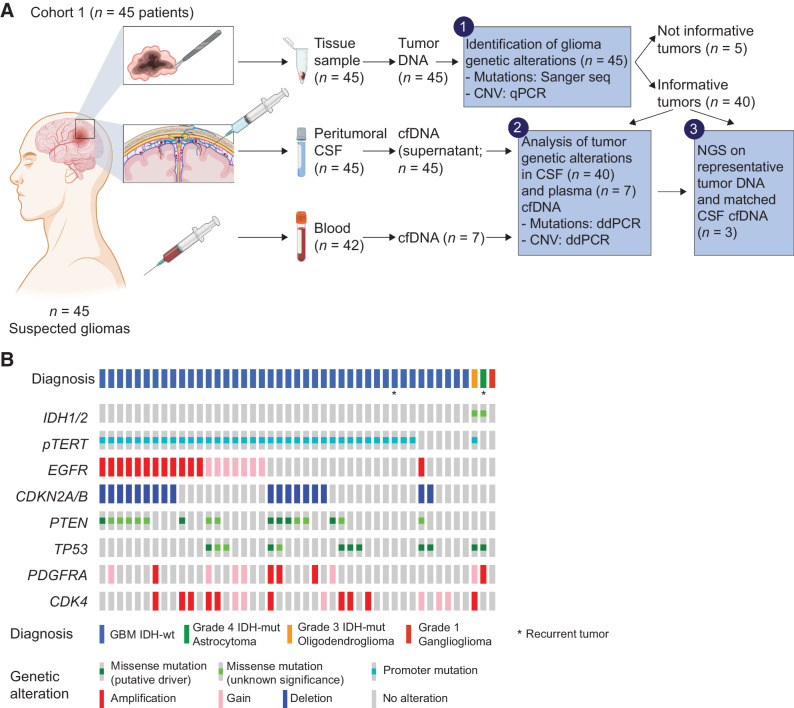
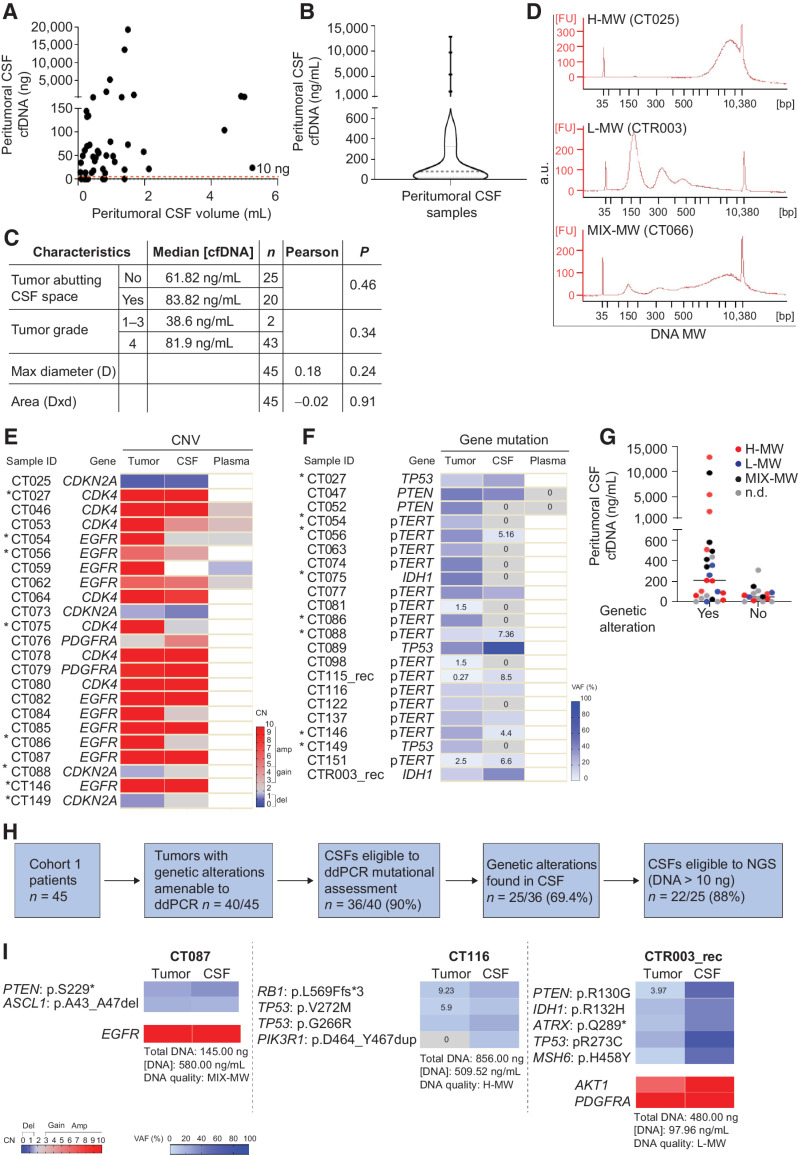
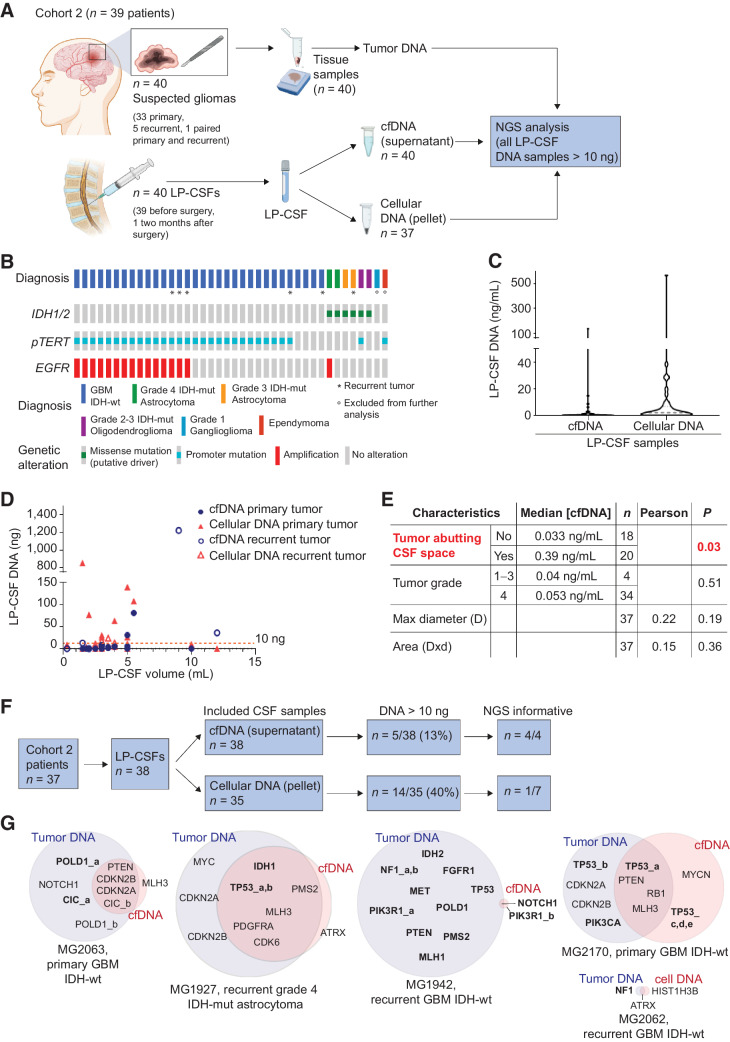
We recruited two cohorts of newly diagnosed patients with glioma, one (n = 45) providing CSF collected in proximity of the tumor, the other (n = 39) CSF collected by lumbar puncture (LP). Both cohorts provided tumor tissues by surgery concomitant with CSF sampling. DNA samples retrieved from CSF and matched tumors were systematically characterized and compared by comprehensive (NGS, next-generation sequencing) or targeted (ddPCR, droplet digital PCR) methodologies. Conventional and molecular diagnosis outcomes were compared.
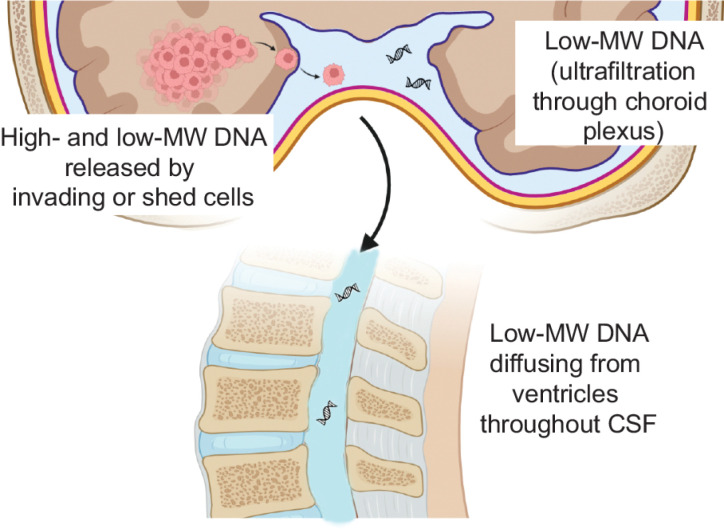
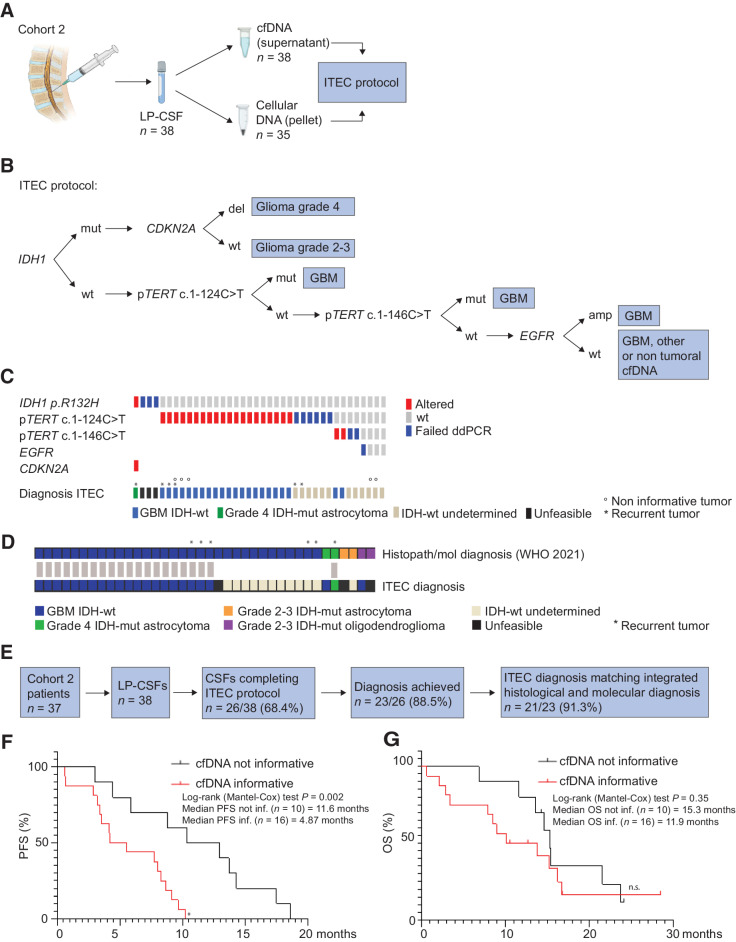
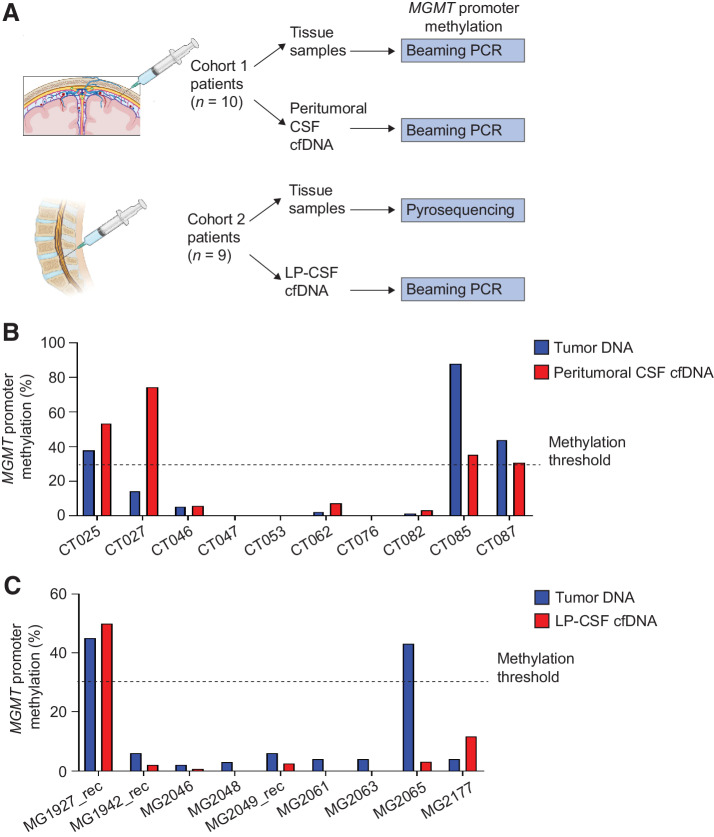
We report that tumor DNA is abundant in CSF close to the tumor, but scanty and mostly below NGS sensitivity threshold in CSF from LP. Indeed, tumor DNA is mostly released by cells invading liquoral spaces, generating a gradient that attenuates by departing from the tumor. Nevertheless, in >60% of LP CSF samples, tumor DNA is sufficient to assess a selected panel of genetic alterations (IDH and TERT promoter mutations, EGFR amplification, CDKN2A/B deletion: ITEC protocol) and MGMT methylation that, combined with imaging, enable tissue-agnostic identification of main glioma molecular subtypes.
This study shows potentialities and limitations of CSF liquid biopsy in achieving molecular characterization of gliomas at first clinical presentation and proposes a protocol to maximize diagnostic information retrievable from CSF DNA.
目前的胶质瘤诊断指南要求对分子谱进行分析,将患者分为预后和治疗亚组。如果肿瘤组织不可用,脑脊液(CSF)已被提议作为液体活检的可靠肿瘤 DNA 来源。我们前瞻性地研究了 CSF 在新诊断的胶质瘤分子特征分析中的应用。
我们招募了两组新诊断的胶质瘤患者,一组(n=45)提供靠近肿瘤采集的 CSF,另一组(n=39)通过腰椎穿刺(LP)采集 CSF。两组患者均在手术时同时提供 CSF 和肿瘤组织样本。从 CSF 和匹配的肿瘤中提取的 DNA 样本通过综合(NGS,下一代测序)或靶向(ddPCR,数字液滴 PCR)方法进行系统表征和比较。比较了常规和分子诊断结果。
我们报告说,靠近肿瘤的 CSF 中肿瘤 DNA 丰富,但 LP CSF 中的肿瘤 DNA 稀少且大部分低于 NGS 检测灵敏度阈值。事实上,肿瘤 DNA 主要是由浸润性液体空间的细胞释放的,产生的梯度会随着远离肿瘤而减弱。然而,在>60%的 LP CSF 样本中,肿瘤 DNA 足以评估一组选定的遗传改变(IDH 和 TERT 启动子突变、EGFR 扩增、CDKN2A/B 缺失:ITEC 方案)和 MGMT 甲基化,结合影像学,可以在没有组织学依据的情况下识别主要的胶质瘤分子亚型。
这项研究展示了 CSF 液体活检在初次临床就诊时实现胶质瘤分子特征分析的潜力和局限性,并提出了一种最大限度地从 CSF DNA 中获取诊断信息的方案。