• 文献检索
  • 文档翻译
  • 深度研究
  • 学术资讯
  • Suppr Zotero 插件Zotero 插件
  • 邀请有礼
  • 套餐&价格
  • 历史记录
应用&插件
Suppr Zotero 插件Zotero 插件浏览器插件Mac 客户端Windows 客户端微信小程序
定价
高级版会员购买积分包购买API积分包
服务
文献检索文档翻译深度研究API 文档MCP 服务
关于我们
关于 Suppr公司介绍联系我们用户协议隐私条款
关注我们

Suppr 超能文献

核心技术专利:CN118964589B侵权必究
粤ICP备2023148730 号-1Suppr @ 2026

文献检索

告别复杂PubMed语法,用中文像聊天一样搜索,搜遍4000万医学文献。AI智能推荐,让科研检索更轻松。

立即免费搜索

文件翻译

保留排版,准确专业,支持PDF/Word/PPT等文件格式,支持 12+语言互译。

免费翻译文档

深度研究

AI帮你快速写综述,25分钟生成高质量综述,智能提取关键信息,辅助科研写作。

立即免费体验

胸腺瘤 CTLA4 阳性细胞数量减少与重症肌无力发生概率升高相关。

Reduced Number of Thymoma CTLA4-Positive Cells Is Associated With a Higher Probability of Developing Myasthenia Gravis.

机构信息

From the Neuromuscular Diseases Unit (R.Á.-V., D.R.-L., E.C.-V., I.I.), Department of Neurology, Hospital de la Santa Creu i Sant Pau, Barcelona; Department of Medicine (R.Á.-V., D.R.-L.), Universitat Autónoma de Barcelona; Memory Unit (O.D.-I., S.E.B.), Neurology Department and Sant Pau Biomedical Research Institute, Hospital de la Santa Creu i Sant Pau, Universitat Autònoma de Barcelona; Network Center for Biomedical Research in Neurodegenerative Diseases (CIBERNED) (O.D.-I., S.E.B.), Madrid; Departments of Pathology (L.L.-V.) and Thoracic Surgery (J.C.T.), Hospital de la Santa Creu i Sant Pau, Barcelona; Neuromuscular Diseases Group (X.S.-C., E.G.), Sant Pau Biomedical Research Institute, Hospital de la Santa Creu i Sant Pau, Barcelona; and Centro de Investigación Biomédica en Red de Enfermedades Raras (CIBERER) (E.G.), Instituto de Salud Carlos III, Madrid.

出版信息

Neurol Neuroimmunol Neuroinflamm. 2023 Jan 25;10(2). doi: 10.1212/NXI.0000000000200085. Print 2023 Mar.

DOI:10.1212/NXI.0000000000200085
PMID:36697230
原文链接:https://pmc.ncbi.nlm.nih.gov/articles/PMC9879278/
Abstract

BACKGROUND AND OBJECTIVES

Myasthenia gravis (MG) is an autoimmune disease associated with comorbid thymoma in 10%-15% of cases. Cytotoxic T lymphocyte-associated antigen 4 (CTLA4) expressed by T cells downregulates T-cell-mediated immune response. Polymorphisms in the CTLA4 gene have been associated with the development of MG. In this context, we aimed to determine whether CTLA4 expression in the thymoma differs between patients with and without MG and whether CTLA4 gene polymorphisms are associated with these differences.

METHODS

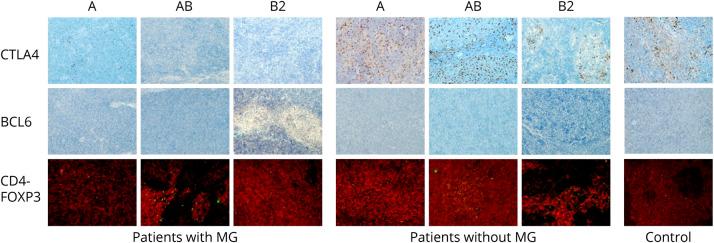
This is a retrospective study of all patients, with and without MG, surgically treated at our institution for thymoma between January 2010 and December 2020. Ten samples were obtained from normal thymuses as controls. The number of CTLA4-positive cells in paraffin-embedded thymoma samples was determined by immunohistochemistry. The presence of follicular-center and regulatory T-cell lymphocytes was determined by immunohistochemistry (B-cell lymphoma [BCL]-6 expression) and double immunofluorescence-based staining of CD4-FOXP3, respectively. We evaluated the association between thymic expression of CTLA4 and the development of MG. We also determined the association between CTLA4 expression and various clinical and prognostic characteristics of MG. We sequenced the CTLA4 gene and evaluated possible associations between CTLA4 polymorphisms and thymic CTLA4 expression. Finally, we assessed the potential association between these polymorphisms and the risk of MG.

RESULTS

Forty-one patients with thymoma were included. Of them, 23 had comorbid MG (56.1%). On average, patients with MG had fewer CTLA4-positive cells in the thymoma than non-MG patients: 69.3 cells/mm (95% CIs: 39.6-99.1) vs 674.4 (276.0-1,024.0) cells/mm; = 0.001 and vs controls (200.74 [57.9-343.6] cells/mm; = 0.02). No between-group differences (MG vs non-MG) were observed in the number of cells positive for BCL6 or CD4-FOXP3. CTLA4 expression was not associated with differences in MG outcome or treatment refractoriness. Two polymorphisms were detected in the CTLA4 gene, rs231770 (n = 30 patients) and rs231775 (n = 17). MG was present in a similar proportion of patients for all genotypes. However, a nonsignificant trend toward a lower CTLA4-positive cell count was observed among carriers of the rs231775 polymorphism vs noncarriers: 77.9 cells/mm (95% CI: -51.5 to 207.5) vs 343.3 cells/mm (95% CI: 126.2-560.4).

DISCUSSION

Reduced CTLA4 expression in thymoma may predispose to a higher risk of developing MG.

摘要

背景和目的

重症肌无力(MG)是一种自身免疫性疾病,约 10%-15%的病例与胸腺瘤合并存在。T 细胞表达的细胞毒性 T 淋巴细胞相关抗原 4(CTLA4)可下调 T 细胞介导的免疫反应。CTLA4 基因的多态性与 MG 的发生有关。在这种情况下,我们旨在确定 CTLA4 在胸腺瘤中的表达是否在伴有和不伴有 MG 的患者之间存在差异,以及 CTLA4 基因多态性是否与这些差异相关。

方法

这是一项回顾性研究,纳入了 2010 年 1 月至 2020 年 12 月在我院因胸腺瘤接受手术治疗的所有伴有和不伴有 MG 的患者。10 例正常胸腺组织标本作为对照。通过免疫组织化学检测石蜡包埋胸腺瘤标本中 CTLA4 阳性细胞的数量。通过免疫组织化学(B 细胞淋巴瘤[BCL]-6 表达)和 CD4-FOXP3 的双免疫荧光染色分别确定滤泡中心和调节性 T 细胞淋巴细胞的存在。我们评估了 CTLA4 在胸腺中的表达与 MG 发生之间的相关性。我们还评估了 CTLA4 表达与 MG 的各种临床和预后特征之间的相关性。我们对 CTLA4 基因进行了测序,并评估了 CTLA4 多态性与胸腺 CTLA4 表达之间的可能关联。最后,我们评估了这些多态性与 MG 风险之间的潜在关联。

结果

共纳入 41 例胸腺瘤患者。其中 23 例合并 MG(56.1%)。平均而言,伴有 MG 的患者胸腺瘤中 CTLA4 阳性细胞数少于非 MG 患者:69.3 个细胞/mm(95%CI:39.6-99.1)vs 674.4(276.0-1024.0)个细胞/mm;=0.001 和 vs 对照组(200.74[57.9-343.6]个细胞/mm;=0.02)。BCL6 或 CD4-FOXP3 阳性细胞数在 MG 组与非 MG 组之间无差异。CTLA4 表达与 MG 结局或治疗抵抗无相关性。在 CTLA4 基因中检测到两个多态性,rs231770(n=30 例)和 rs231775(n=17 例)。所有基因型的 MG 患者比例相似。然而,与非携带者相比,rs231775 多态性携带者的 CTLA4 阳性细胞计数有降低的趋势,但无统计学意义:77.9 个细胞/mm(95%CI:-51.5 至 207.5)vs 343.3 个细胞/mm(95%CI:126.2 至 560.4)。

讨论

胸腺瘤中 CTLA4 表达减少可能导致发生 MG 的风险增加。

https://cdn.ncbi.nlm.nih.gov/pmc/blobs/2340/9879278/518d28bee34f/NXI-2022-200092f2.jpg
https://cdn.ncbi.nlm.nih.gov/pmc/blobs/2340/9879278/ab0d081f7cc7/NXI-2022-200092f1.jpg
https://cdn.ncbi.nlm.nih.gov/pmc/blobs/2340/9879278/518d28bee34f/NXI-2022-200092f2.jpg
https://cdn.ncbi.nlm.nih.gov/pmc/blobs/2340/9879278/ab0d081f7cc7/NXI-2022-200092f1.jpg
https://cdn.ncbi.nlm.nih.gov/pmc/blobs/2340/9879278/518d28bee34f/NXI-2022-200092f2.jpg

相似文献

1
Reduced Number of Thymoma CTLA4-Positive Cells Is Associated With a Higher Probability of Developing Myasthenia Gravis.胸腺瘤 CTLA4 阳性细胞数量减少与重症肌无力发生概率升高相关。
Neurol Neuroimmunol Neuroinflamm. 2023 Jan 25;10(2). doi: 10.1212/NXI.0000000000200085. Print 2023 Mar.
2
Late-onset myasthenia gravis - CTLA4(low) genotype association and low-for-age thymic output of naïve T cells.迟发性重症肌无力- CTLA4(低)基因型关联和幼稚 T 细胞的年龄相关胸腺输出减少。
J Autoimmun. 2014 Aug;52:122-9. doi: 10.1016/j.jaut.2013.12.006. Epub 2013 Dec 24.
3
Thymoma in Patient with Myasthenia Gravis Has Significantly Fewer Forkhead Box P3 Positive Lymphocytes than that without One.重症肌无力患者的胸腺瘤中,叉头框P3阳性淋巴细胞显著少于无胸腺瘤的患者。
Kurume Med J. 2015;61(3-4):65-71. doi: 10.2739/kurumemedj.MS65002. Epub 2015 Aug 25.
4
CTLA4 variants and haplotype contribute genetic susceptibility to myasthenia gravis in northern Chinese population.CTLA4基因变异和单倍型对中国北方人群重症肌无力具有遗传易感性。
PLoS One. 2014 Jul 8;9(7):e101986. doi: 10.1371/journal.pone.0101986. eCollection 2014.
5
A CTLA4high genotype is associated with myasthenia gravis in thymoma patients.CTLA4高基因型与胸腺瘤患者的重症肌无力相关。
Ann Neurol. 2005 Oct;58(4):644-8. doi: 10.1002/ana.20577.
6
Two-color flow cytometric analysis of thymic lymphocytes from patients with myasthenia gravis and/or thymoma.对重症肌无力患者和/或胸腺瘤患者胸腺淋巴细胞进行双色流式细胞术分析。
Clin Immunol Immunopathol. 1992 Jan;62(1 Pt 1):91-6. doi: 10.1016/0090-1229(92)90027-l.
7
Thymopoiesis, regulatory T cells, and TCRVbeta expression in thymoma with and without myasthenia gravis, and modulatory effects of steroid therapy.伴或不伴重症肌无力的胸腺瘤中的胸腺生成、调节性T细胞及TCRVβ表达,以及类固醇疗法的调节作用
J Clin Immunol. 2008 Mar;28(2):194-206. doi: 10.1007/s10875-007-9147-2. Epub 2007 Nov 14.
8
Risk factors associated with myasthenia gravis in thymoma patients: The potential role of thymic germinal centers.与胸腺瘤患者重症肌无力相关的风险因素:胸腺生发中心的潜在作用。
J Autoimmun. 2020 Jan;106:102337. doi: 10.1016/j.jaut.2019.102337. Epub 2019 Oct 5.
9
Thymoma pathology and myasthenia gravis outcomes.胸腺瘤病理学与重症肌无力结局。
Muscle Nerve. 2021 Jun;63(6):868-873. doi: 10.1002/mus.27220. Epub 2021 Mar 16.
10
Thymectomy and systemic lupus erythematosus (SLE).胸腺切除术与系统性红斑狼疮(SLE)
Ann Ital Chir. 2014 Nov-Dec;85(6):617-8.

引用本文的文献

1
Fluorescent probes in autoimmune disease research: current status and future prospects.自身免疫性疾病研究中的荧光探针:现状与未来展望。
J Transl Med. 2025 Apr 9;23(1):411. doi: 10.1186/s12967-025-06430-5.
2
A new gene signature associated with disulfidptosis that forecasts myasthenia gravis and suggests infiltration of immune microenvironment in thymoma patients.一种与二硫键介导的程序性坏死相关的新基因特征,可预测重症肌无力,并提示胸腺瘤患者免疫微环境的浸润情况。
Heliyon. 2024 Apr 15;10(8):e29650. doi: 10.1016/j.heliyon.2024.e29650. eCollection 2024 Apr 30.
3
Molecular and Functional Key Features and Oncogenic Drivers in Thymic Carcinomas.

本文引用的文献

1
Genomic Insights into Myasthenia Gravis Identify Distinct Immunological Mechanisms in Early and Late Onset Disease.重症肌无力的基因组学研究揭示了早发性和晚发性疾病中不同的免疫机制。
Ann Neurol. 2021 Sep;90(3):455-463. doi: 10.1002/ana.26169. Epub 2021 Aug 4.
2
Immune checkpoint inhibitor related myasthenia gravis: single center experience and systematic review of the literature.免疫检查点抑制剂相关重症肌无力:单中心经验和文献系统评价。
J Immunother Cancer. 2019 Nov 21;7(1):319. doi: 10.1186/s40425-019-0774-y.
3
Risk factors associated with myasthenia gravis in thymoma patients: The potential role of thymic germinal centers.
胸腺癌的分子与功能关键特征及致癌驱动因素
Cancers (Basel). 2023 Dec 29;16(1):166. doi: 10.3390/cancers16010166.
4
Neurologic Complications of Cancer Immunotherapy.癌症免疫治疗的神经系统并发症。
Curr Oncol. 2023 Jun 19;30(6):5876-5897. doi: 10.3390/curroncol30060440.
与胸腺瘤患者重症肌无力相关的风险因素:胸腺生发中心的潜在作用。
J Autoimmun. 2020 Jan;106:102337. doi: 10.1016/j.jaut.2019.102337. Epub 2019 Oct 5.
4
Pathogenic Mechanisms and Clinical Correlations in Autoimmune Myasthenic Syndromes.自身免疫性肌无力综合征的发病机制与临床关联
Semin Neurol. 2018 Jun;38(3):344-354. doi: 10.1055/s-0038-1660500. Epub 2018 Jul 16.
5
Inter-relationship among myasthenia gravis, WHO histology, and Masaoka clinical stage and effect on surgical methods in patients with thymoma: a retrospective cohort study.重症肌无力、世界卫生组织组织学类型、Masaoka临床分期之间的相互关系及其对胸腺瘤患者手术方式的影响:一项回顾性队列研究
J Thorac Dis. 2018 May;10(5):2981-2990. doi: 10.21037/jtd.2018.05.30.
6
International consensus guidance for management of myasthenia gravis: Executive summary.重症肌无力管理的国际共识指南:执行摘要。
Neurology. 2016 Jul 26;87(4):419-25. doi: 10.1212/WNL.0000000000002790. Epub 2016 Jun 29.
7
Increased frequency of thymic T follicular helper cells in myasthenia gravis patients with thymoma.胸腺瘤型重症肌无力患者胸腺T滤泡辅助细胞频率增加。
J Thorac Dis. 2016 Mar;8(3):314-22. doi: 10.21037/jtd.2016.03.03.
8
Treg Cell Differentiation: From Thymus to Peripheral Tissue.调节性T细胞分化:从胸腺到外周组织
Prog Mol Biol Transl Sci. 2015;136:175-205. doi: 10.1016/bs.pmbts.2015.07.014. Epub 2015 Aug 18.
9
Thymoma associated with autoimmune diseases: 85 cases and literature review.胸腺瘤合并自身免疫性疾病:85 例病例并文献复习。
Autoimmun Rev. 2016 Jan;15(1):82-92. doi: 10.1016/j.autrev.2015.09.005. Epub 2015 Sep 25.
10
Myasthenia gravis: subgroup classification and therapeutic strategies.重症肌无力:亚组分类与治疗策略。
Lancet Neurol. 2015 Oct;14(10):1023-36. doi: 10.1016/S1474-4422(15)00145-3.