
意向性再植术治疗牙齿脱出性脱位:1例病例报告
Intentional Replantation as Treatment of Extrusive Luxation: A Case Report.
作者信息
Satie Takamiya Aline, Raniel Figueiredo Leonardo, Lourenço Debortoli Caio Vinicius, Hara Sonoda Paulo Koji, de Abreu Costa Luy, Flor Figueiredo Cássio Messias Beija, Sonoda Celso Koogi
机构信息
Dental School of Araçatuba, São Paulo State University (UNESP), Araçatuba, SP, Brazil.
Federal University of Triângulo Mineiro (UFTM), Medical School, Uberaba, MG, Brazil.
出版信息
Iran Endod J. 2022;17(4):205-208. doi: 10.22037/iej.v17i4.38469.
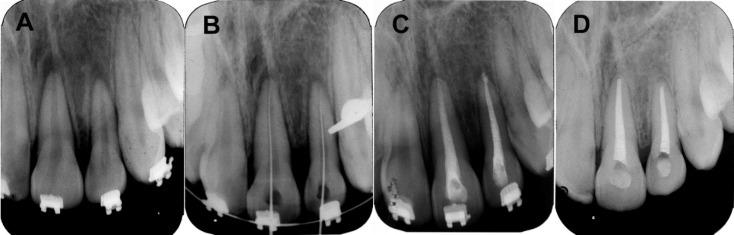
Accurate diagnosis, immediate care and proper treatment planning are important factors for the successful treatment of dental traumatic injuries. In extrusive luxation, postponement in treatment may lead to the need for new strategies for the resolution of unwanted consequences. The present case report describes an unusual condition of delayed treatment regarding extrusive luxation of two anterior teeth treated by intentional replantation. An 18-year-old female patient attended the Dental School for the treatment of a traumatic injury to the anterior teeth 5 days after a fall from a bicycle. Clinically, teeth #21 and #22 were extruded in incisal edges for 5 mm from their neighboring teeth, had edematous gingiva, showed grade II mobility and were painful to percussion. Radiographically, the roots were intact and the periodontal ligament space was thickened along its entire length. As immediate repositioning could not be performed, intentional replantation was recommended. After detaching the periodontal ligament, the teeth were extracted and the alveolus was curetted and irrigated with saline solution to remove the already-formed clot. After replantation, the teeth were restrained and the patient was medicated with antibiotics as well as analgesics. After 10 days, the splint was removed, the root canals were instrumented and then, filled with calcium hydroxide. After 30 days, they were completely obturated using gutta-percha. The 5-year follow-up showed root integrity, absence of mobility and normal periodontium. The outcomes of the current case report revealed that when intentional replantation was properly conducted, it could be considered an option for the treatment of extrusive luxation where the teeth were not to be immediately repositioned.
准确的诊断、及时的护理和恰当的治疗计划是成功治疗牙外伤的重要因素。在牙齿脱出性脱位中,治疗延迟可能导致需要采取新策略来解决不良后果。本病例报告描述了一例通过有意再植治疗两颗前牙脱出性脱位的延迟治疗的特殊情况。一名18岁女性患者在从自行车上摔下5天后到牙科学院治疗前牙外伤。临床检查发现,21号和22号牙切缘相对于邻牙脱出5毫米,牙龈水肿,Ⅱ度松动,叩诊疼痛。影像学检查显示,牙根完整,牙周膜间隙在全长范围内增宽。由于无法立即进行复位,建议采用有意再植。分离牙周膜后,拔除患牙,刮除牙槽窝并用生理盐水冲洗以清除已形成的血凝块。再植后,固定患牙,并给予患者抗生素和镇痛药。10天后,拆除夹板,预备根管,然后用氢氧化钙充填。30天后,用牙胶尖进行根管完全充填。5年随访显示牙根完整,无松动,牙周组织正常。本病例报告的结果表明,当正确进行有意再植时,对于不能立即复位的脱出性脱位牙,可将其视为一种治疗选择。

 Zotero 插件