
鉴定并分析导致原发卵巢功能不全伴抵抗卵巢综合征的新型复合杂合变异。
Identification and characterization of novel compound heterozygous variants in causing primary ovarian insufficiency with resistant ovary syndrome.
机构信息
Reproductive Medicine Center, Department of Reproductive Endocrinology, Zhejiang Provincial People's Hospital, Affiliated People's Hospital, Hangzhou Medical College, Hangzhou, China.
Department of Genetic and Genomic Medicine, Zhejiang Provincial People's Hospital, Affiliated People's Hospital, Hangzhou Medical College, Hangzhou, China.
出版信息
Front Endocrinol (Lausanne). 2023 Jan 10;13:1013894. doi: 10.3389/fendo.2022.1013894. eCollection 2022.
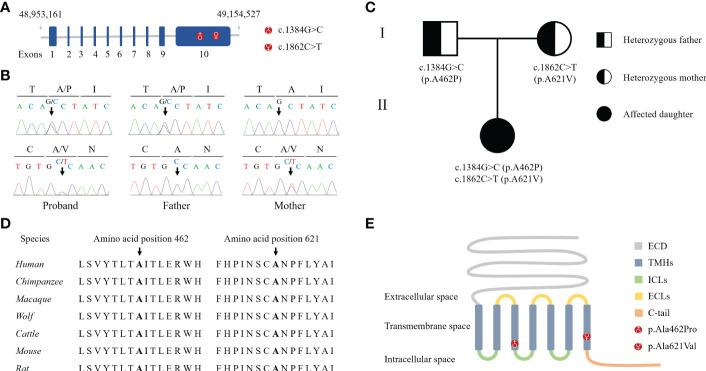
Primary ovarian insufficiency (POI) is among the foremost causes of women infertility due to premature partial or total loss of ovarian function. Resistant ovary syndrome (ROS) is a subtype of POI manifested as normal ovarian reserve but insensitive to gonadotropin stimulation. Inactivating variants of follicle-stimulating hormone receptor (FSHR), a class A G-protein coupled receptor, have been associated with POI and are inherited an autosomal recessive pattern. In this study, we investigated the genetic causes of a primary infertility patient manifested as POI with ROS, and elucidated the structural and functional impact of variants of uncertain significance. Next-generation sequencing (NGS) combined with Sanger sequencing revealed novel compound heterozygous variants: c.1384G>C/p.Ala462Pro and c.1862C>T/p.Ala621Val, inherited from her father and mother, respectively. The two altered amino acid sequences, localized in the third and seventh transmembrane helix of FSHR, were predicted as deleterious by prediction. experiments revealed that the p.Ala462Pro variant resulted in barely detectable levels of intracellular signaling both in cAMP-dependent CRE-reporter activity and ERK activation and displayed a severely reduced plasma membrane receptor expression. In contrast, the p.Ala621Val variant resulted in partial loss of receptor activation without disruption of cell surface expression. In conclusion, two unreported inactivating variants potentially responsible for POI with ROS were first identified. This study expands the current phenotypic and genotypic spectrum of POI.
原发性卵巢功能不全(POI)是导致女性不孕的主要原因之一,其病因是卵巢功能过早地部分或完全丧失。抵抗卵巢综合征(ROS)是 POI 的一种亚型,表现为正常的卵巢储备功能,但对促性腺激素刺激不敏感。促卵泡生成素受体(FSHR)的失活变异体是一种 A 类 G 蛋白偶联受体,与 POI 相关,呈常染色体隐性遗传模式。在这项研究中,我们调查了一名表现为 POI 伴 ROS 的原发性不孕患者的遗传病因,并阐明了意义不明变异体的结构和功能影响。新一代测序(NGS)结合 Sanger 测序揭示了新的复合杂合变异体:c.1384G>C/p.Ala462Pro 和 c.1862C>T/p.Ala621Val,分别来自她的父亲和母亲。这两个改变的氨基酸序列定位于 FSHR 的第三和第七跨膜螺旋,预测实验表明它们具有有害性。实验表明,p.Ala462Pro 变异体导致细胞内信号几乎检测不到,无论是在 cAMP 依赖性 CRE 报告基因活性还是 ERK 激活方面,并且显示出严重降低的质膜受体表达。相比之下,p.Ala621Val 变异体导致受体激活部分丧失,而不破坏细胞表面表达。总之,首次鉴定了两个可能导致 ROS 伴 POI 的未报道的失活变异体。本研究扩展了 POI 的现有表型和基因型谱。

 Zotero 插件