Kaiser Permanente Division of Research, 2000 Broadway, Oakland, CA 94612. Email:
Am J Manag Care. 2023 Jan 1;29(1):e13-e17. doi: 10.37765/ajmc.2023.89307.
Telemedicine use expanded greatly during the COVID-19 pandemic, and broad use of telemedicine is expected to persist beyond the pandemic. More evidence on the efficiency and safety of different telemedicine modalities is needed to inform clinical and policy decisions around telemedicine use. To evaluate the efficiency and safety of telemedicine, we compared treatment and follow-up care between video and telephone visits during the COVID-19 pandemic.
Observational study of patient-scheduled telemedicine visits for primary care.
We used multivariate logistic regression to compare treatment (medication prescribing, laboratory/imaging orders) and 7-day follow-up care (in-person office visits, emergency department visits, and hospitalizations) between video and telephone visits, adjusted for patient characteristics.
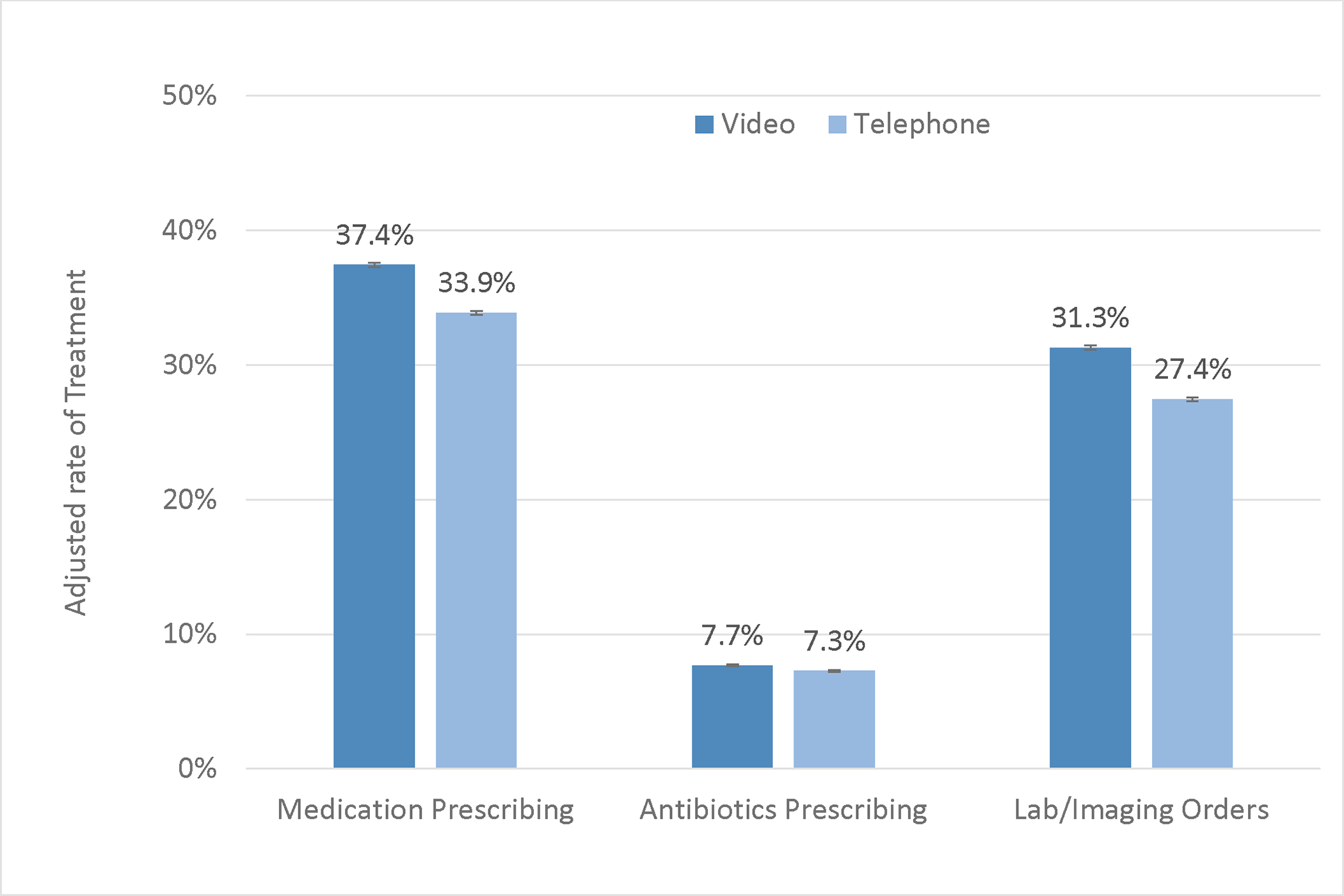
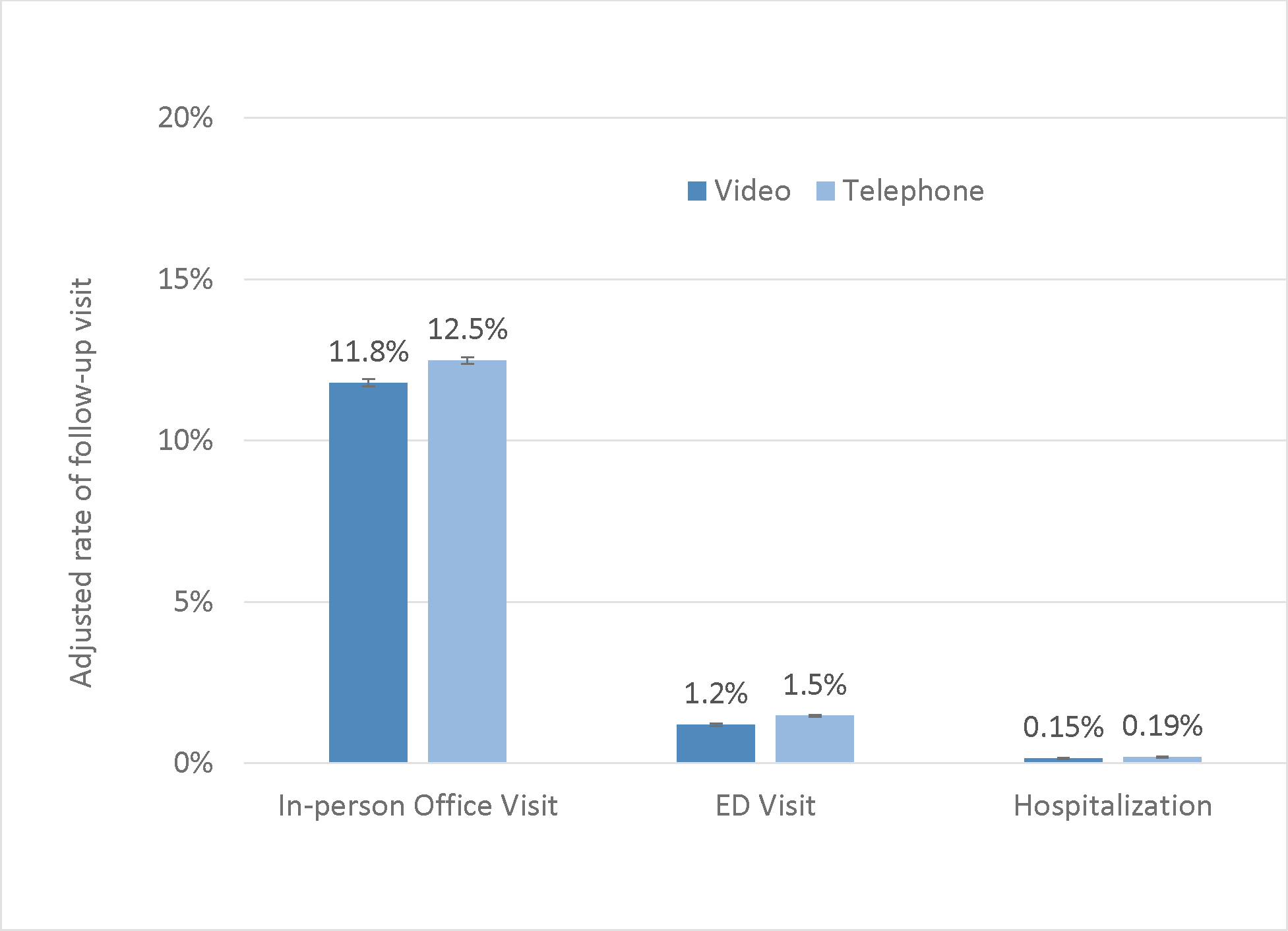
Among 734,442 telemedicine visits, 58.4% were telephone visits. Adjusted rates of medication prescribing and laboratory/imaging orders were higher in video visits than telephone visits, with differences of 3.5% (95% CI, 3.3%-3.8%) and 3.9% (95% CI, 3.6%-4.1%), respectively. Adjusted rates of 7-day follow-up in-person office visits, emergency department visits, and hospitalizations were lower after video than telephone visits, with differences of 0.7% (95% CI, 0.5%-0.9%), 0.3% (95% CI, 0.2%-0.3%), and 0.04% (95% CI, 0.02%-0.06%), respectively.
Among telemedicine visits with primary care clinicians, return visits were not common and downstream emergency events were rare. Adjusted rates of treatment measures were higher and adjusted rates of follow-up care were lower for video visits than telephone visits. Although video visits were marginally more efficient than telephone visits, telephone visits may offer an accessible option to address patient primary care needs without raising safety concerns.
在 COVID-19 大流行期间,远程医疗的使用大大增加,预计远程医疗的广泛使用将持续到大流行之后。需要更多关于不同远程医疗模式的效率和安全性的证据,以便为远程医疗的使用提供临床和政策决策依据。为了评估远程医疗的效率,我们比较了 COVID-19 大流行期间视频和电话就诊的治疗和随访护理。
对初级保健患者预约远程医疗就诊的观察性研究。
我们使用多变量逻辑回归比较了视频和电话就诊之间的治疗(药物处方、实验室/影像学检查)和 7 天随访护理(门诊、急诊和住院),并根据患者特征进行了调整。
在 734442 次远程医疗就诊中,58.4%为电话就诊。视频就诊的药物处方和实验室/影像学检查率高于电话就诊,差异分别为 3.5%(95%CI,3.3%-3.8%)和 3.9%(95%CI,3.6%-4.1%)。视频就诊后 7 天内门诊就诊、急诊就诊和住院就诊的调整率低于电话就诊,差异分别为 0.7%(95%CI,0.5%-0.9%)、0.3%(95%CI,0.2%-0.3%)和 0.04%(95%CI,0.02%-0.06%)。
在与初级保健临床医生进行的远程医疗就诊中,复诊并不常见,下游急诊事件也很少见。与电话就诊相比,视频就诊的治疗措施调整率较高,随访护理调整率较低。尽管视频就诊的效率略高于电话就诊,但电话就诊可能为满足患者的基本医疗需求提供了一种可及的选择,而不会引起安全问题。