
西班牙萨利内塔高盐湿地微生物群落的垂直结构
Vertical organization of microbial communities in Salineta hypersaline wetland, Spain.
作者信息
Bourhane Zeina, Cagnon Christine, Castañeda Carmen, Rodríguez-Ochoa Rafael, Álvaro-Fuentes Jorge, Cravo-Laureau Cristiana, Duran Robert
机构信息
Université de Pau et des Pays de l'Adour, E2S UPPA, CNRS, IPREM, Pau, France.
Estación Experimental de Aula Dei, EEAD-CSIC, Zaragoza, Spain.
出版信息
Front Microbiol. 2023 Jan 27;14:869907. doi: 10.3389/fmicb.2023.869907. eCollection 2023.
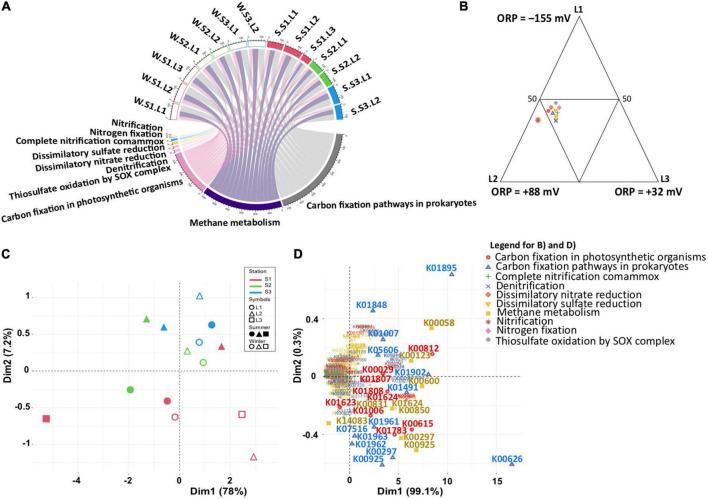
Microbial communities inhabiting hypersaline wetlands, well adapted to the environmental fluctuations due to flooding and desiccation events, play a key role in the biogeochemical cycles, ensuring ecosystem service. To better understand the ecosystem functioning, we studied soil microbial communities of Salineta wetland (NE Spain) in dry and wet seasons in three different landscape stations representing situations characteristic of ephemeral saline lakes: S1 soil usually submerged, S2 soil intermittently flooded, and S3 soil with halophytes. Microbial community composition was determined according to different redox layers by 16S rRNA gene barcoding. We observed reversed redox gradient, negative at the surface and positive in depth, which was identified by PERMANOVA as the main factor explaining microbial distribution. The Pseudomonadota, Gemmatimonadota, Bacteroidota, Desulfobacterota, and Halobacteriota phyla were dominant in all stations. Linear discriminant analysis effect size (LEfSe) revealed that the upper soil surface layer was characterized by the predominance of operational taxonomic units (OTUs) affiliated to strictly or facultative anaerobic halophilic bacteria and archaea while the subsurface soil layer was dominated by an OTU affiliated to , an aerobic alkali-tolerant bacterium. In addition, the potential functional capabilities, inferred by PICRUSt2 analysis, involved in carbon, nitrogen, and sulfur cycles were similar in all samples, irrespective of the redox stratification, suggesting functional redundancy. Our findings show microbial community changes according to water flooding conditions, which represent useful information for biomonitoring and management of these wetlands whose extreme aridity and salinity conditions are exposed to irreversible changes due to human activities.
栖息在高盐湿地的微生物群落,由于洪水和干涸事件而能很好地适应环境波动,在生物地球化学循环中发挥着关键作用,确保生态系统服务。为了更好地理解生态系统功能,我们研究了西班牙东北部萨利内塔湿地在旱季和雨季三个不同景观站点的土壤微生物群落,这三个站点代表了季节性盐湖的典型情况:S1土壤通常被淹没,S2土壤间歇性被洪水淹没,S3土壤生长有盐生植物。通过16S rRNA基因条形码技术,根据不同的氧化还原层确定微生物群落组成。我们观察到氧化还原梯度反转,表面为负,深度为正,经PERMANOVA分析确定这是解释微生物分布的主要因素。在所有站点中,假单胞菌门、芽单胞菌门、拟杆菌门、脱硫杆菌门和盐杆菌门占主导地位。线性判别分析效应大小(LEfSe)显示,土壤表层的特征是隶属于严格或兼性厌氧嗜盐细菌和古菌的操作分类单元(OTU)占优势,而地下土壤层则由隶属于一种好氧耐碱细菌的OTU主导。此外,通过PICRUSt2分析推断的参与碳、氮和硫循环的潜在功能能力在所有样本中相似,与氧化还原分层无关,表明功能冗余。我们的研究结果表明,微生物群落会根据水淹条件发生变化,这为这些湿地的生物监测和管理提供了有用信息,因为这些湿地的极端干旱和盐碱条件因人类活动而面临不可逆转的变化。


 Zotero 插件