
肝硬化患者肝移植术后,移植前功能状态可预测术后发病率和死亡率。
Pretransplant Functional Status Predicts Postoperative Morbidity and Mortality after Liver Transplantation in Patients with Cirrhosis.
机构信息
Departments of Medicine, Sungkyunkwan University School of Medicine, Seoul, Korea.
Departments of Physical and Rehabilitation Medicine, Sungkyunkwan University School of Medicine, Seoul, Korea.
出版信息
Gut Liver. 2023 Sep 15;17(5):786-794. doi: 10.5009/gnl220337. Epub 2023 Feb 15.
BACKGROUND/AIMS: This study aimed to investigate whether pretransplant frailty can predict postoperative morbidity and mortality after liver transplantation (LT) in patients with cirrhosis.
METHODS
We retrospectively reviewed 242 patients who underwent LT between 2018 and 2020 at a tertiary hospital in Korea.
RESULTS
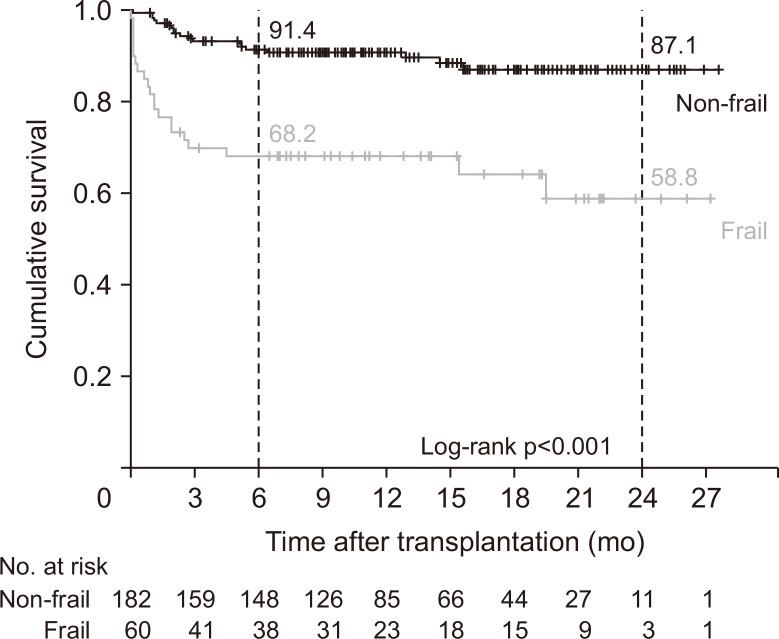
Among them, 189 patients (78.1%) received LT from a living donor. Physical frailty at baseline was assessed by the Short Physical Performance Battery (SPPB), by which patients were categorized into two groups: frail (SPPB <10) and non-frail (SPPB ≥10). Among the whole cohort (age, 55.0±9.2 years; male, 165 [68.2%]), 182 patients were classified as non-frail and 60 patients were classified as frail. Posttransplant survival was shorter in the frail group than the non-frail group (9.3 months vs 11.6 months). Postoperative intensive care unit stay was longer in the frail group than in the non-frail group (median, 6 days vs 4 days), and the 30-day complication rate was higher in the frail group than in the non-frail group (78.3% vs 59.3%). Frailty was an independent risk factor for posttransplant mortality (adjusted hazard ratio, 2.38; 95% confidence interval, 1.02 to 5.57). In subgroup analysis, frail patients showed lower posttransplant survival regardless of history of hepatocellular carcinoma and donor type.
CONCLUSIONS
Assessment of pretransplant frailty, as measured by SPPB, provides important prognostic information for clinical outcomes in cirrhotic patients undergoing LT.
背景/目的:本研究旨在探讨肝硬化患者肝移植(LT)前的虚弱状态是否可以预测术后发病率和死亡率。
方法
我们回顾性分析了 2018 年至 2020 年期间在韩国一家三级医院接受 LT 的 242 例患者。
结果
其中,189 例(78.1%)患者接受活体供者的 LT。基线时的身体虚弱状态通过简短体能测试(SPPB)进行评估,患者分为两组:虚弱(SPPB<10)和非虚弱(SPPB≥10)。在整个队列中(年龄,55.0±9.2 岁;男性,165[68.2%]),182 例患者被归类为非虚弱,60 例患者被归类为虚弱。虚弱组的移植后生存时间短于非虚弱组(9.3 个月比 11.6 个月)。虚弱组的术后重症监护病房停留时间长于非虚弱组(中位数,6 天比 4 天),虚弱组的 30 天并发症发生率高于非虚弱组(78.3%比 59.3%)。虚弱是移植后死亡的独立危险因素(调整后的危险比,2.38;95%置信区间,1.02 至 5.57)。在亚组分析中,无论是否存在肝细胞癌和供体类型,虚弱患者的移植后生存率均较低。
结论
通过 SPPB 评估的移植前虚弱状态为接受 LT 的肝硬化患者的临床结局提供了重要的预后信息。



 Zotero 插件