
快速细胞力传递的能量学。
The energetics of rapid cellular mechanotransduction.
机构信息
Department of Neurobiology, Duke University Medical Center, Durham, NC 27710.
Department of Mechanical Engineering and Materials Science, Duke University, Durham, NC 27710.
出版信息
Proc Natl Acad Sci U S A. 2023 Feb 21;120(8):e2215747120. doi: 10.1073/pnas.2215747120. Epub 2023 Feb 16.
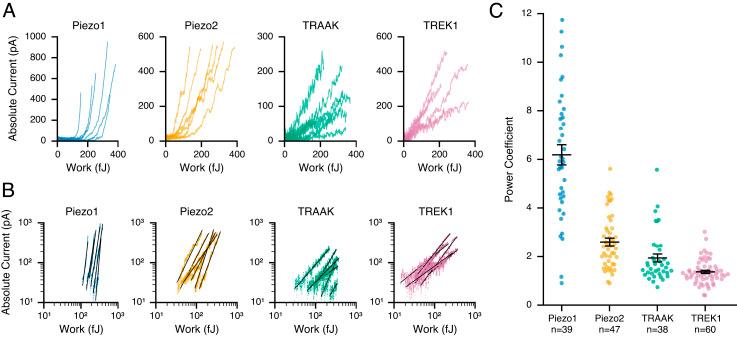
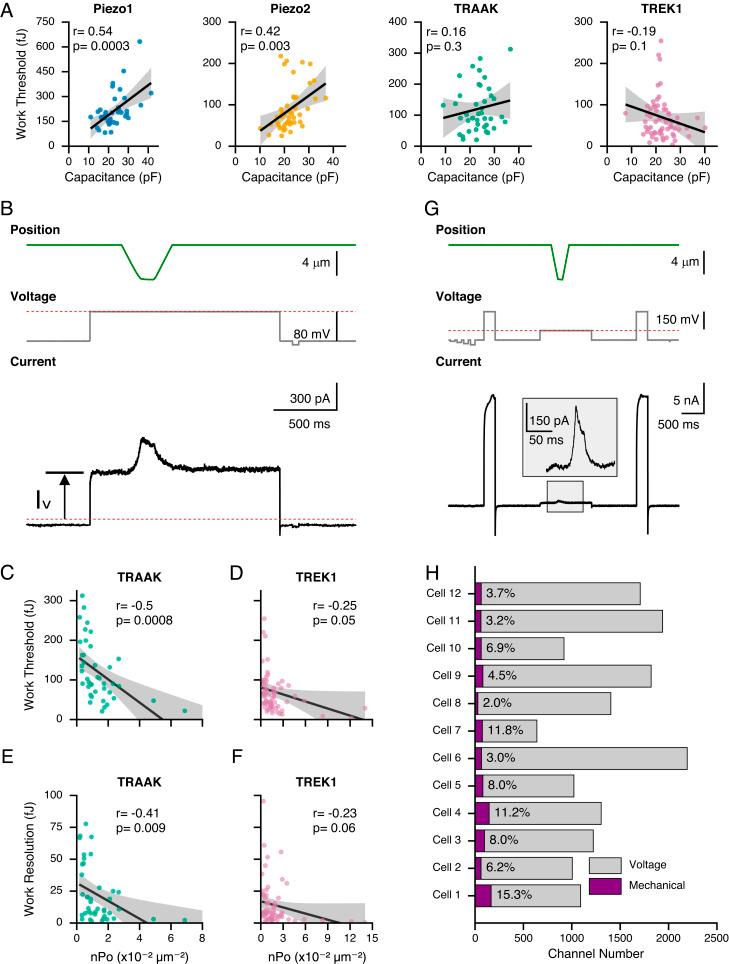
Cells throughout the human body detect mechanical forces. While it is known that the rapid (millisecond) detection of mechanical forces is mediated by force-gated ion channels, a detailed quantitative understanding of cells as sensors of mechanical energy is still lacking. Here, we combine atomic force microscopy with patch-clamp electrophysiology to determine the physical limits of cells expressing the force-gated ion channels (FGICs) Piezo1, Piezo2, TREK1, and TRAAK. We find that, depending on the ion channel expressed, cells can function either as proportional or nonlinear transducers of mechanical energy and detect mechanical energies as little as 100 fJ, with a resolution of up to ~1 fJ. These specific energetic values depend on cell size, channel density, and cytoskeletal architecture. We also make the surprising discovery that cells can transduce forces either nearly instantaneously (<1 ms) or with a substantial time delay (10 ms). Using a chimeric experimental approach and simulations, we show how such delays can emerge from channel-intrinsic properties and the slow diffusion of tension in the membrane. Overall, our experiments reveal the capabilities and limits of cellular mechanosensing and provide insights into molecular mechanisms that different cell types may employ to specialize for their distinct physiological roles.
人体细胞可以感知机械力。虽然众所周知,机械力的快速(毫秒级)检测是由力门控离子通道介导的,但对于细胞作为机械能传感器的详细定量理解仍有所欠缺。在这里,我们结合原子力显微镜和膜片钳电生理学来确定表达力门控离子通道(FGICs)Piezo1、Piezo2、TREK1 和 TRAAK 的细胞的物理极限。我们发现,根据表达的离子通道的不同,细胞可以作为机械能的比例或非线性传感器,检测低至约 100 fJ 的机械能,分辨率高达约 1 fJ。这些特定的能量值取决于细胞大小、通道密度和细胞骨架结构。我们还惊奇地发现,细胞可以几乎瞬间(<1 ms)或延迟很长时间(~10 ms)来传递力。我们使用嵌合实验方法和模拟,展示了这种延迟如何源自通道内在特性和膜中张力的缓慢扩散。总的来说,我们的实验揭示了细胞机械感知的能力和限制,并为不同细胞类型可能用于专门化其独特生理角色的分子机制提供了见解。





 Zotero 插件