Maglie Roberto, Solimani Farzan, Didona Dario, Pipitò Carlo, Antiga Emiliano, Di Zenzo Giovanni
Section of Dermatology, Department of Health Sciences, University of Florence, Florence, Italy.
Department of Dermatology, Venereology and Allergology, Charité - Universitätsmedizin Berlin, Corporate Member of Freie Universität Berlin, Humboldt-Universität zu Berlin, Berlin Institute of Health, Berlin, Germany.
Front Med (Lausanne). 2023 Feb 6;10:1128154. doi: 10.3389/fmed.2023.1128154. eCollection 2023.
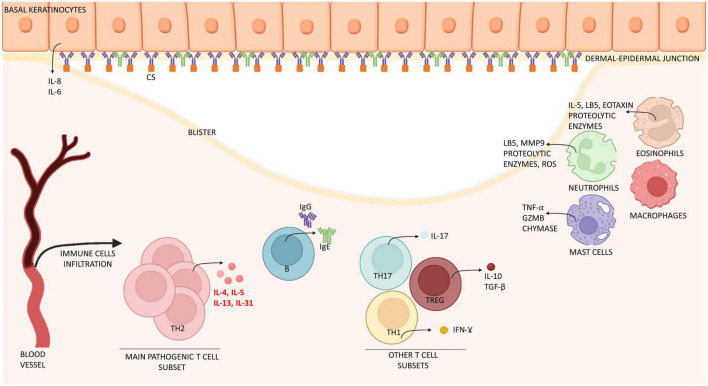
Bullous pemphigoid (BP) is the most common autoimmune bullous disease, characterized by severe pruritus and skin blistering. The loss of tolerance against Collagen XVII, also referred to as BP180, is the main pathogenic event of BP, leading to production of IgG autoantibodies which mainly target the juxtamembranous extracellular non-collagenous 16th A (NC16A) domain of BP180. A complex inflammatory network is activated upon autoantibody binding to the basement membrane zone; this inflammatory loop involves the complement cascade and the release of several inflammatory cytokines, chemokines and proteases from keratinocytes, lymphocytes, mast cells and granulocytes. Collectively, these events disrupt the integrity of the dermal-epidermal junction, leading to subepidermal blistering. Recent advances have led to identify novel therapeutic targets for BP, whose management is mainly based on the long-term use of topical and systemic corticosteroids. As an example, targeting type-2 T-helper cell-associated cytokines, such as Interleukin-4 and interleukin-13 has shown meaningful clinical efficacy in case series and studies; targeting IL-17 and IL-23 has also been tried, owing to an important role of these cytokines in the chronic maintenance phase of BP. In this review article, we discuss the complex cytokine milieu that characterized BP inflammation, highlighting molecules, which are currently investigated as present and future therapeutic targets for this life-threatening disease.
大疱性类天疱疮(BP)是最常见的自身免疫性大疱性疾病,其特征为严重瘙痒和皮肤水疱形成。对ⅩⅦ型胶原(也称为BP180)的免疫耐受丧失是BP的主要致病事件,导致产生主要靶向BP180近膜细胞外非胶原第16A(NC16A)结构域的IgG自身抗体。自身抗体与基底膜带结合后会激活一个复杂的炎症网络;这个炎症循环涉及补体级联反应以及角质形成细胞、淋巴细胞、肥大细胞和粒细胞释放多种炎性细胞因子、趋化因子和蛋白酶。这些事件共同破坏了真皮 - 表皮连接的完整性,导致表皮下水疱形成。最近的进展已促使人们确定了BP的新治疗靶点,其治疗主要基于长期使用局部和全身皮质类固醇。例如,靶向2型辅助性T细胞相关细胞因子,如白细胞介素 - 4和白细胞介素 - 13,在病例系列和研究中已显示出有意义的临床疗效;由于这些细胞因子在BP慢性维持期的重要作用,针对白细胞介素 - 17和白细胞介素 - 23的治疗也已进行尝试。在这篇综述文章中,我们讨论了以BP炎症为特征的复杂细胞因子环境,重点介绍了目前作为这种危及生命疾病的现有和未来治疗靶点正在研究的分子。