Oh Chang-Wug, Park Kyeong-Hyeon, Kim Joon-Woo, Kim Dong-Hyun, Seo Il, Lee Jin-Han, Kim Ji-Wan, Yoon Sung-Hyuk
Department of Orthopedic Surgery, School of Medicine, Kyungpook National University, Kyungpook National University Hospital, Daegu 41944, Republic of Korea.
Department of Orthopedic Surgery, Severance Children's Hospital, Yonsei University College of Medicine, Seoul 03722, Republic of Korea.
J Clin Med. 2023 Feb 7;12(4):1335. doi: 10.3390/jcm12041335.
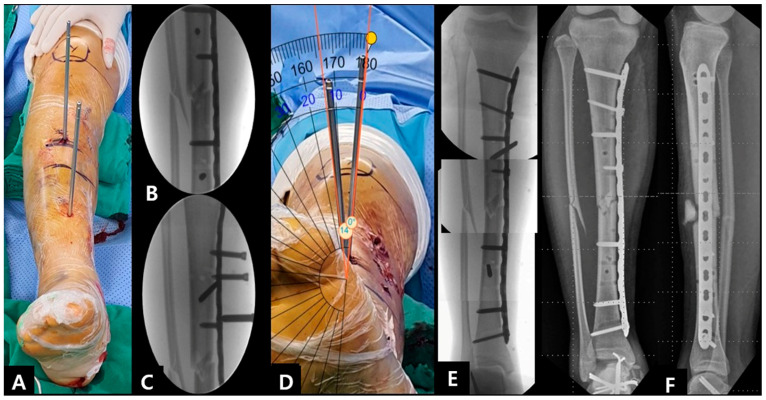
Correction of rotational malalignments caused by fractures is essential as it may cause pain and gait disturbances. This study evaluated the intraoperative use of a smartphone application (SP app) to measure the extent of corrective rotation in patients treated using minimally invasive derotational osteotomy. Intraoperatively, two parallel 5 mm Schanz pins were placed above and below the fractured/injured site, and derotation was performed manually after percutaneous osteotomy. A protractor SP app was used intraoperatively to measure the angle between the two Schanz pins (angle-SP). Intramedullary nailing or minimally invasive plate osteosynthesis was performed after derotation, and computerized tomography (CT) scans were used to assess the angle of correction postoperatively (angle-CT). The accuracy of rotational correction was assessed by comparing angle-SP and angle-CT. The mean preoperative rotational difference observed was 22.1°, while the mean angle-SP and angle-CT were 21.6° and 21.3°, respectively. A significant positive correlation between angle-SP and angle-CT was observed, and 18 out of 19 patients exhibited complete healing within 17.7 weeks (1 patient exhibited nonunion). These findings suggest that using an SP app during minimally invasive derotational osteotomy can result in accurate correction of malrotation of long bones in a reproducible manner. Therefore, SP technology with integrated gyroscope function represents a suitable alternative for determination of the magnitude of rotational correction when performing corrective osteotomy.
纠正骨折引起的旋转畸形至关重要,因为它可能导致疼痛和步态障碍。本研究评估了在使用微创去旋转截骨术治疗的患者中,术中使用智能手机应用程序(SP应用程序)测量矫正旋转程度的情况。术中,在骨折/损伤部位上方和下方平行放置两根5毫米的斯氏针,经皮截骨后手动进行去旋转操作。术中使用量角器SP应用程序测量两根斯氏针之间的角度(角度-SP)。去旋转后进行髓内钉固定或微创钢板接骨术,并使用计算机断层扫描(CT)评估术后矫正角度(角度-CT)。通过比较角度-SP和角度-CT评估旋转矫正的准确性。术前观察到的平均旋转差异为22.1°,而平均角度-SP和角度-CT分别为21.6°和21.3°。观察到角度-SP和角度-CT之间存在显著正相关,19例患者中有18例在17.7周内完全愈合(1例患者出现骨不连)。这些发现表明,在微创去旋转截骨术中使用SP应用程序可以以可重复的方式准确矫正长骨的旋转畸形。因此,具有集成陀螺仪功能的SP技术是进行矫正截骨术时确定旋转矫正幅度的合适替代方法。