Rathnayaka Achala R, Chethana K W Thilini, Phillips Alan J L, Liu Jian-Kui, Samarakoon Milan C, Jones E B Gareth, Karunarathna Samantha C, Zhao Chang-Lin
School of Science, Mae Fah Luang University, Chiang Rai 57100, Thailand.
Center of Excellence in Fungal Research, Mae Fah Luang University, Chiang Rai 57100, Thailand.
J Fungi (Basel). 2023 Jan 29;9(2):184. doi: 10.3390/jof9020184.
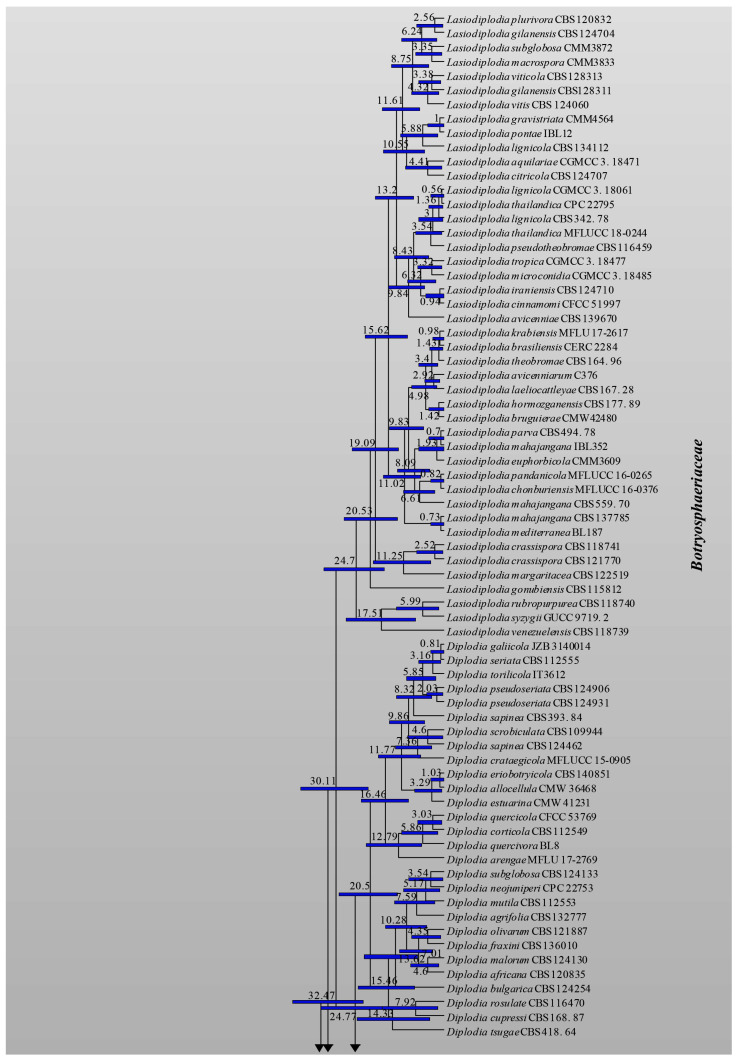
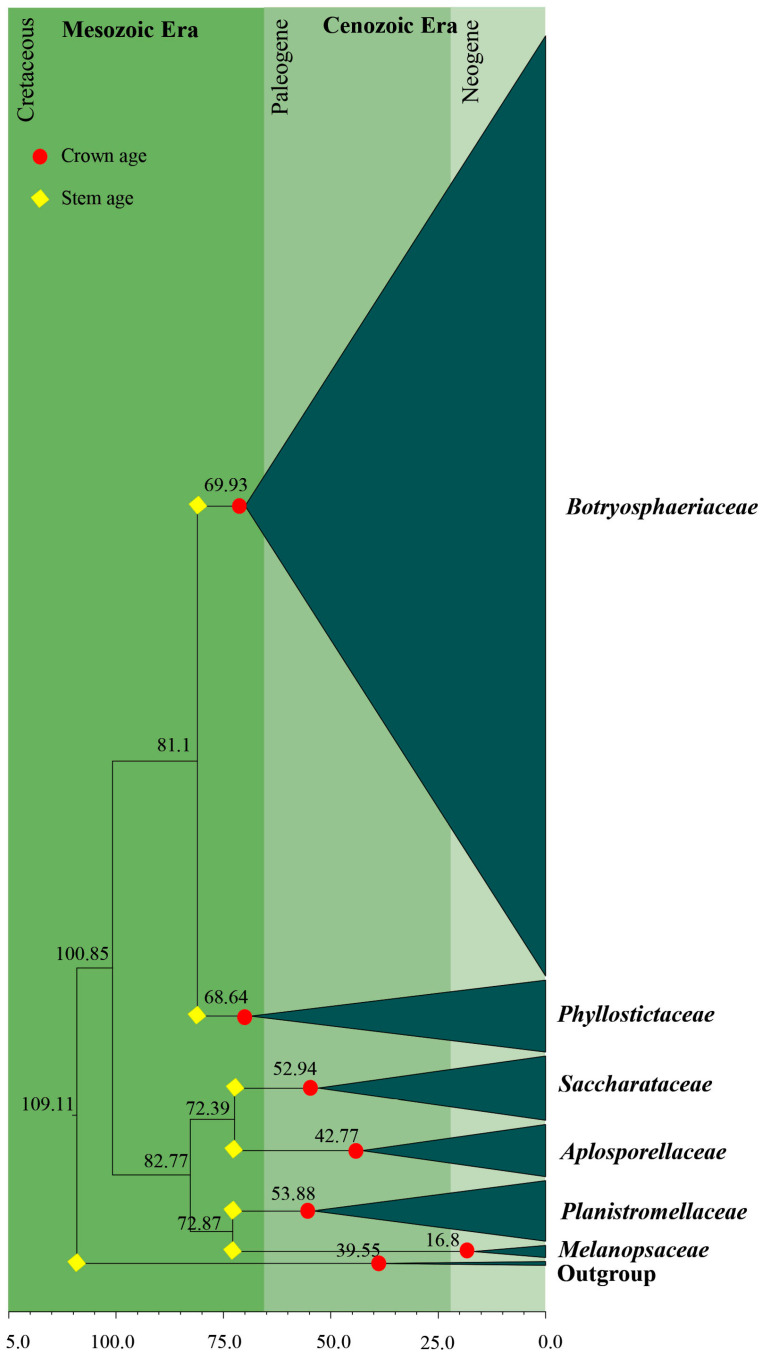
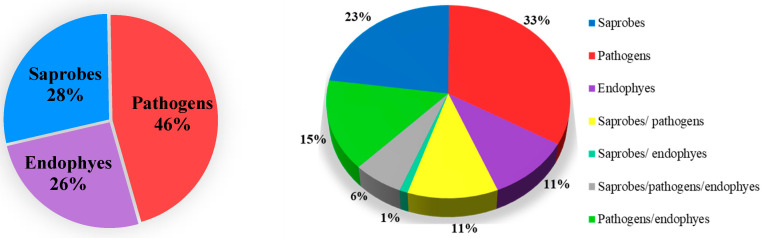
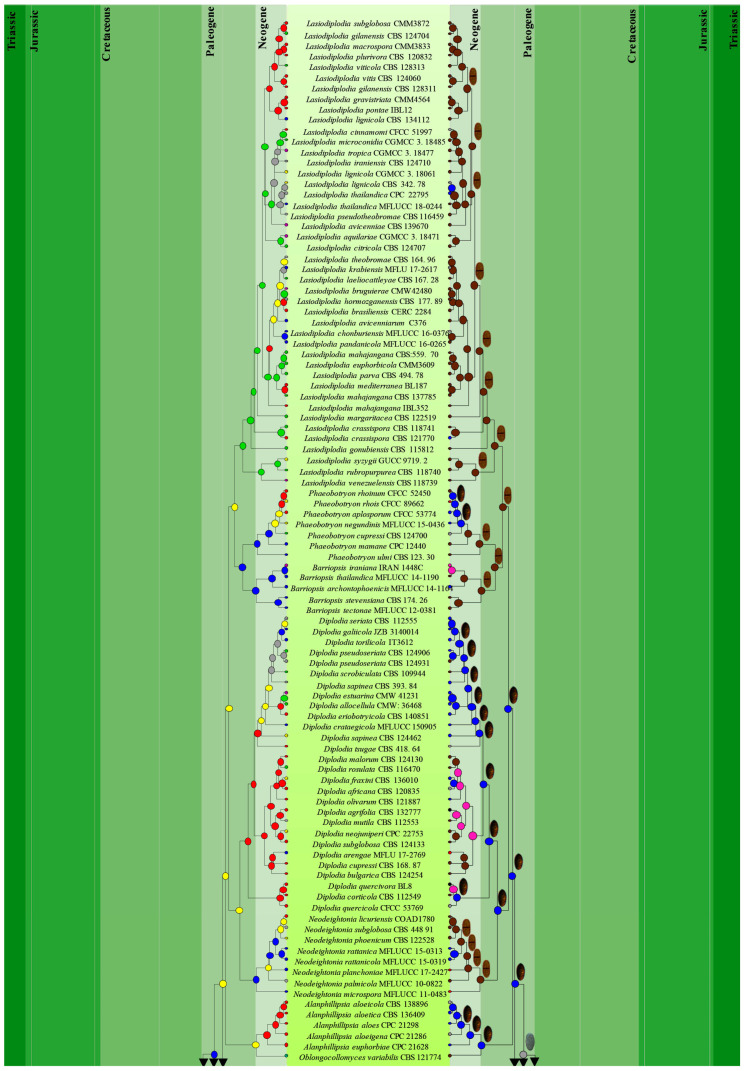
(, ) occur in a wide range of habitats as endophytes, saprobes, and pathogens. The order has not been subjected to evaluation since 2019 by Phillips and co-authors using phylogenetic and evolutionary analyses. Subsequently, many studies introduced novel taxa into the order and revised several families separately. In addition, no ancestral character studies have been conducted for this order. Therefore, in this study, we re-evaluated the character evolution and taxonomic placements of species based on ancestral character evolution, divergence time estimation, and phylogenetic relationships, including all the novel taxa that have been introduced so far. Maximum likelihood, maximum parsimony, and Bayesian inference analyses were conducted on a combined LSU and ITS sequence alignment. Ancestral state reconstruction was carried out for conidial colour, septation, and nutritional mode. Divergence times estimates revealed that originated around 109 Mya in the early epoch of the Cretaceous period. All six families in evolved in the late epoch of the Cretaceous period (66-100 Mya), during which Angiosperms also appeared, rapidly diversified and became dominant on land. Families of diversified during the Paleogene and Neogene periods in the Cenozoic era. The order comprises the families , , , , and . Furthermore, current study assessed two hypotheses; the first one being "All species originated as endophytes and then switched into saprobes when their hosts died or into pathogens when their hosts were under stress"; the second hypothesis states that "There is a link between the conidial colour and nutritional mode in botryosphaerialean taxa". Ancestral state reconstruction and nutritional mode analyses revealed a pathogenic/saprobic nutritional mode as the ancestral character. However, we could not provide strong evidence for the first hypothesis mainly due to the significantly low number of studies reporting the endophytic botryosphaerialean taxa. Results also showed that hyaline and aseptate conidia were ancestral characters in and supported the relationship between conidial pigmentation and the pathogenicity of species.
(某类生物)作为内生菌、腐生菌和病原体存在于广泛的栖息地中。自2019年菲利普斯及其合著者进行系统发育和进化分析以来,该目尚未经过评估。随后,许多研究将新分类群引入该目,并分别对几个科进行了修订。此外,尚未对该目进行祖先性状研究。因此,在本研究中,我们基于祖先性状进化、分歧时间估计和系统发育关系,重新评估了(某类)物种的性状进化和分类位置,包括迄今引入的所有新分类群。对LSU和ITS序列比对组合进行了最大似然法、最大简约法和贝叶斯推断分析。对分生孢子颜色、隔膜和营养模式进行了祖先状态重建。分歧时间估计显示,(某类生物)起源于白垩纪早期约1.09亿年前。(某目)中的所有六个科在白垩纪晚期(6600 - 1亿年前)进化,在此期间被子植物也出现了,迅速多样化并在陆地上占据主导地位。(某目)的科在新生代的古近纪和新近纪时期多样化。该目包括(若干)科。此外,当前研究评估了两个假设;第一个假设是“所有(某类)物种最初作为内生菌起源,然后在宿主死亡时转变为腐生菌,或在宿主受到压力时转变为病原体”;第二个假设是“葡萄座腔菌目分类群中的分生孢子颜色与营养模式之间存在联系”。祖先状态重建和营养模式分析表明,致病/腐生营养模式是祖先性状。然而,我们无法为第一个假设提供有力证据,主要原因是报告内生葡萄座腔菌目分类群的研究数量显著较少。结果还表明,透明和无隔膜的分生孢子是(某类生物)的祖先性状,并支持了分生孢子色素沉着与(某类)物种致病性之间的关系。