
新型机器视觉图像引导系统在儿科畸形手术中与基于二维透视的引导相比,显著减少了手术时间和辐射暴露。
Novel Machine Vision Image Guidance System Significantly Reduces Procedural Time and Radiation Exposure Compared With 2-dimensional Fluoroscopy-based Guidance in Pediatric Deformity Surgery.
机构信息
Driscoll Children's Hospital, Corpus Christi, TX.
出版信息
J Pediatr Orthop. 2023;43(5):e331-e336. doi: 10.1097/BPO.0000000000002377. Epub 2023 Mar 6.
BACKGROUND
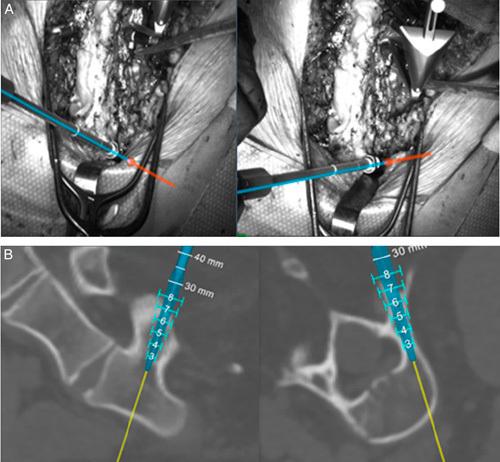
Intraoperative 2-dimensional (2D) fluoroscopy imaging has been commonly adopted for guidance during complex pediatric spinal deformity correction. Despite the benefits, fluoroscopy imaging emits harmful ionizing radiation, which has been well-established to have deleterious effects on the surgeon and operating room staff. This study investigated the difference in intraoperative fluoroscopy time and radiation exposure during pediatric spine surgery between 2D fluoroscopy-based navigation and a novel machine vision navigation system [machine vision image guidance system (MvIGS)].
METHODS
This retrospective chart review was conducted at a pediatric hospital with patients who underwent posterior spinal fusion for spinal deformity correction from 2018 to 2021. Patient allocation to the navigation modality was determined by the date of their surgery and the date of implementation of the MvIGS. Both modalities were the standard of care. Intraoperative radiation exposure was collected from the fluoroscopy system reports.
RESULTS
A total of 1442 pedicle screws were placed in 77 children: 714 using MvIGS and 728 using 2D fluoroscopy. There were no significant differences in the male-to-female ratio, age range, body mass index, distribution of spinal pathologies, number of levels operated on, types of levels operated on, and the number of pedicle screws implanted. Total intraoperative fluoroscopy time was significantly reduced in cases utilizing MvIGS (18.6 ± 6.3 s) compared with 2D fluoroscopy (58.5 ± 19.0 s) ( P < 0.001). This represents a relative reduction of 68%. Intraoperative radiation dose area product and cumulative air kerma were reduced by 66% (0.69 ± 0.62 vs 2.0 ± 2.1 Gycm 2 , P < 0.001) and 66% (3.4 ± 3.2 vs 9.9 ± 10.5 mGy, P < 0.001) respectively. The length of stay displayed a decreasing trend with MVIGS, and the operative time was significantly reduced in MvIGS compared with 2D fluoroscopy for an average of 63.6 minutes (294.5 ± 15.5 vs 358.1 ± 60.6 min, P < 0.001).
CONCLUSION
In pediatric spinal deformity correction surgery, MvIGS was able to significantly reduce intraoperative fluoroscopy time, intraoperative radiation exposure, and total surgical time, compared with traditional fluoroscopy methods. MvIGS reduced the operative time by 63.6 minutes and reduced intraoperative radiation exposure by 66%, which may play an important role in reducing the risks to the surgeon and operating room staff associated with radiation in spinal surgery procedures.
LEVEL OF EVIDENCE
Level III; retrospective comparative study.
背景
术中二维(2D)透视成像已广泛应用于复杂儿科脊柱畸形矫正手术中。尽管透视成像有很多益处,但它会发出有害的电离辐射,这已经被证实对术者和手术室工作人员有有害影响。本研究旨在调查在小儿脊柱手术中,基于二维透视导航和新型机器视觉导航系统(机器视觉图像引导系统(MvIGS))的术中透视时间和辐射暴露的差异。
方法
这是一项在一家儿童医院进行的回顾性图表研究,研究对象为 2018 年至 2021 年期间因脊柱畸形接受后路脊柱融合术的患者。患者的导航模式分配由手术日期和 MvIGS 的实施日期决定。两种模式均为标准治疗方法。术中辐射暴露量从透视系统报告中收集。
结果
共 77 名儿童的 1442 枚椎弓根螺钉采用 MvIGS(714 枚)和二维透视(728 枚)进行植入。在男女比例、年龄范围、体重指数、脊柱病变分布、手术节段数、手术节段类型和植入椎弓根螺钉数量方面,两组间无显著差异。与二维透视(58.5±19.0s)相比,MvIGS 组的总术中透视时间明显减少(18.6±6.3s)(P<0.001)。这表示相对减少了 68%。术中辐射剂量面积产品和累积空气比释动能分别减少了 66%(0.69±0.62 与 2.0±2.1Gycm 2,P<0.001)和 66%(3.4±3.2 与 9.9±10.5mGy,P<0.001)。MVIGS 组的住院时间呈下降趋势,MvIGS 组的手术时间与二维透视相比显著缩短,平均缩短 63.6 分钟(294.5±15.5 与 358.1±60.6min,P<0.001)。
结论
在小儿脊柱畸形矫正手术中,与传统透视方法相比,MvIGS 可显著减少术中透视时间、术中辐射暴露和总手术时间。MvIGS 减少了 63.6 分钟的手术时间,并减少了 66%的术中辐射暴露,这可能在降低脊柱手术中术者和手术室工作人员与辐射相关的风险方面发挥重要作用。
证据水平
III 级;回顾性比较研究。
 Zotero 插件