
低水平自主输入增强健康年轻成年人踝关节背屈神经肌肉电刺激时的皮质脊髓兴奋性。
Low-level voluntary input enhances corticospinal excitability during ankle dorsiflexion neuromuscular electrical stimulation in healthy young adults.
机构信息
Department of Life Sciences, Graduate School of Arts and Sciences, The University of Tokyo, Meguroku, Tokyo, Japan.
Department of Rehabilitation Medicine I, Fujita Health University School of Medicine, Toyoake, Aichi, Japan.
出版信息
PLoS One. 2023 Mar 8;18(3):e0282671. doi: 10.1371/journal.pone.0282671. eCollection 2023.
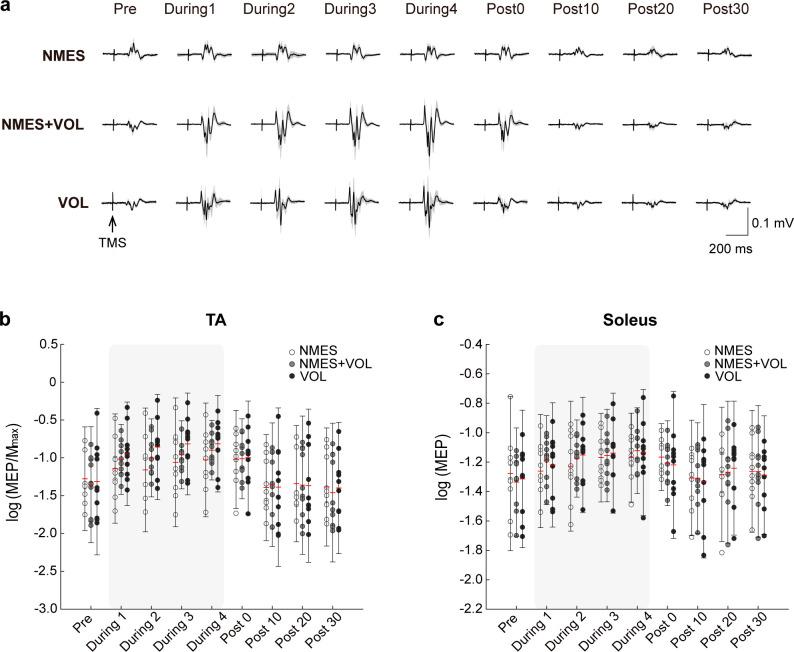
Previous evidence indicated that interventions with combined neuromuscular electrical stimulation (NMES) and voluntary muscle contractions could have superior effects on corticospinal excitability when the produced total force is larger than each single intervention. However, it is unclear whether the superior effects exist when the produced force is matched between the interventions. Ten able-bodied individuals performed three intervention sessions on separate days: (i) NMES-tibialis anterior (TA) stimulation; (ii) NMES+VOL-TA stimulation combined with voluntary ankle dorsiflexion; (iii) VOL-voluntary ankle dorsiflexion. Each intervention was exerted at the same total output of 20% of maximal force and applied intermittently (5 s ON / 19 s OFF) for 16 min. Motor evoked potentials (MEP) of the right TA and soleus muscles and maximum motor response (Mmax) of the common peroneal nerve were assessed: before, during, and for 30 min after each intervention. Additionally, the ankle dorsiflexion force-matching task was evaluated before and after each intervention. Consequently, the TA MEP/Mmax during NMES+VOL and VOL sessions were significantly facilitated immediately after the interventions started until the interventions were over. Compared to NMES, larger facilitation was observed during NMES+VOL and VOL sessions, but no difference was found between them. Motor control was not affected by any interventions. Although superior combined effects were not shown compared to voluntary contractions alone, low-level voluntary contractions combined with NMES resulted in facilitated corticospinal excitability compared to NMES alone. This suggests that the voluntary drive could improve the effects of NMES even during low-level contractions, even if motor control is not affected.
先前的证据表明,当产生的总力大于单一干预时,联合神经肌肉电刺激 (NMES) 和自愿肌肉收缩的干预措施可能对皮质脊髓兴奋性具有更好的效果。然而,当干预措施之间产生的力相匹配时,是否存在更好的效果尚不清楚。 10 名健康个体在不同的日子进行了三次干预:(i)NMES-胫骨前肌(TA)刺激;(ii)NMES+VOL-TA 刺激与自愿踝关节背屈相结合;(iii)VOL-自愿踝关节背屈。每个干预以相同的总输出 20%的最大力施加,并间歇施加(5 s ON / 19 s OFF)16 分钟。评估右侧 TA 和比目鱼肌的运动诱发电位(MEP)和腓总神经的最大运动反应(Mmax):在每次干预之前、期间和之后 30 分钟。此外,在每次干预前后评估踝关节背屈力匹配任务。结果,NMES+VOL 和 VOL 期间的 TA MEP/Mmax 在干预开始后立即直至干预结束时明显得到促进。与 NMES 相比,NMES+VOL 和 VOL 期间观察到更大的促进作用,但两者之间没有差异。运动控制不受任何干预的影响。尽管与单独的自愿收缩相比没有显示出更好的联合效果,但与 NMES 相比,低水平的自愿收缩与 NMES 相结合导致皮质脊髓兴奋性增加。这表明即使在低水平收缩期间,自愿驱动力也可以改善 NMES 的效果,即使运动控制不受影响。



 Zotero 插件